Self-guided audio tour in Rio de Janeiro
Start Free on iPhone
Start free on iPhone to unlock this self-guided walking tour in Rio de Janeiro. Hear all the stories that make it amazing, walk at your own pace, and begin whenever you want.
Your Private Tour Guide
Step back in time to 1808, when Rio de Janeiro underwent a transformation unlike any other city in the Americas. This self-guided walking route explores the heart of the 'Imperial City,' the neighborhood where the Portuguese Royal Family settled after fleeing Napoleon's troops. By moving the entire court across the Atlantic, Rio was elevated from a colonial outpost to the capital of the United Kingdom of Portugal, Brazil, and the Algarves. This historical shift left behind a rich tapestry of neoclassical palaces, ornate churches, and grand plazas that define the city's unique identity today. This neighborhood stroll begins at the historic waterfront of Praça XV, where the royals first stepped ashore. You will encounter the Paço Imperial, the modest palace that served as the seat of power for both Portuguese kings and Brazilian emperors. The route leads you through the narrow, colonial-era alleys of Arco do Teles, offering a glimpse into the 18th-century urban layout that survived the city's modernization. As you follow this walking tour Rio de Janeiro route, you will see how European architectural styles were adapted to the tropics. Highlights include the Old Cathedral, which hosted imperial coronations, and the stunning Mosteiro de São Bento, a masterpiece of Brazilian Baroque. Beyond the royalty, this route also touches on the city's cultural evolution, passing by the Centro Cultural Banco do Brasil, a former financial hub turned into one of the world's most visited museums. Exploring independently allows you to linger under the intricate gold-leaf carvings of ancient churches or stop for a coffee in the same squares where history was made. This walking route is perfect for history buffs and architecture lovers who want to understand why Rio de Janeiro feels so distinct from its South American neighbors. It is a journey through the transition from colony to empire, and eventually, to the vibrant republic we see today.
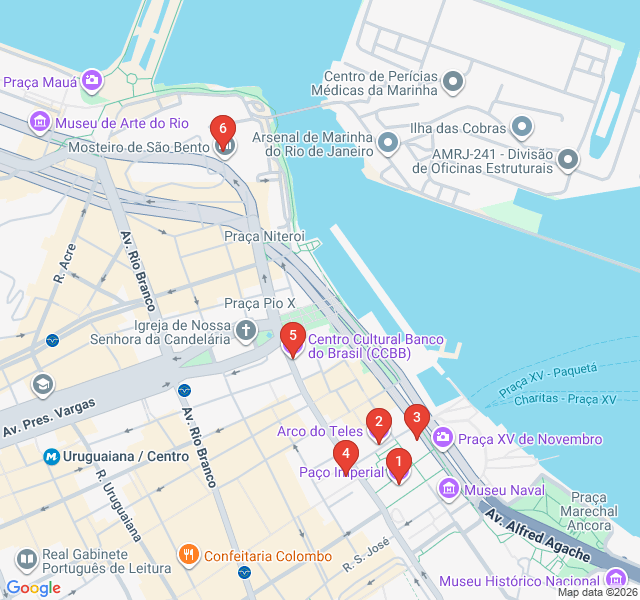
Numbers indicate the order of stops on the tour.
Start your self-guided adventure at the Paço Imperial, the very heart of Brazil's monarchical history. Originally built as the Governor’s Palace in 1743, it became the Royal Palace when Dom João VI arrived in 1808. This building has witnessed the most pivotal moments in Brazilian history, including 'Dia do Fico,' when Dom Pedro I defied Portuguese orders to return home, eventually leading to Brazil's independence. It was also here that Princess Isabel signed the Golden Law in 1888, finally abolishing slavery in the country. Notice the simple, sturdy colonial architecture, which belies the grand events that occurred within these walls.
Tucked away in the corner of Praça XV, the Arco do Teles is a portal to the past. This arch is all that remains of the 18th-century residence of the Teles de Menezes family. In the late 1700s, a devastating fire destroyed much of the surrounding block, but the arch survived. Walking through it, the atmosphere shifts instantly from the open plaza to narrow, cobblestone streets. This area was once the epicenter of Rio's elite social life and later became a bohemian haunt. Today, the alleyways behind the arch are lined with bars and restaurants that occupy the restored colonial townhouses.
Standing near the water's edge is the Chafariz do Mestre Valentim, a granite fountain completed in 1789. Before modern plumbing, fountains like this were the lifeblood of the city, providing fresh water to residents and ships. It was designed by Mestre Valentim, one of Brazil's most significant colonial artists and a man of mixed-race heritage who rose to architectural prominence. The fountain's pyramidal shape and functional design represent the transition from Baroque to Neoclassical styles. Imagine the chaos of the 18th century here, with water carriers and sailors crowding around this very spot.
This church served as the Royal Chapel and the Cathedral of Rio for over a century. It is historically significant as the site of the coronations of both Emperor Pedro I and Emperor Pedro II, as well as the royal wedding of Princess Isabel. While the exterior underwent neoclassical renovations, the interior remains a stunning example of the Rococo style, featuring intricate wood carvings gilded in gold. The church stands as a testament to the close relationship between the Portuguese Crown and the Catholic Church, reflecting the grandeur expected of an Imperial capital.
The CCBB is housed in a magnificent neoclassical building designed by Francisco Joaquim Bethencourt da Silva. Opened in 1906 as the headquarters of the Bank of Brazil, it was converted into a cultural center in the late 1980s. Step inside to admire the breathtaking rotunda and the marble-clad interiors. The building represents the 'Belle Époque' of Rio, a period when the city sought to reinvent itself as the 'Paris of the Tropics.' Today, it hosts world-class art exhibitions, a cinema, and a theater, making it a cornerstone of downtown Rio's cultural life.
Perched on a hill overlooking the harbor, the Monastery of St. Benedict is a sanctuary of silence and splendor. Founded by Benedictine monks in 1590, the current structure dates back to the mid-1600s. While the facade is austere and Mannerist, the interior is one of the most spectacular examples of Baroque art in the world. Virtually every surface is covered in dark wood carvings heavily layered with gold leaf. The monastery is still active today, and if you arrive during services, you might hear the monks' famous Gregorian chants echoing through the golden nave.
Start Free on iPhone
Explore “Imperial Rio: The Portuguese Court's Legacy” with your very own Private Tour Guide with Zigway. Start free on iPhone, skip the large group and the fixed routes, and hear the city come alive as you go.
Your Private Tour Guide
Don't miss the good stuff
Explore Freely
 Easy
EasyRio de Janeiro, Brazil
Explore the world's largest murals and futuristic architecture in Rio's revitalized port on this vibrant self-guided walking route.
 Easy
EasyRio de Janeiro, Brazil
Discover the 'BotaSoho' vibe on this self-guided food and nightlife stroll through Rio's most creative neighborhood.
 Easy
EasyRio de Janeiro, Brazil
Discover the former seat of Brazilian power on this self-guided walk through the palaces, gardens, and presidential history of Catete and Glória.
 Easy
EasyRio de Janeiro, Brazil
Discover Rio's literary soul on this self-guided walk through historic libraries, ornate Belle Époque cafes, and iconic bookstores in Centro.
 Easy
EasySalzburg, Austria
Discover the 'Rome of the North' on this self-guided walk through the Baroque squares and monumental legacy of Salzburg’s Prince-Archbishops.
 Easy
EasyNairobi, Kenya
Explore Nairobi's architectural evolution from colonial-era landmarks to iconic Brutalist skyscrapers on this historic self-guided walking route.
 Easy
EasyNairobi, Kenya
Discover Nairobi's iconic skyline on this self-guided architecture walk through the CBD’s most famous modernist and Brutalist landmarks.
 Easy
EasyKrakow, Poland
Explore the historic heart of Kazimierz on this self-guided walk through synagogues, ancient cemeteries, and vibrant squares.
 Moderate
Sao Paulo, Brazil
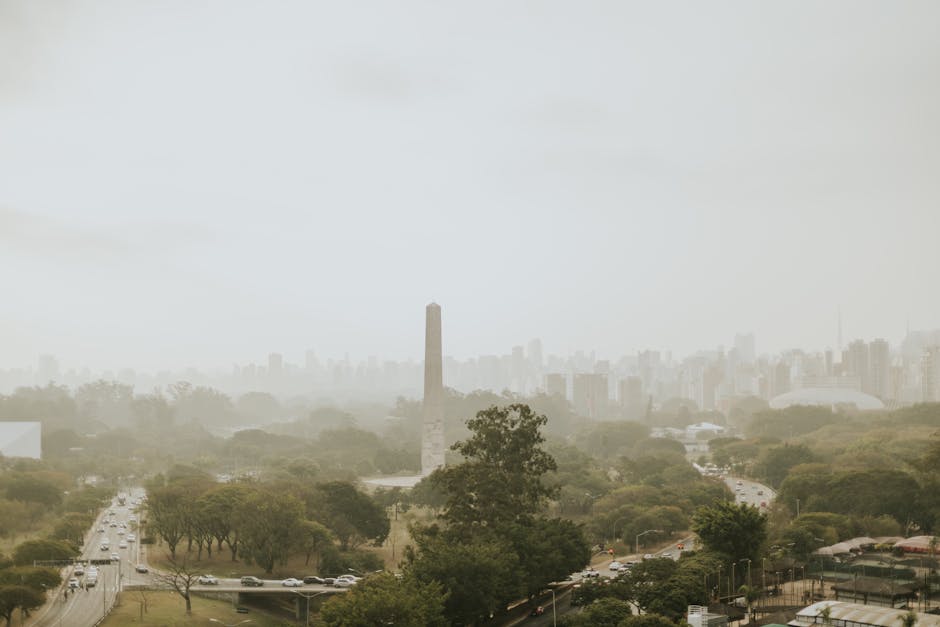
Discover the flowing concrete curves and modernist masterpieces of Oscar Niemeyer on this self-guided walk through São Paulo’s premier urban park.
 Easy
EasySao Paulo, Brazil
Explore the world's largest Japanese diaspora. A self-guided walk through Sao Paulo's vibrant Liberdade district, rich in history, food, and culture.
 Easy
EasySao Paulo, Brazil
Discover the art, history, and British-inspired architecture of São Paulo’s historic Luz district on this immersive self-guided walk.
 Easy
EasySao Paulo, Brazil
Discover Sao Paulo's historic heart and vibrant food scene on this self-guided walk through the Old Center and the legendary Mercadão.