Self-guided audio tour in Pittsburgh
Start Free on iPhone
Start free on iPhone to unlock this self-guided walking tour in Pittsburgh. Hear all the stories that make it amazing, walk at your own pace, and begin whenever you want.
Your Private Tour Guide
Beneath the soaring skyscrapers of the Golden Triangle lies a history forged in iron, glass, and blood. This self-guided walk invites you to peel back the layers of Pittsburgh's industrial dominance to discover the lingering spirits of the Gilded Age. As you navigate the streets of Downtown, you will encounter the architectural legacies of titans like Henry Clay Frick and the tragic tales of those who lived and died in the shadow of their ambition. This walking route offers a unique perspective on the Steel City, focusing on the hidden histories and local legends that standard sightseeing often overlooks. The journey begins at the opulent Omni William Penn Hotel, a landmark of 1916 luxury where the ghosts of the past are said to still frequent the upper floors. From there, you will move through the heart of the business district, exploring the Fourth Avenue Historic District—once known as the 'Wall Street of the West'—where the echoes of financial triumphs and ruin still resonate. The route also takes you to the imposing Allegheny County Gaol, a masterpiece of Richardsonian Romanesque architecture that holds dark secrets within its granite walls, including the infamous story of the Biddle Boys and their daring, tragic escape. This walking tour Pittsburgh experience is designed for those who prefer to explore independently and at their own pace. By following this audio walk, you can avoid the constraints of a traditional guided tour Pittsburgh and instead immerse yourself in the atmosphere of the city as the sun begins to set. Whether you are a history buff or a fan of the supernatural, this neighborhood stroll provides a compelling look at how the city's rugged past continues to haunt its modern skyline. Discover the hidden gems of the Steel City and decide for yourself which legends are grounded in fact and which are merely whispers in the wind.
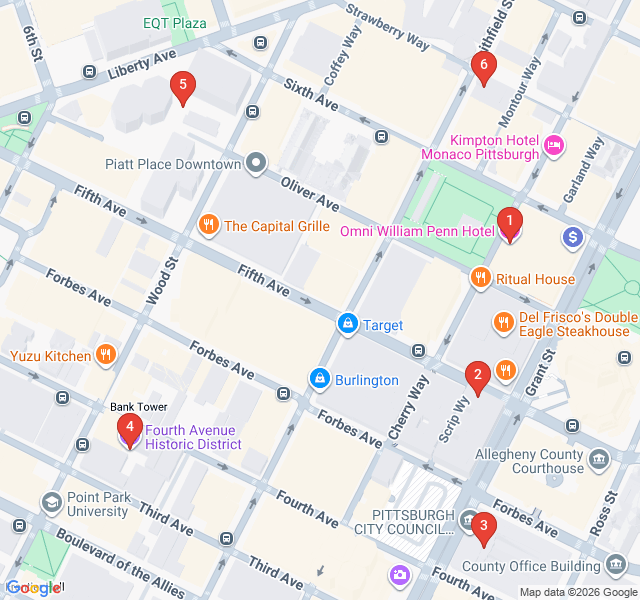
Numbers indicate the order of stops on the tour.
Welcome to the grandest dame of Pittsburgh hotels. Opened in 1916 by industrialist Henry Clay Frick, the Omni William Penn was designed to be the ultimate in luxury. But luxury often comes with a lingering guest list. Staff and visitors have long reported strange occurrences on the 17th floor, which was once a lavish ballroom. Legend tells of the 'Lady in White,' a former debutante or perhaps an employee who never checked out. People often report the smell of vintage perfume and the sound of phantom music echoing through the halls. As you stand outside this Beaux-Arts masterpiece, imagine the Gilded Age galas that once filled these rooms, and the spirits that might still be waiting for the next dance.
This 20-story skyscraper was Henry Clay Frick's personal statement of power, built directly across from his rival Andrew Carnegie's office. Completed in 1902, the Frick Building is a temple of industry, but it’s also the site of many reported hauntings. Security guards have frequently spoken of 'phantom elevators' that move on their own late at night, stopping at floors where no one is waiting. Some believe Frick himself still keeps a watchful eye on his empire. Look up at the white terracotta and granite facade; it is said that the building was designed to intentionally overshadow Carnegie's holdings, a grudge so deep it may have followed both men into the afterlife.
The City-County Building is the seat of local government, but its history is more than just bureaucracy. Completed in 1917, its massive granite columns and grand barrel-vaulted loggia have seen a century of legal battles and political drama. Ghost hunters and employees have reported seeing the figure of a man in an old-fashioned suit wandering the basement levels, where the archives are kept. There are also stories of cold spots and the sound of heavy footsteps in the courtrooms long after they've been locked for the night. It seems that for some, the quest for justice in Pittsburgh never truly ends, even after death.
Known as Pittsburgh's 'Wall Street,' this district was the financial heart of the city during its industrial peak. The Narrow street is lined with stunning examples of Neoclassical and Revival architecture. However, the high-stakes world of banking brought with it great tragedy. During the Great Fire of 1845, much of this area was leveled, and some believe the energy of that catastrophic event remains. Passersby have reported seeing flickering lights in the upper windows of these historic banks and hearing the faint sound of old-fashioned ticker-tape machines. It is a place where the ghosts of fortunes lost still seem to linger in the narrow alleys between the stone giants.
Standing before you is one of the most significant pieces of architecture in the city, designed by H.H. Richardson. The Old Jail, with its massive stone walls, was built to be impenetrable. The most famous story here involves the 'Bridge of Sighs,' the enclosed walkway connecting the jail to the courthouse. In 1902, the Biddle Boys, two condemned prisoners, escaped with the help of the warden’s wife, Kate Soffel, who had fallen in love with one of them. The escape ended in a bloody shootout. Many believe the heavy atmosphere here is due to the centuries of despair felt by the inmates. Visitors often report a feeling of being watched from the narrow, slit-like windows.
Our final stop is the Smithfield United Church of Christ, a striking example of Gothic Revival architecture with a unique aluminum spire. This congregation is the oldest in Pittsburgh, dating back to 1782. The land it sits on was originally a burial ground for early settlers and Native Americans. When the current church was built in the 1920s, many of the graves remained beneath the foundation. This has led to numerous reports of apparitions within the sanctuary and the sound of organ music playing when the building is empty. It serves as a final reminder that in Downtown Pittsburgh, the modern world is built directly on top of a very active and storied past.
Start Free on iPhone
Explore “Shadows of the Steel City: Downtown Ghost Walk” with your very own Private Tour Guide with Zigway. Start free on iPhone, skip the large group and the fixed routes, and hear the city come alive as you go.
Your Private Tour Guide
Don't miss the good stuff
Explore Freely
 Easy
EasyPittsburgh, United States
Explore the dramatic transformation of Pittsburgh's East Liberty through its Gilded Age architecture and vibrant modern art scene.
 Easy
EasyPittsburgh, United States
Taste the heart of the Steel City on this self-guided audio walk through the legendary markets and eateries of Pittsburgh's vibrant Strip District.
 Easy
EasyPittsburgh, United States
Explore Pittsburgh's Gilded Age grandeur and modern glass spires on this self-guided architecture walk through the historic Golden Triangle.
 Moderate
Pittsburgh, United States
Explore Pittsburgh's vibrant history and hidden gems from Downtown to the heights of Polish Hill and the grandeur of Oakland on this audio walk.
 Easy
EasyNairobi, Kenya
Explore Nairobi's architectural evolution from colonial-era landmarks to iconic Brutalist skyscrapers on this historic self-guided walking route.
 Easy
EasyNairobi, Kenya
Discover Nairobi's iconic skyline on this self-guided architecture walk through the CBD’s most famous modernist and Brutalist landmarks.
 Easy
EasyKrakow, Poland
Explore the historic heart of Kazimierz on this self-guided walk through synagogues, ancient cemeteries, and vibrant squares.
 Easy
EasyWarsaw, Poland
Discover the hidden courtyards and grand pre-war architecture of Warsaw's most atmospheric neighborhood on this self-guided stroll.
 Easy
EasyNashville, United States
Explore the 'Athens of the South' on this self-guided walk through Centennial Park, featuring the world's only full-scale Parthenon replica.
 Easy
EasyNashville, United States
Explore Nashville's academic heart and Art Deco gems on this self-guided walk through historic Hillsboro Village.
 Easy
EasyNashville, United States
Explore the heart of Nashville's music industry. Discover iconic studios and the history of the legendary Nashville Sound at your own pace.
 Easy
EasyNashville, United States
Explore Nashville's oldest neighborhood! Discover Victorian architecture, Civil War history, and world-class craft beer on this self-guided walk.