Self-guided audio tour in Pittsburgh
Start Free on iPhone
Start free on iPhone to unlock this self-guided walking tour in Pittsburgh. Hear all the stories that make it amazing, walk at your own pace, and begin whenever you want.
Your Private Tour Guide
Pittsburgh is often called the Steel City, but its skyline tells a story far more intricate than heavy industry alone. On this self-guided walk through the Downtown area, also known as the Golden Triangle, you will discover how Gilded Age wealth transformed a rugged river town into a showcase of world-class design. From the stone-carved majesty of the 19th century to the glass-and-steel innovations of the modern era, this architecture walk highlights the competitive spirit of the magnates who built America. The route begins at the Omni William Penn Hotel, a symbol of early 20th-century luxury, before leading you toward the Flemish Gothic masterpiece that is the Union Trust Building. As you explore, you will encounter the Allegheny County Courthouse, widely considered one of the finest examples of Richardsonian Romanesque architecture in the world. This isn't just a collection of buildings; it is a timeline of American ambition. You will see how the U.S. Steel Tower utilized the very product that made the city famous to reach new heights, and how the Gulf Tower once dominated the horizon with its stepped-pyramid crown. The journey concludes at the striking PPG Place, a 'Cathedral of Glass' that reimagines Gothic spires for the corporate age. This neighborhood stroll offers a deep dive into the artistic legacy of the Mellons, Fricks, and Carnegies, providing a perspective on the city that most visitors overlook. Whether you are a fan of historic preservation or modern skyscrapers, this travel experience allows you to appreciate the details of Pittsburgh's unique urban fabric at your own pace. This is more than a walking tour Pittsburgh provides; it is a curated journey through the evolution of an American metropolis.
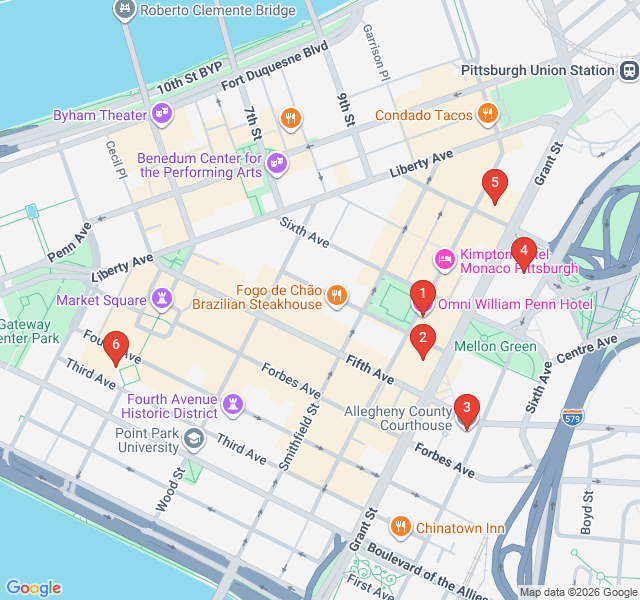
Numbers indicate the order of stops on the tour.
Start your self-guided adventure at the Omni William Penn Hotel, a bastion of Gilded Age elegance. Opened in 1916, this was the last major project of industrialist Henry Clay Frick. He envisioned a hotel that would rival the great palaces of Europe, and he spared no expense. As you stand outside or step briefly into the lobby, notice the crystal chandeliers and the ornate plasterwork. This hotel has hosted every U.S. President since Theodore Roosevelt and remains a central hub for Pittsburgh society. It represents the peak of the city’s early 20th-century wealth, built at a time when Pittsburgh produced more steel than any other place on earth.
Just across the street, the Union Trust Building stands as a testament to the Flemish Gothic style. Built by Henry Clay Frick in 1917, it was originally designed as a shopping arcade. The exterior is covered in intricate terra cotta details and topped with two chapel-like mechanical towers. If the building is open, look for the stunning ten-story central rotunda capped by a stained-glass dome. The architectural detail here is meant to inspire awe, mimicking the grandeur of European cathedrals but repurposed for the world of finance and commerce, marking a bridge between old-world aesthetics and new-world capitalism.
Continue your walking route to the Allegheny County Courthouse, a masterpiece by architect H.H. Richardson. Completed in 1888, this building defined the 'Richardsonian Romanesque' style with its heavy masonry, rounded arches, and rugged stone textures. The most famous feature is the 'Bridge of Sighs,' a stone corridor modeled after the one in Venice, which connects the courthouse to the former jail. Richardson considered this his finest work, and it influenced American civic architecture for decades. Notice the deep-set windows and the massive tower that symbolizes the strength and permanence of the law in a rapidly industrializing city.
Look up to see the U.S. Steel Tower, the tallest point in the Pittsburgh skyline. Completed in 1970, this 64-story skyscraper is a celebration of the industry that built this city. It features an unusual triangular footprint and is clad in Cor-Ten steel, a material designed to develop a protective layer of rust over time, giving the building its distinct dark-brown hue. This tower was the first in the world to use liquid-filled fireproofing in its hollow steel columns. It stands as a bold, mid-century modern contrast to the stone buildings you just visited, representing the city’s transition into a modern corporate headquarters.
Next, observe the Gulf Tower, an Art Deco icon completed in 1932. For many years, it was the tallest building in the city. Its design is inspired by the Mausoleum of Halicarnassus, one of the Seven Wonders of the Ancient World, featuring a stepped-pyramid top. The very tip of the tower serves as a weather beacon; the colors of the lights change to indicate temperature, precipitation, and humidity. It was built as the headquarters for the Gulf Oil Company, another giant of Pittsburgh industry, and it remains one of the most recognizable silhouettes in the city's skyline.
Conclude your walk at PPG Place, often called the 'Crown Jewel of Pittsburgh.' Designed by renowned architect Philip Johnson and completed in 1984, this complex consists of six buildings clad in nearly one million square feet of reflective glass. The design is a postmodern tribute to Gothic architecture, featuring 231 glass spires that mimic the look of a medieval castle or a great cathedral. The central plaza is a popular gathering spot, featuring a fountain in the summer and an ice rink in the winter. It perfectly encapsulates Pittsburgh’s ability to blend its industrial heritage with forward-thinking, imaginative design.
Start Free on iPhone
Explore “Steel Magnates and Gothic Spires: Downtown Architecture” with your very own Private Tour Guide with Zigway. Start free on iPhone, skip the large group and the fixed routes, and hear the city come alive as you go.
Your Private Tour Guide
Don't miss the good stuff
Explore Freely
 Easy
EasyPittsburgh, United States
Explore the dramatic transformation of Pittsburgh's East Liberty through its Gilded Age architecture and vibrant modern art scene.
 Easy
EasyPittsburgh, United States
Taste the heart of the Steel City on this self-guided audio walk through the legendary markets and eateries of Pittsburgh's vibrant Strip District.
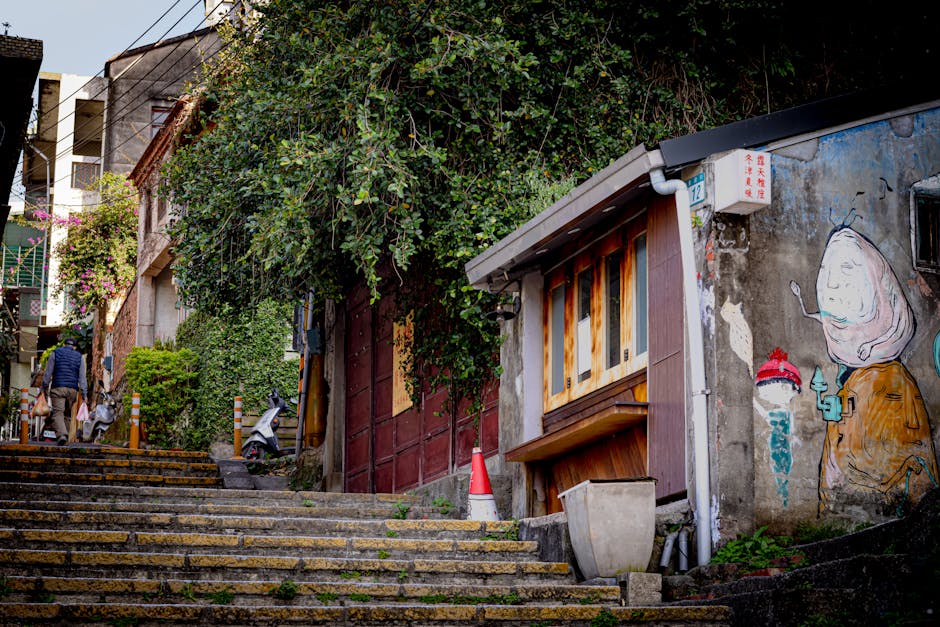 Moderate
Pittsburgh, United States
Explore Pittsburgh's vibrant history and hidden gems from Downtown to the heights of Polish Hill and the grandeur of Oakland on this audio walk.
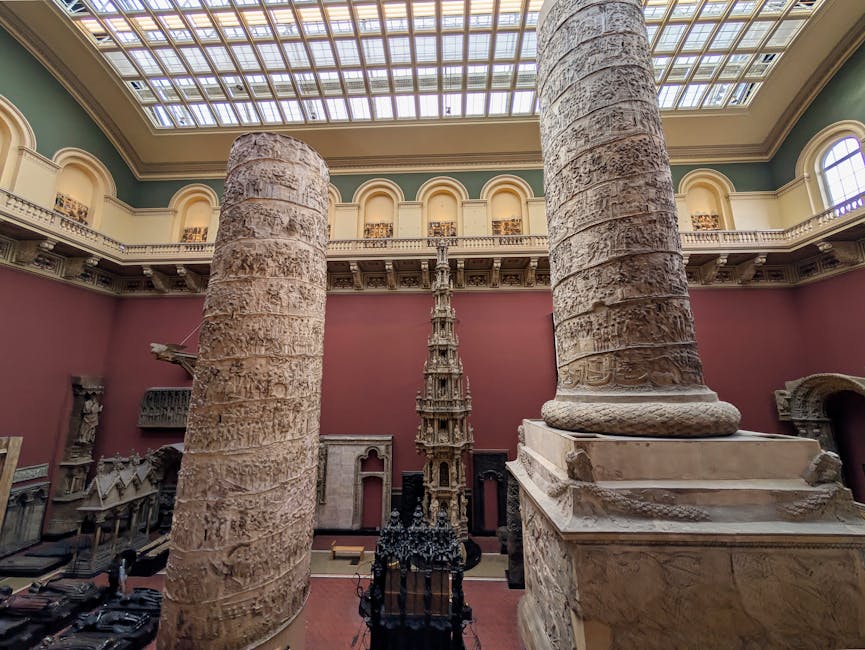 Moderate
Pittsburgh, United States
Explore the grand architecture and academic legacy of Pittsburgh's Oakland district on this self-guided audio walk through history.
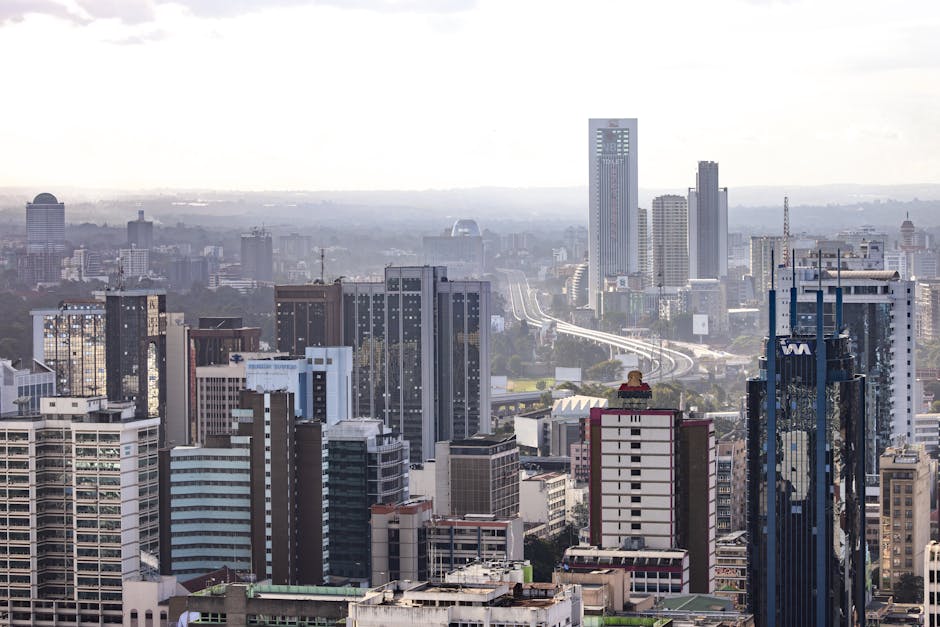 Easy
EasyNairobi, Kenya
Discover Nairobi's iconic skyline on this self-guided architecture walk through the CBD’s most famous modernist and Brutalist landmarks.
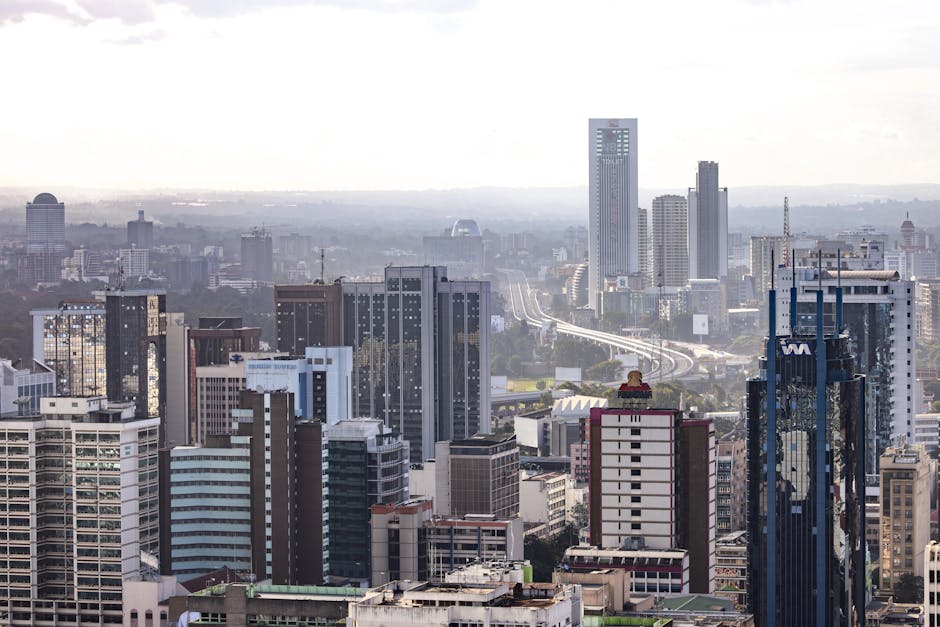 Easy
EasyNairobi, Kenya
Explore Nairobi's architectural evolution from colonial-era landmarks to iconic Brutalist skyscrapers on this historic self-guided walking route.
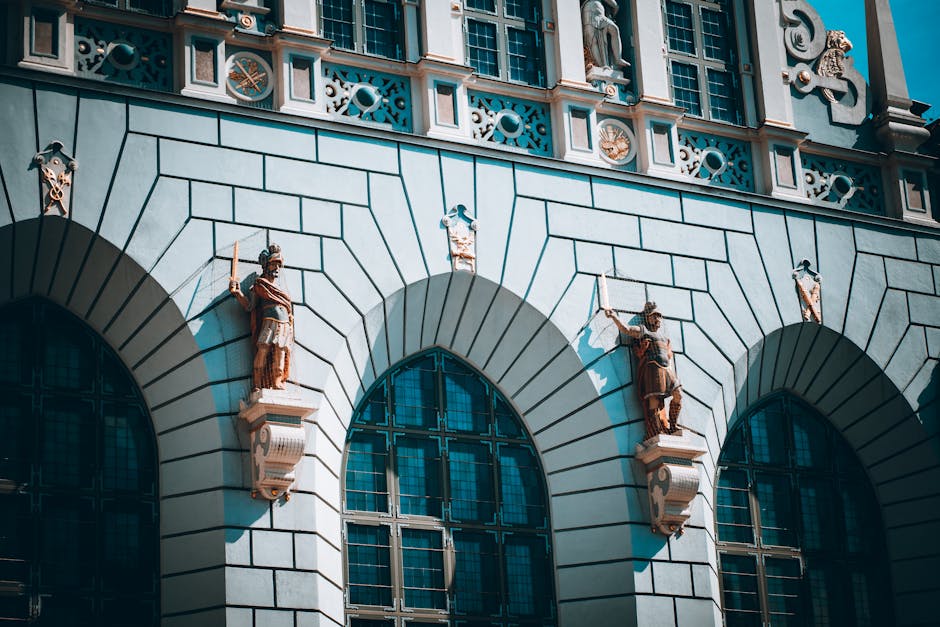 Easy
EasyGdansk, Poland
Discover the opulent Royal Way of Gdansk at your own pace. Explore Hanseatic history, gilded architecture, and the iconic Neptune's Fountain.
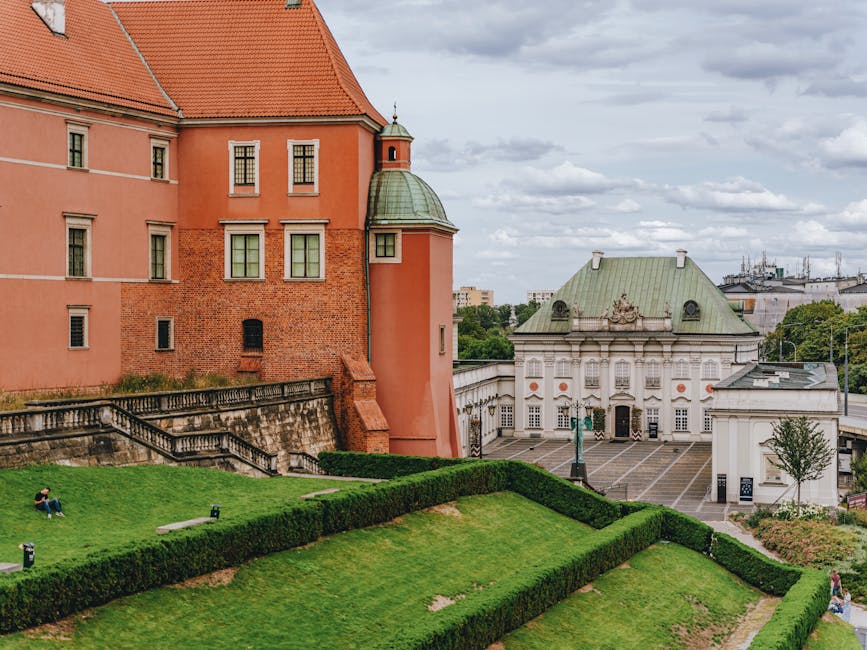 Easy
EasyWarsaw, Poland
Explore the miracle of Warsaw's reconstructed Old Town on this self-guided walk through royal squares, medieval walls, and heroic monuments.
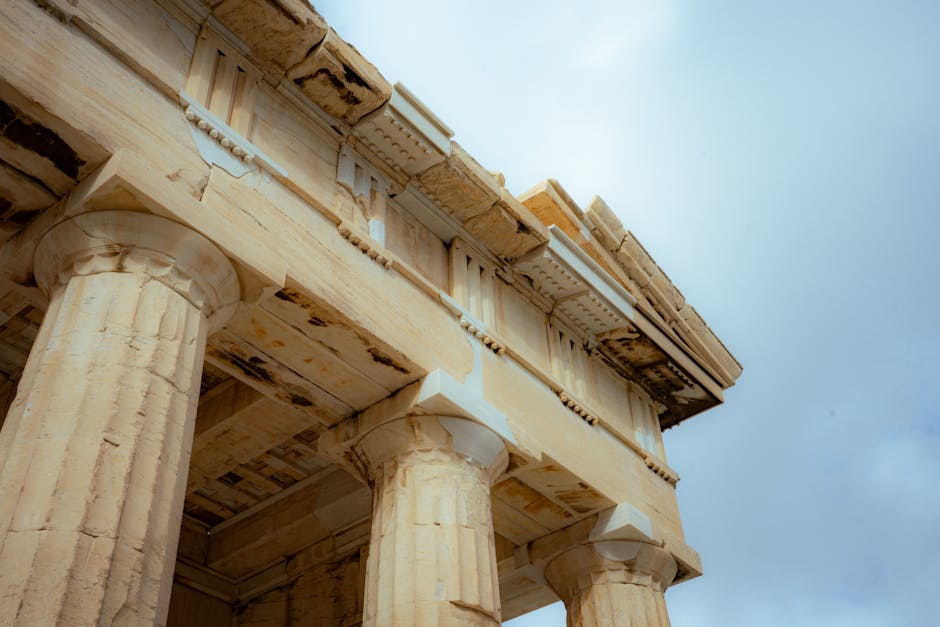 Easy
EasyNashville, United States
Explore the 'Athens of the South' on this self-guided walk through Centennial Park, featuring the world's only full-scale Parthenon replica.
 Easy
EasyNashville, United States
Explore Nashville's academic heart and Art Deco gems on this self-guided walk through historic Hillsboro Village.
 Easy
EasyNashville, United States
Explore the heart of Nashville's music industry. Discover iconic studios and the history of the legendary Nashville Sound at your own pace.
 Easy
EasyNashville, United States
Explore Nashville's oldest neighborhood! Discover Victorian architecture, Civil War history, and world-class craft beer on this self-guided walk.