Self-guided audio tour in Tirana
Start Free on iPhone
Start free on iPhone to unlock this self-guided walking tour in Tirana. Hear all the stories that make it amazing, walk at your own pace, and begin whenever you want.
Your Private Tour Guide
Tirana is a city that wears its scars and triumphs on its sleeve, offering a landscape where Ottoman ruins sit comfortably alongside socialist-realist monuments and sleek modern hubs. This self-guided walk invites you to peel back the layers of Albania's capital, moving from the grand architecture of Skanderbeg Square into the intimate, shaded alleys that hold the city's secrets. You will discover how a former fortress has become a vibrant social space and how cold-war bunkers have been transformed into hauntingly beautiful art galleries. This neighborhood stroll captures the essence of a city that is constantly reinventing itself while keeping its complex past in plain sight. The route takes you through the heart of the city, highlighting the juxtaposition of old and new. You will encounter the Justinian Wall, a remnant of the Byzantine era, and the Kapllan Pasha Tomb, a lone survivor of a once-grand mosque complex. As you explore independently, the path leads to the 'House of Leaves,' a chilling reminder of the surveillance state, and the iconic Pyramid of Tirana, which has recently been reborn as a center for technology and youth. This walking route is designed for those who want to understand the soul of Tirana beyond the typical tourist paths, providing a narrative that spans from Roman mosaics to the atomic bunkers of the communist elite. Whether you are a history buff or a curious traveler, this audio walk provides the context needed to appreciate Tirana's unique charm. You will wander through pedestrian-friendly streets like Murat Toptani, where the scent of coffee mingles with the history of the Toptani family, and venture out to the city's edges to see the Roman Mosaic of Tirana. By following this independent path, you can experience the city's transition from a closed-off regime to a burgeoning Balkan capital at your own pace. This walking tour Tirana experience ensures you don't just see the landmarks, but truly understand the stories etched into the castle walls and hidden alleys of this resilient city.
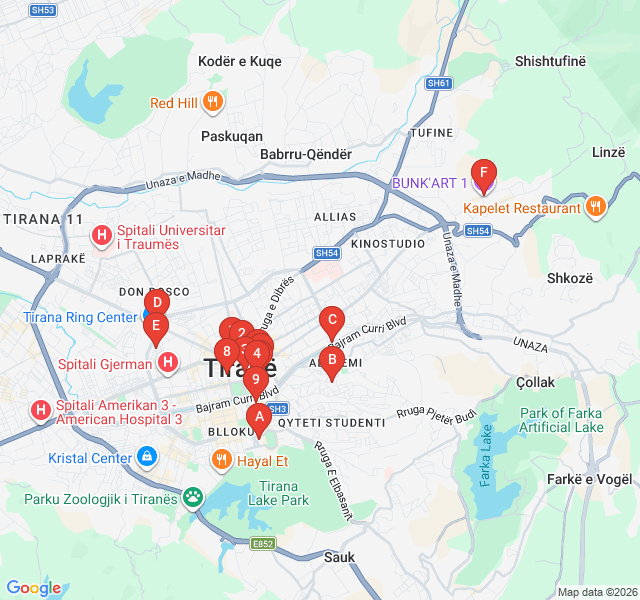
Numbers indicate the order of stops on the tour.
Start your self-guided walk at the northern end of Skanderbeg Square. The most striking feature here is the massive mosaic above the entrance titled 'The Albanians.' It depicts the evolution of the Albanian people from Illyrian warriors to socialist workers. Inside, the museum's pavilions cover everything from antiquity to the harrowing 'Mother Teresa' gallery and the pavilion of Communist Terror. It is the perfect place to ground yourself in the long, often turbulent history of this nation before heading deeper into the city's streets.
Located on the eastern side of Skanderbeg Square, this building is a classic example of socialist-realist architecture. Completed in the 1950s with help from the Soviet Union, it remains the cultural heart of Tirana. While the exterior is relatively austere, it represents a period when Albania sought to establish its own high-culture institutions under the communist regime. Today, it hosts world-class performances, standing as a testament to the city's enduring love for the arts despite decades of political isolation.
Just a short walk from the square, you will find a concrete dome that serves as the entrance to Bunk'Art 2. This is not just a museum; it is a former nuclear bunker built for the Ministry of Internal Affairs during the Enver Hoxha era. As you descend, you enter a labyrinth of corridors that once housed the secret police (Sigurimi). Today, the rooms are filled with historical exhibits and contemporary art installations that tell the story of domestic surveillance and political persecution, making it a powerful site for reflection.
Step out of the heavy history of the bunkers and onto Murat Toptani Street, a beautiful pedestrian promenade lined with century-old trees. This area is named after the prominent Toptani family, who were instrumental in the city's development. It is a favorite spot for locals to enjoy a 'xhiro' (evening stroll). The street is flanked by traditional architecture and modern cafes, offering a peaceful atmosphere that feels worlds away from the busy traffic of the main boulevards.
Along Murat Toptani Street, look for the ancient stone remains known as the Justinian Wall. These ruins date back to the Byzantine era, specifically the 6th century, though they were extensively rebuilt during the Ottoman period. They are the last visible fragments of the Castle of Tirana. Standing by these stones, you can imagine the city as a small, fortified crossroads long before it became the sprawling capital it is today. It is a rare physical link to Tirana's late-antique past.
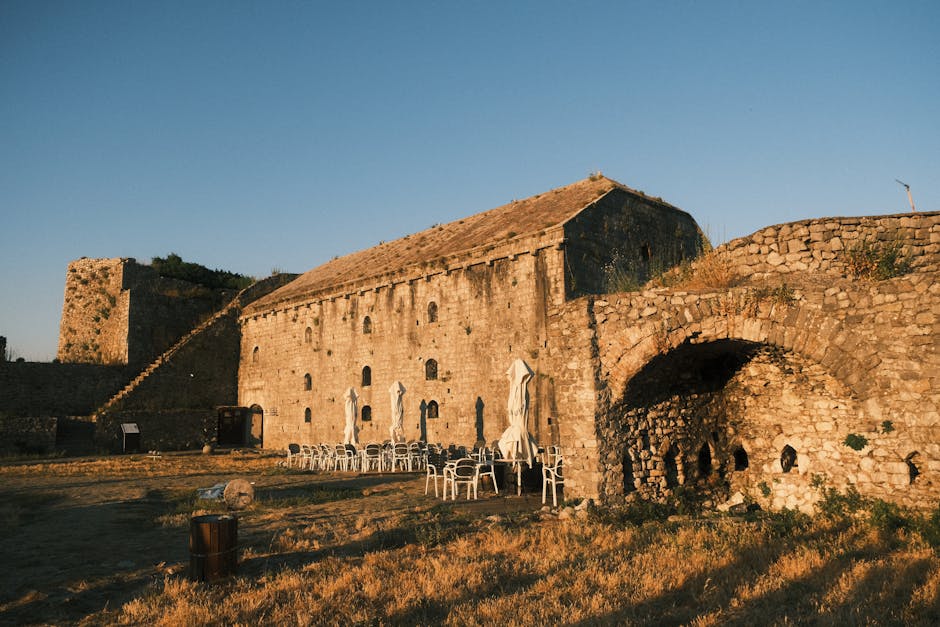
Enter the walls of the Toptani Castle, which has been beautifully restored as a social and commercial space. Unlike many castles that are preserved as silent monuments, this fortress is alive with traditional craft shops, modern restaurants, and galleries. It is a prime example of how Tirana repurposes its historical sites for modern use. Take a moment to walk the interior perimeter and enjoy the blend of ancient masonry and contemporary design, perhaps stopping for a quick coffee in the shaded courtyard.
Just outside the castle walls stands the Kapllan Pasha Tomb. Built in 1817, this octagonal structure is one of the few remaining examples of Ottoman funerary architecture in the city. The tomb once stood next to the Sylejman Pasha Mosque, which was destroyed during World War II. Its presence here is a poignant reminder of the architectural heritage that was lost during the 20th century. Notice the intricate carvings on the columns, which have survived the city's many transformations.
Heading back toward the center, you will find the Museum of Secret Surveillance, popularly known as the 'House of Leaves.' The building itself was originally a maternity clinic, but during the communist era, it became the headquarters for the Sigurimi's electronic surveillance. The name comes from the ivy that once covered the building, hiding the dark activities within. Today, it houses an award-winning museum that explores the chilling methods used to spy on Albanian citizens, offering an unflinching look at the paranoia of the regime.
Cross the Lana River to see one of Tirana's most famous landmarks: The Pyramid. Designed by the daughter of Enver Hoxha as a museum to his legacy, it has served as a NATO base, a nightclub, and a derelict climbing spot for local youth. Recently, it underwent a massive renovation by MVRDV architects, transforming it into a vibrant IT hub and public park with stairs that allow you to walk up to the top. It symbolizes Tirana's transition from a cult of personality to a future-focused, democratic society.
Located in Mother Teresa Square, this was the first museum opened in Albania after World War II. It houses a vast collection of artifacts from the Prehistoric, Illyrian, and Roman periods. The building itself is part of the Italian-designed ensemble that defines this end of the city's main boulevard. It is a quieter, more academic stop that provides deep historical context for the Illyrian tribes that are considered the ancestors of modern Albanians.
A bit of a walk from the center, this museum is named after Sabiha Kasimati, a pioneering scientist who was tragically executed by the communist regime. The museum holds extensive collections of Albania's flora and fauna, but for many, the primary reason to visit is to honor the memory of the woman who defied a dictator. It serves as a reminder of the intellectual cost of Albania's decades of isolation.
As you move toward the Brryli neighborhood, you leave the grand boulevards behind and enter a more residential side of the city. Brryli is known for its local atmosphere and its history as a hub of trade and transport. It is a great place to observe the 'real' Tirana, where colorful apartment blocks and small family-run shops define the landscape. The name itself means 'elbow,' referring to a sharp bend in the main road, and it serves as a gateway to the eastern suburbs.
Traveling to the western side of the city, you reach Zogu i Zi, or 'The Black Bird' square. This is one of Tirana's busiest roundabouts and a major landmark. While mostly a modern transport hub today, the name has various folk origins, some suggesting it was named after a black bird statue or a local tavern owner. It is a bustling intersection that highlights the rapid urban development and the constant motion of the city's residents.
Tucked away in a quiet residential neighborhood near Zogu i Zi is the Mosaic of Tirana. This is the oldest archaeological site in the city, discovered in 1972. The intricate floor mosaics were part of a 3rd-century Roman villa, which was later converted into a church. It is a hidden gem that proves Tirana has been inhabited for nearly two millennia, long before its official founding in the Ottoman era. The peaceful garden setting makes it a perfect place to contemplate the city's ancient roots.
To finish your journey, head to the outskirts of the city to Bunk'Art 1. This massive five-story underground bunker was built for Enver Hoxha and his inner circle in the event of a nuclear attack. It is significantly larger than Bunk'Art 2 and focuses more on the military and political history of the regime. Walking through the theater, the dictator's private suite, and the decontamination rooms is an eerie and unforgettable experience. It is the ultimate symbol of the isolation and paranoia that once defined Albania.
Start Free on iPhone
Explore “Hidden Alleys and Castle Walls” with your very own Private Tour Guide with Zigway. Start free on iPhone, skip the large group and the fixed routes, and hear the city come alive as you go.
Your Private Tour Guide
Don't miss the good stuff
Explore Freely
 Easy
EasyTirana, Albania
Explore the vibrant stalls of Pazari i Ri and the trendy eateries of Blloku on this flavor-focused self-guided walk through Tirana.
 Moderate
Tirana, Albania
Explore Tirana's green side on this self-guided walk from Skanderbeg Square to the serene Grand Park and hidden lakeside memorials.
 Easy
EasyTirana, Albania
Explore Tirana’s neon-lit landmarks and vibrant nightlife districts on this self-guided evening photography walk.
 Easy
EasyTirana, Albania
Explore Tirana’s unique religious harmony on this self-guided walk through historic mosques, grand cathedrals, and Ottoman landmarks.
 Easy
EasyNairobi, Kenya
Explore Nairobi's architectural evolution from colonial-era landmarks to iconic Brutalist skyscrapers on this historic self-guided walking route.
 Easy
EasyNairobi, Kenya
Discover Nairobi's iconic skyline on this self-guided architecture walk through the CBD’s most famous modernist and Brutalist landmarks.
 Easy
EasySalzburg, Austria
Discover the 'Rome of the North' on this self-guided walk through the Baroque squares and monumental legacy of Salzburg’s Prince-Archbishops.
 Moderate
Vienna, Austria
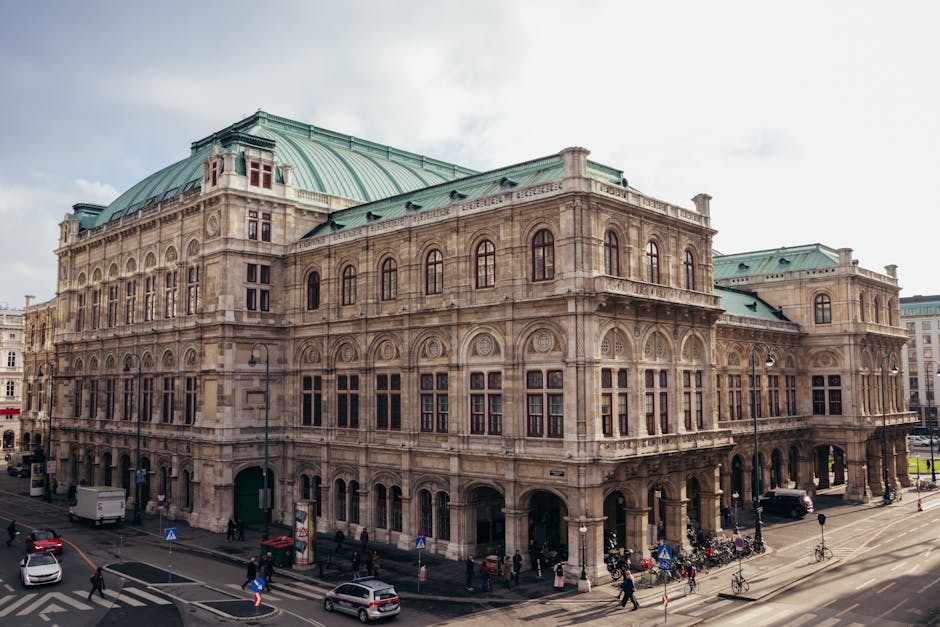
Follow the footsteps of Mozart and Strauss through Vienna’s historic center on this self-guided walk through the city's rich musical history.
 Easy
EasyBerat, Albania
Explore Berat’s stunning riverside, historic bridges, and iconic 'thousand windows' views on this peaceful self-guided nature and photography walk.
 Moderate
Berat, Albania
Explore Berat’s unique religious harmony on this self-guided walk through ancient mosques, Sufi shrines, and Byzantine churches.
 Moderate
Berat, Albania
Discover the legends and landmarks of Berat on this self-guided walk through Ottoman neighborhoods and the ancient living citadel.
 Moderate
Berat, Albania
Explore the 'City of a Thousand Windows' on this self-guided walk through the historic Ottoman districts of Mangalem and Gorica in Berat.