Self-guided audio tour in St. Augustine
Start Free on iPhone
Start free on iPhone to unlock this self-guided walking tour in St. Augustine. Hear all the stories that make it amazing, walk at your own pace, and begin whenever you want.
Your Private Tour Guide
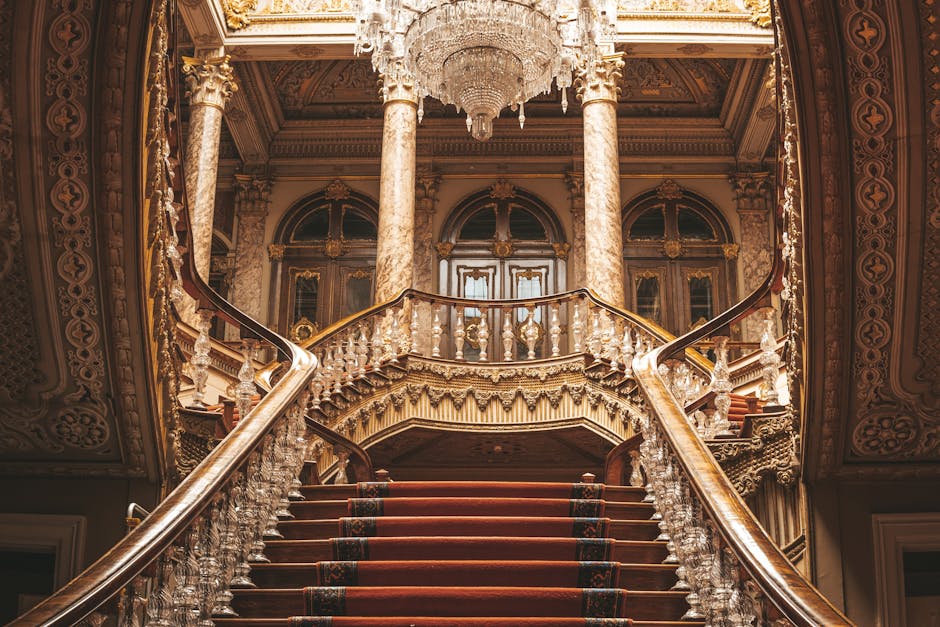
Step back into the late 19th century, a time when Florida was a wild frontier and St. Augustine was transformed into the 'American Riviera' by industrialist Henry Flagler. This self-guided walk explores the architectural splendor of the Gilded Age, where Spanish Renaissance Revival and Moorish influences meet the innovative spirit of the industrial revolution. As you navigate the historic Flagler District, you will encounter the massive poured-concrete structures that redefined luxury and set the stage for Florida’s tourism boom. This walking route highlights how Flagler's vision turned a sleepy colonial town into a winter playground for the world's elite. Your journey begins at the Villa Zorayda, a building that broke architectural norms with its scale and style, setting the precedent for the grand hotels to follow. From there, you will witness the imposing beauty of the Casa Monica and the Lightner Museum—the latter once housing the Alcazar Hotel, which featured the world’s largest indoor swimming pool at the time. The centerpiece of this neighborhood stroll is Flagler College, formerly the Hotel Ponce de Leon. This masterpiece of architecture remains one of the most significant Gilded Age structures in the United States, famous for its extensive collection of Tiffany stained glass and its early adoption of electricity. Beyond the hotels, this walking tour St. Augustine explores the spiritual and personal side of Flagler’s legacy. You will visit the Memorial Presbyterian Church, a stunning Venetian-inspired mausoleum where Flagler and his family are interred, and the Grace United Methodist Church, which showcases the meticulous craftsmanship of the era. Whether you are an architecture enthusiast or a history buff, this route offers a deep dive into the opulence, ambition, and drama of the men and women who built modern Florida. Explore independently and at your own pace, soaking in the intricate terracotta details and the lush courtyards that make this area one of the most photographed places in the country.
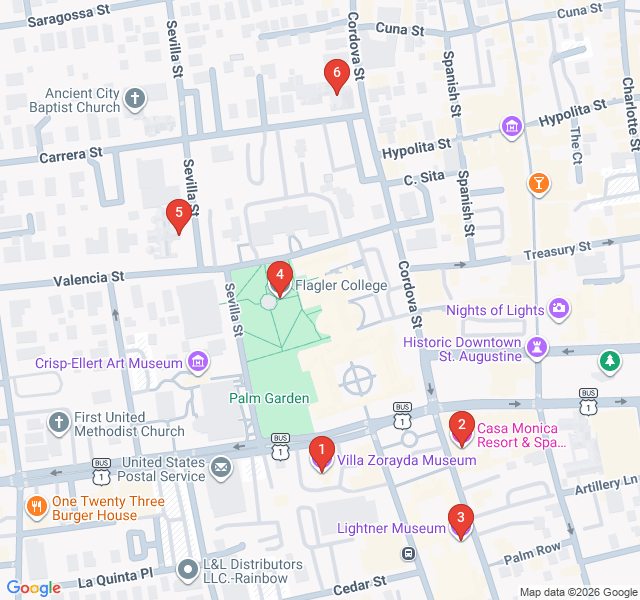
Numbers indicate the order of stops on the tour.
Welcome to the starting point of your self-guided walk. Built in 1883 by Franklin Smith, Villa Zorayda was the first building in St. Augustine to be constructed of poured concrete and crushed coquina shells—a method Henry Flagler would later adopt for his grand hotels. Smith was an eccentric amateur architect who modeled this building after the Alhambra Palace in Granada, Spain. Notice the intricate 'mudejar' style, characterized by horseshoe arches and geometric patterns. This residence sparked the Spanish Revival movement in Florida. While it looks like stone, the coquina-concrete mix was a revolutionary engineering feat for the time, allowing for the massive, durable structures you see throughout this district today.
Directly across the street stands the Casa Monica. Originally opened in 1888, this building was also the brainchild of Franklin Smith. However, Smith ran into financial trouble early on, and Henry Flagler stepped in to purchase the unfinished hotel for a fraction of its cost. Flagler renamed it the Cordova and it became an integral part of his luxury hotel system. The architecture is a blend of Moorish and Spanish styles, featuring crenelated towers and iron balconies. Today, it remains one of the oldest hotels in the United States and serves as a testament to the competition and collaboration between the visionaries who built this city.
Before you is the former Alcazar Hotel, commissioned by Henry Flagler in 1887. While the neighboring Ponce de Leon Hotel was for the ultra-wealthy, the Alcazar was intended for the 'slightly less' wealthy. It featured a massive courtyard, shops, and a world-class recreation center that included the world’s largest indoor swimming pool, a bowling alley, and a gymnasium. The pool was located where the Cafe Alcazar sits today. After the hotel closed during the Great Depression, it was purchased by Chicago publisher Otto Lightner to house his vast collection of Victorian-era hobbies and antiquities. Look up at the twin towers, which were inspired by the Cathedral of Seville.
This is the crown jewel of Henry Flagler’s empire: the former Hotel Ponce de Leon. When it opened in 1888, it was the height of modern luxury, being one of the first buildings in the country to be wired for electricity by Thomas Edison himself. It is said that guests were so terrified of the new technology that hotel staff had to turn the light switches on and off for them. The building is famous for its 79 Tiffany stained-glass windows and the spectacular rotunda with its hand-painted murals. Today, it serves as the heart of Flagler College. Take a moment to admire the terracotta details on the facade, which were crafted specifically to withstand the salty Florida air.
A short walk from the college brings you to this architectural marvel. Built in just one year (1889), this church was dedicated by Henry Flagler to the memory of his daughter, Jennie Louise, who died from complications of childbirth. The design is inspired by St. Mark’s Basilica in Venice, featuring a massive copper dome and intricate stone carvings. It serves not only as a place of worship but as the final resting place for Flagler, his daughter, and his first wife. The interior is equally impressive, with woodwork carved from Santo Domingo mahogany and a massive pipe organ. It remains one of the most significant examples of Venetian Renaissance architecture in North America.
Our final stop is Grace United Methodist Church. Like much of the district, this church was built by Henry Flagler. In fact, he funded its construction to replace the original Methodist church that stood where he wanted to build his Ponce de Leon Hotel. Completed in 1887, it was designed by Carrère and Hastings, the same architectural firm responsible for the New York Public Library. It reflects the Spanish Renaissance style that Flagler loved, with its terracotta trim and coquina-concrete walls. This site marks the completion of Flagler's 'Grand Vision' for the city’s skyline, ensuring that even the local churches matched the Gilded Age aesthetic of his luxury resorts.
Start Free on iPhone
Explore “Henry Flagler’s Gilded Age Opulence” with your very own Private Tour Guide with Zigway. Start free on iPhone, skip the large group and the fixed routes, and hear the city come alive as you go.
Your Private Tour Guide
Don't miss the good stuff
Explore Freely
 Moderate
St. Augustine, United States
Explore maritime history and coastal nature on this self-guided walk from the Bridge of Lions to the dunes of Anastasia State Park.
 Easy
EasySt. Augustine, United States
Explore the oldest street in America through its historic courtyards, military history, and vibrant local art galleries on this self-guided walk.
 Easy
EasySt. Augustine, United States
Explore the Golden Age of Piracy on this self-guided walking route through St. Augustine’s historic waterfront and defensive fortifications.
 Moderate
St. Augustine, United States
Explore the oldest Catholic parish in the U.S. and Spanish colonial landmarks on this self-guided walking route through historic St. Augustine.
 Easy
EasyNairobi, Kenya
Explore Nairobi's architectural evolution from colonial-era landmarks to iconic Brutalist skyscrapers on this historic self-guided walking route.
 Easy
EasyNairobi, Kenya
Discover Nairobi's iconic skyline on this self-guided architecture walk through the CBD’s most famous modernist and Brutalist landmarks.
 Easy
EasySalzburg, Austria
Discover the 'Rome of the North' on this self-guided walk through the Baroque squares and monumental legacy of Salzburg’s Prince-Archbishops.
 Easy
EasyKrakow, Poland
Uncover Krakow's legendary past on this self-guided walk from literary monuments to the fire-breathing Wawel Dragon.
 Easy
EasyNashville, United States
Explore the 'Athens of the South' on this self-guided walk through Centennial Park, featuring the world's only full-scale Parthenon replica.
 Easy
EasyNashville, United States
Explore Nashville's academic heart and Art Deco gems on this self-guided walk through historic Hillsboro Village.
 Easy
EasyNashville, United States
Explore the heart of Nashville's music industry. Discover iconic studios and the history of the legendary Nashville Sound at your own pace.
 Easy
EasyNashville, United States
Explore Nashville's oldest neighborhood! Discover Victorian architecture, Civil War history, and world-class craft beer on this self-guided walk.