Self-guided audio tour in Bratislava
Start Free on iPhone
Start free on iPhone to unlock this self-guided walking tour in Bratislava. Hear all the stories that make it amazing, walk at your own pace, and begin whenever you want.
Your Private Tour Guide
Step into the 'Little Vienna' of the Danube with this self-guided walk through Bratislava’s most prestigious district. Long before it was the capital of modern Slovakia, Bratislava (then known as Pressburg) served as the coronation city for the Kingdom of Hungary. This legacy of royal favor is etched into the very stones of the palaces and the verdant layouts of the hidden gardens you will encounter on this route. This architectural journey begins at the majestic Grassalkovich Palace, the Rococo masterpiece that currently serves as the seat of the President of the Slovak Republic. As you explore independently, you will transition from the grand, open spaces of the Palisády neighborhood into the intimate, winding streets of the medieval Old Town. This walking route is designed for those who appreciate the finer details of 18th-century design, from ornate wrought-iron gates to the symmetry of French-style parterres. Beyond the gold-leafed interiors of the aristocracy, this neighborhood stroll reveals the city's 'green lungs.' You will discover the Presidential Gardens, a public oasis that once hosted lavish Baroque parties and concerts by Joseph Haydn. As you move deeper into the historic core, the experience shifts from the public to the private. You will find the Franciscan Garden, a secluded sanctuary hidden behind ancient walls that offers a rare moment of silence in the bustling city. This self-guided adventure also highlights the intellectual history of the region at the Palace of the Hungarian Royal Chamber, where pivotal political decisions were once made. Instead of a traditional guided tour Bratislava visitors often find themselves in, this audio walk allows you to linger under the linden trees or spend extra time admiring the gothic foundations of the Pálffy Palace at your own pace. Whether you are a fan of Baroque architecture or simply looking for a peaceful escape through historic courtyards, this route offers a comprehensive look at the elegance of Bratislava's aristocratic past.
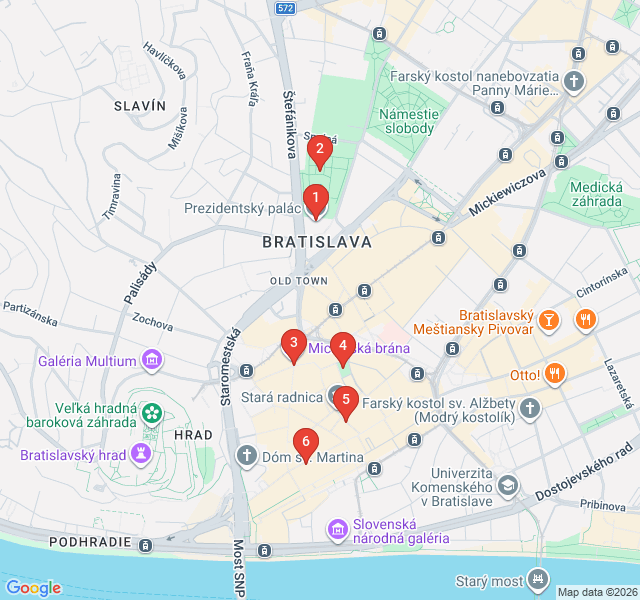
Numbers indicate the order of stops on the tour.
Start exploring with Zigway here at the Grassalkovich Palace, a stunning example of Rococo-Baroque architecture. Built in 1760 for Count Antal Grassalkovich, a close advisor to Empress Maria Theresa, this palace was once the center of aristocratic social life in Pressburg. It was famous for its grand balls and musical performances; in fact, the composer Joseph Haydn premiered several of his works within these walls. Today, it serves a more somber but equally important role as the official residence of the President of Slovakia. While the interior is generally closed to the public except on special open-house days, the facade remains one of the most photographed spots in the city. Notice the elegant guard of honor often stationed at the front gates, maintaining a tradition that stretches back centuries.
Located directly behind the palace, these gardens offer a transition from royal exclusivity to public enjoyment. Originally designed as a formal French garden, the space has evolved over time but retains its symmetrical charm and rows of manicured trees. As you walk the gravel paths, look for the statue of Maria Theresa, which honors the monarch who frequented this estate. The garden also features modern art installations and a fountain called 'Joy of Life,' reflecting the city's contemporary spirit. It is a perfect place to observe local life, as families and students often gather here. The towering trees provide a canopy of shade that makes this one of the most refreshing stops on your walking route.
As you move toward the Old Town, you encounter this imposing building on Michalská Street. This was once the most important political address in the city. Built in the 1750s, it served as the seat of the Hungarian Royal Chamber and later hosted the Hungarian Diet, or parliament, until 1848. It was here that influential figures of the Hungarian Reform Era debated the future of the empire. The architecture is a transition from Baroque to Classicism, featuring a clean, authoritative facade. Today, it houses the University Library, continuing its legacy as a place of intellectual pursuit. Imagine the horse-drawn carriages and frantic messengers that would have crowded this street during the height of the imperial era.
Tucked away behind the Franciscan Church, this garden is a true hidden gem. It is one of the oldest green spaces in the city, dating back to the medieval period when it served as a monastery garden for the Franciscan friars. To enter, you must pass through a relatively inconspicuous gate, but once inside, the noise of the city fades away. The garden is enclosed by ancient stone walls and offers a view of the back of the church and the nearby Mirbach Palace. It’s a place of quiet contemplation, filled with benches and well-kept flower beds. This stop perfectly illustrates the 'hidden' nature of Bratislava’s aristocracy, who often kept their most beautiful spaces shielded from the public eye.
Constructed in the late 18th century for Count George Apponyi, this palace represents the height of aristocratic luxury. The building is unique because it was built directly into the existing townhouses of the Old Town, creating a grand facade on a narrow street. Inside, the palace retains its original wood-paneled rooms and ornate ceilings. Today, it houses the Museum of Period Rooms and the Museum of Viticulture. Bratislava has a long history of wine production, and the aristocratic families were often the primary owners of the surrounding vineyards. The courtyard here is a beautiful example of how the wealthy integrated their grand residences into the dense urban fabric of the medieval city.
Your self-guided adventure concludes at the Pálffy Palace on Panská Street. The Pálffy family was one of the most powerful noble houses in the Kingdom of Hungary, and this residence reflects their status. Interestingly, the palace was built over several older houses, and during renovations, archaeologists discovered Celtic mint remains and Gothic architectural elements underneath. In 1762, a six-year-old Wolfgang Amadeus Mozart is said to have performed here, adding a layer of musical history to the site. Currently, the palace serves as a branch of the Bratislava City Gallery, showcasing both historic and contemporary art. It stands as a testament to the city’s ability to preserve its multi-layered history within a single structure.
Start Free on iPhone
Explore “Palaces and Hidden Gardens of the Aristocracy” with your very own Private Tour Guide with Zigway. Start free on iPhone, skip the large group and the fixed routes, and hear the city come alive as you go.
Your Private Tour Guide
Don't miss the good stuff
Explore Freely
 Easy
EasyBratislava, Slovakia
Discover Bratislava’s soul through its historic pubs and traditional flavors on this self-guided walk through the atmospheric Old Town.
 Moderate
Bratislava, Slovakia
Explore the resilient history of Pressburg's Jewish community on this poignant self-guided walk through Bratislava's Old Town and Castle Hill.
 Moderate
Bratislava, Slovakia
Discover Bratislava’s transformation from industrial heartland to a hub of street art and futuristic Zaha Hadid architecture on this self-guided walk.
 Easy
EasyBratislava, Slovakia
Follow the path of Hungarian kings through Bratislava's Old Town. Discover Michael's Gate, royal palaces, and the cathedral of coronations.
 Easy
EasyWarsaw, Poland
Discover the hidden courtyards and grand pre-war architecture of Warsaw's most atmospheric neighborhood on this self-guided stroll.
 Easy
EasySalzburg, Austria
Discover Salzburg's oldest medieval alley, the birthplace of the 'Silent Night' author, and breathtaking views on this quiet self-guided walk.
 Easy
EasyWarsaw, Poland
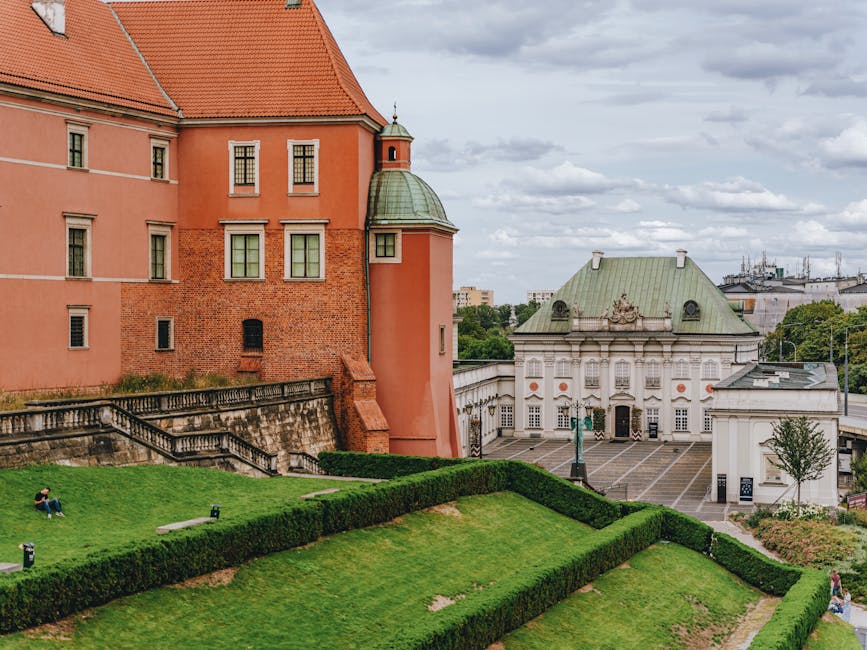
Explore the miracle of Warsaw's reconstructed Old Town on this self-guided walk through royal squares, medieval walls, and heroic monuments.
 Easy
EasyNairobi, Kenya
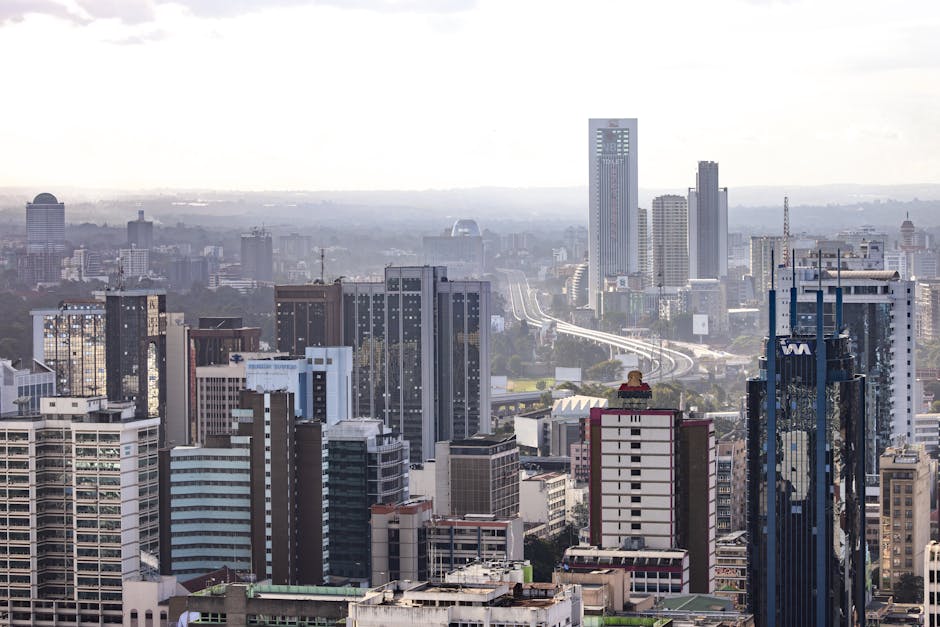
Discover Nairobi's iconic skyline on this self-guided architecture walk through the CBD’s most famous modernist and Brutalist landmarks.