Self-guided audio tour in Berat
Start Free on iPhone
Start free on iPhone to unlock this self-guided walking tour in Berat. Hear all the stories that make it amazing, walk at your own pace, and begin whenever you want.
Your Private Tour Guide
Step into a living masterpiece within the ancient stone walls of Berat, Albania. This self-guided walking route, titled 'The Master of Red,' invites you to uncover the secrets of the 16th-century iconographer Onufri. Known for his mysterious and vibrant red pigment, Onufri’s work represents a peak in Byzantine-style art, and Berat serves as his most magnificent gallery. As you wander through the Kalaja, or Castle district, you are not just visiting a monument; you are exploring a neighborhood that has been continuously inhabited for over two millennia. This neighborhood stroll takes you from the heights of the fortress down through the winding Ottoman-era streets of Mangalem and Gorica. Along the way, you will discover why Berat is celebrated as a UNESCO World Heritage site, focusing on the unique blend of religious harmony and architectural resilience. While exploring independently, you will see how the intricate icons inside the Onufri Museum contrast with the rugged, weathered stone of the castle walls. The route also highlights the city's broader history, from its Byzantine roots and Ottoman peaks to the more recent layers of 20th-century history, including World War II resistance and Cold War bunkers. This walking tour Berat experience is designed for those who want to move at their own pace, pausing to admire the 'thousand windows' of the Mangalem district or looking out over the Osum River from the old castle ramparts. Whether you are an art enthusiast fascinated by the secret of 'Onufri Red' or a history buff eager to explore one of the oldest inhabited cities in the Balkans, this journey provides a comprehensive look at the artistic and cultural soul of Berat. By the end of this self-guided adventure, you will understand how faith, art, and endurance have shaped this extraordinary Albanian landscape.
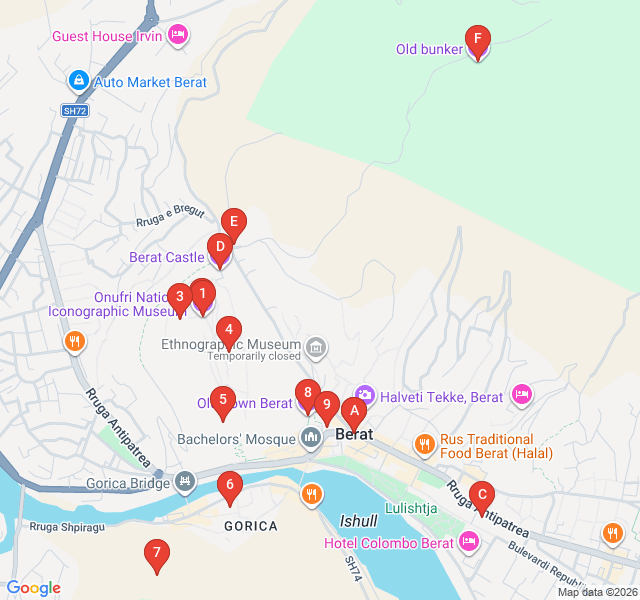
Numbers indicate the order of stops on the tour.
Your journey begins at the heart of Berat's artistic heritage. This museum, located within the Cathedral of the Dormition of Saint Mary, honors Onufri, Albania's most famous 16th-century painter. Onufri was a master of the Byzantine style, but he introduced a level of realism and emotional depth that was revolutionary for his time. His greatest secret, however, was the 'Onufri Red'—a vibrant, glowing pigment whose exact chemical composition remains a mystery to this day. As you look at the icons, notice how the red seems to radiate light, a testament to a master who blended technique with spiritual devotion.
The building housing the museum is a masterpiece in itself. Reconstructed in 1797 on the site of an even older church, this cathedral served as the seat of the Orthodox Bishop of Berat. The interior features a magnificent gilded wood iconostasis, one of the finest examples of Albanian craftsmanship from the late 18th century. It separates the nave from the sanctuary and is intricately carved with floral and mythical motifs. This space was once the center of religious life for the families living within the castle walls, surviving through centuries of Ottoman rule.
Just a short walk away is the Church of St. Nicholas, another 16th-century gem. While smaller than the cathedral, it offers a more intimate look at the religious architecture of the Kalaja. Many of the churches in this district were built partially underground or behind high walls to comply with Ottoman regulations of the time. Inside, you can find fragments of frescoes that demonstrate how the artistic traditions of Onufri were carried on by his son, Nikola, and other students who formed the 'Onufri School.'
To understand Berat, you must look at its homes. The Haxhistasës house is a prime example of the traditional 'Berat style' architecture. These houses are characterized by their white-washed stone walls and large wooden windows designed to catch the breeze and the light. In the Kalaja, houses were built closely together, often sharing walls, creating a dense, labyrinthine feel. This specific residence highlights the transition from purely functional fortress living to the more ornate Ottoman residential style that became famous in the lower parts of the city.
Walking along the old castle walls, you are standing on history that dates back to the 4th century BC. The fortifications you see today are largely Byzantine, with Ottoman repairs. These walls have withstood sieges by Romans, Bulgarians, and Crusaders. Look out over the valley and imagine the strategic importance of this height. The castle was never just a military outpost; it was a fortified city where thousands of people lived, worked, and worshipped, protected by these massive stone barriers.
From this vantage point, look across the Osum River to the Gorica neighborhood. While the Kalaja was historically the Christian quarter and Mangalem the Muslim quarter, Gorica sat on the opposite bank, largely inhabited by Christians. The stone bridge connecting the two sides is a symbol of the city's unity. The houses in Gorica mirror those in Mangalem, creating the famous 'thousand windows' effect that defines Berat’s skyline. It is one of the most photographed views in Albania.
Art in Berat wasn't just found in churches; it was a local industry. These ruins mark the site of what is believed to have been an icon painter's workshop. Here, apprentices would grind minerals to create pigments and prepare wooden panels for masters like Onufri. The proximity to the churches allowed for a constant flow of work. Seeing these ruins reminds us that the masterpieces in the museum were once fresh products of a bustling creative community within these very walls.
Descending from the castle, you enter the Mangalem district, the core of Berat's Old Town. This area is a UNESCO World Heritage site for a reason. The layers of history are visible in every stone. The architecture here is purely Ottoman, with houses stacked vertically up the hillside so that no one house blocks the light or view of another. It is a masterclass in urban planning and social consideration from centuries ago.
The Sarajet e Vrionasve was once the palatial residence of the Vrioni family, one of the most powerful land-owning families in Albania during the late Ottoman period. While much of the original grandeur has faded, the scale of the site indicates the wealth and influence that Berat once held as a regional administrative center. It represents the secular power that existed alongside the religious and artistic life of the city.
Hidden within the castle walls is the Church of St. Mary of Blaherna, the oldest standing church in Berat, dating back to the 13th century. It is named after the famous Blachernae church in Constantinople. Inside, the floor is decorated with a beautiful 16th-century mosaic, and the walls are covered in frescoes painted by Nikola, Onufri's son, in 1578. The survival of this church is a testament to the enduring faith of the residents of the Kalaja.
This area serves as the administrative heart of the modern district. As you walk through, notice how the historic and the modern begin to blend. Berat has always been more than a museum; it is a functioning provincial capital. This district connects the ancient roots of the Kalaja with the daily lives of the people who live in the newer parts of the city today.
The Municipality building represents the civic governance of Berat. In the mid-20th century, Berat underwent significant changes under the communist regime, which sought to modernize the city while preserving its 'Museum City' status. The balance between preservation and progress is a constant conversation in Berat, as the city seeks to maintain its UNESCO status while providing for its modern inhabitants.
The castle itself, or Kalaja, is a massive triangular fortress. Most of what remains today dates from the 13th century, built by the Despot of Epirus, Michael I Komnenos Doukas. Unlike many European castles that are empty ruins, Berat's castle is still a living neighborhood. People still live in the houses, children play in the alleys, and laundry hangs near ancient Byzantine gates. It is this continuity of life that makes the castle truly unique.
This monument commemorates a unique piece of World War II history. After Italy's capitulation in 1943, many Italian soldiers refused to join the Germans and instead formed the Antonio Gramsci Battalion to fight alongside the Albanian partisans against the Nazi occupation. It is a symbol of international solidarity and a reminder of the complex roles Albania played during the global conflict.
Your walk ends at a relic of the Cold War. During the regime of Enver Hoxha, hundreds of thousands of concrete bunkers were built across Albania due to a fear of foreign invasion. This bunker, tucked away near the historic sites, serves as a stark contrast to the Byzantine and Ottoman beauty you have seen. It represents the isolationist era of the late 20th century, adding a final, modern layer to the deep history of Berat.
Start Free on iPhone
Explore “The Master of Red: Onufri's Artistic Legacy” with your very own Private Tour Guide with Zigway. Start free on iPhone, skip the large group and the fixed routes, and hear the city come alive as you go.
Your Private Tour Guide
Don't miss the good stuff
Explore Freely
 Easy
EasyBerat, Albania
Explore Berat’s stunning riverside, historic bridges, and iconic 'thousand windows' views on this peaceful self-guided nature and photography walk.
 Moderate
Berat, Albania
Explore Berat’s unique religious harmony on this self-guided walk through ancient mosques, Sufi shrines, and Byzantine churches.
 Moderate
Berat, Albania
Discover the legends and landmarks of Berat on this self-guided walk through Ottoman neighborhoods and the ancient living citadel.
 Moderate
Berat, Albania
Explore the 'City of a Thousand Windows' on this self-guided walk through the historic Ottoman districts of Mangalem and Gorica in Berat.
 Easy
EasyKrakow, Poland
Explore the historic heart of Kazimierz on this self-guided walk through synagogues, ancient cemeteries, and vibrant squares.
 Easy
EasySalzburg, Austria
Discover the 'Rome of the North' on this self-guided walk through the Baroque squares and monumental legacy of Salzburg’s Prince-Archbishops.
 Easy
EasyGdansk, Poland
Discover the 'Baltic Gold' on this self-guided walk through Gdansk's historic mills, massive cathedrals, and the magical Mariacka Street.
 Easy
EasyWarsaw, Poland
Discover the hidden courtyards and grand pre-war architecture of Warsaw's most atmospheric neighborhood on this self-guided stroll.
 Easy
EasyTirana, Albania
Explore the vibrant stalls of Pazari i Ri and the trendy eateries of Blloku on this flavor-focused self-guided walk through Tirana.
 Moderate
Tirana, Albania
Explore Tirana's green side on this self-guided walk from Skanderbeg Square to the serene Grand Park and hidden lakeside memorials.
 Easy
EasyTirana, Albania
Explore Tirana’s neon-lit landmarks and vibrant nightlife districts on this self-guided evening photography walk.
 Easy
EasyTirana, Albania
Explore Tirana’s unique religious harmony on this self-guided walk through historic mosques, grand cathedrals, and Ottoman landmarks.