Self-guided audio tour in Novi Sad
Start Free on iPhone
Start free on iPhone to unlock this self-guided walking tour in Novi Sad. Hear all the stories that make it amazing, walk at your own pace, and begin whenever you want.
Your Private Tour Guide
Novi Sad, often celebrated as the 'Serbian Athens,' holds a history that is as layered as the architecture of its bustling squares. This self-guided walking route invites you to uncover a specific, poignant thread of that history: the legacy of the Jewish community. Before the Second World War, Novi Sad was home to a thriving Jewish population that contributed immensely to the city's intellectual, commercial, and artistic life. This walking route traces their journey from the height of cultural prosperity to the somber days of the Holocaust, and finally to the enduring spirit of resilience that remains today. As you explore independently, you will transition from the grand civic spaces of the Stari Grad to the quiet, reflective banks of the Danube. The journey begins near the Museum of Contemporary Art, setting a cultural context before moving into the heart of the city. You will encounter the Novi Sad Synagogue, one of the most magnificent architectural landmarks in the region, designed by the famed architect Lipót Baumhorn. Nearby, the Jewish Community Center and the former Jewish school stand as testaments to a once-vibrant neighborhood. The route then leads you toward the river, where the atmosphere shifts at 'The Raid' Memorial. Here, you will reflect on the tragic events of January 1942, a moment that forever changed the fabric of the city. The walk concludes by crossing towards the Petrovaradin Fortress area and ending at the Old Locomotive, a powerful symbol of transit and memory. This neighborhood stroll is not just a lesson in history, but an opportunity to see Novi Sad through a lens of cultural preservation. Whether you are interested in religious architecture or the complex social history of Central Europe, this self-guided adventure offers a deep, personal connection to the city's past.
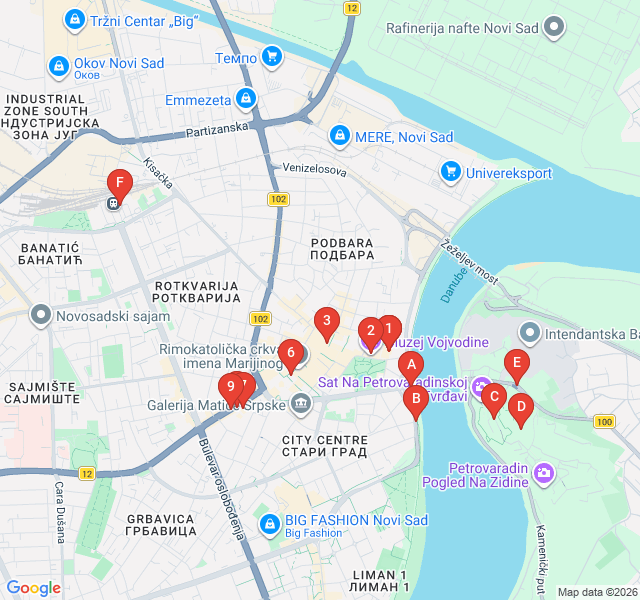
Numbers indicate the order of stops on the tour.
Welcome to the start of your self-guided walk. While this museum focuses on the vibrant modern art scene of the region, its location serves as a gateway to the cultural history of Novi Sad. The Jewish community was historically deeply integrated into the city's artistic and intellectual circles. As you stand here, consider how the modern identity of Vojvodina is built upon the diverse contributions of many ethnic groups, including the Jewish citizens who helped shape Novi Sad into a regional powerhouse of thought and creativity before the mid-20th century.
The Museum of Vojvodina is one of the oldest and most significant cultural institutions in Serbia. Its vast collection covers the archaeology, history, and ethnology of the region. For those tracing Jewish heritage, the museum provides essential context on how different faiths coexisted under the Austro-Hungarian Empire. The Jewish community here was granted significant rights in the 18th and 19th centuries, allowing them to become key figures in the city's industrialization. Take a moment to appreciate the neoclassical architecture of the building itself, which reflects the city's 19th-century prosperity.
This striking building is the seat of the Serbian Orthodox Bishop of Bačka. Its unique facade, featuring a blend of Byzantine and Eastern elements with modern touches, represents the multi-confessional nature of Novi Sad. In this city, religious landmarks often stand in close proximity. The Jewish community lived and worked alongside their Orthodox and Catholic neighbors for centuries. The palace serves as a reminder of the complex religious tapestry that defines the city's 'Stari Grad' or Old Town area, where different faiths shared the same streets and markets.
You are now in the heart of Novi Sad. Liberty Square is flanked by the Name of Mary Catholic Church and the City Hall. Historically, this square was the center of public life where Jewish merchants and professionals were prominent figures. Many of the surrounding buildings were owned by Jewish families who were instrumental in the city's commercial boom. As you look around, imagine the square in the early 1900s, a bustling hub of multicultural trade and social interaction that defined the spirit of the 'Serbian Athens.'
Walking through the pedestrian zones of the city core, you are surrounded by the 19th-century charm of Novi Sad. This area was the backdrop for daily Jewish life—from shops and law offices to social clubs. The resilience of the city is evident here; despite the heavy damage sustained during various wars, the core has been meticulously preserved. The streets you are walking on once echoed with the sounds of Yiddish, German, and Serbian, reflecting the cosmopolitan nature of the community that once thrived here.
This massive bronze statue honors Svetozar Miletić, a former mayor and a key figure in the political struggle for Serbian rights within the Austro-Hungarian Empire. While Miletić was a champion of Serbian nationalism, his era was also one where the Jewish community sought and gained legal emancipation. The political shifts of the 19th century allowed Jewish citizens to move from the outskirts of society into the very center of civic life, a transition that is mirrored in the grand architecture you see around this central monument.
This is the crown jewel of Jewish heritage in Novi Sad. Completed in 1909, the Synagogue was designed by the celebrated Hungarian architect Lipót Baumhorn, who was responsible for many of the finest synagogues in Central Europe. Its grand dome and Secessionist style make it one of the most beautiful buildings in the city. Though it is no longer used for daily worship—as the community was decimated during the Holocaust—it serves today as a prestigious concert hall, ensuring that the building remains a living part of the city's cultural soul.
Located right next to the Synagogue, this building was the administrative and social heart of Jewish life. It housed the community's offices, social welfare programs, and cultural organizations. Today, it continues to serve the small but active Jewish community of Novi Sad. It stands as a symbol of continuity and resilience, a place where the history of the families who returned after 1945 is preserved. It is a quiet reminder that despite the tragedies of the past, the Jewish presence in Novi Sad was never entirely extinguished.
This building once housed the Jewish elementary school, where generations of children learned both their religious heritage and the secular curriculum that allowed them to integrate into wider Serbian society. Education was a cornerstone of the community's values. During the occupation in World War II, this building was used by the Hungarian authorities as a collection center for Jews before their deportation. Standing here, one feels the heavy transition from a place of learning and growth to a site of profound sorrow.
As you move toward the river, you approach spaces dedicated to memory. The Gallery of Memory serves to document and honor the victims of the atrocities committed in Novi Sad during the 1940s. It focuses on individual stories, turning statistics into faces and names. This stop is a preparation for the memorial on the quay, providing the historical details of the 'Racija' or the Raid, when the occupying forces conducted a mass execution of Jews, Serbs, and Roma residents.
This is perhaps the most moving site in Novi Sad. The bronze sculpture, titled 'Family,' depicts a mother, father, and child facing the Danube. It commemorates the January 1942 Raid, when Hungarian occupational forces killed thousands of innocent people, many of whom were thrown through holes cut in the frozen river. The names of the identified victims are listed on nearby plaques. It is a place for quiet reflection on the fragility of life and the immense loss suffered by the Jewish community during those dark winter days.
Located in the Petrovaradin Fortress complex across the river, the City Museum offers a broader view of the city's military and civil history. The fortress itself was a site of strategic importance for the Habsburgs. The museum's exhibits often include details about the city's demographics over the centuries, showing how the Jewish community grew alongside the fortress's development. Crossing the bridge to reach this point offers a panoramic view of the city you have just walked through, connecting the old town with the defensive structures that protected it.
The underground tunnels of the Petrovaradin Fortress are a marvel of 18th-century engineering. While not directly related to Jewish ritual life, the fortress as a whole represents the imperial power that initially invited Jewish settlers to the region to help build the local economy. The catacombs were a place of refuge and military strategy. Today, they remind us of the hidden layers of history that lie beneath the surface of Novi Sad, much like the often-overlooked stories of the minority communities that built the city's foundations.
The Belgrade Gate is one of the most impressive entrances to the Lower Town of the Petrovaradin Fortress. This gate saw the passage of countless merchants, soldiers, and travelers over the centuries. For the Jewish community, this was a vital artery for trade between the fortress and the city of Belgrade to the south. The gate stands as a symbol of the city's role as a gateway between Central Europe and the Balkans, a position that made Novi Sad a melting pot of cultures and a hub for the Jewish diaspora.
Your walk concludes at the Old Locomotive, a monument located near the railway station. While a symbol of industrial progress and the arrival of the railway in the 19th century, the locomotive also carries a darker weight in the context of Jewish history. It serves as a silent witness to the deportations that took place during the Holocaust, when the very trains that once brought prosperity were used to transport the city's Jewish citizens to death camps. This final stop invites you to contemplate the duality of progress and the importance of never forgetting the lessons of history.
Start Free on iPhone
Explore “Jewish Heritage: Memory and Resilience” with your very own Private Tour Guide with Zigway. Start free on iPhone, skip the large group and the fixed routes, and hear the city come alive as you go.
Your Private Tour Guide
Don't miss the good stuff
Explore Freely
 Easy
EasyNovi Sad, Serbia
Explore the vibrant soul of Novi Sad's nightlife on this self-guided walk through iconic pubs, craft beer gems, and the famous Laze Telečkog street.
 Easy
EasyNovi Sad, Serbia
Explore the Austro-Hungarian grandeur of Novi Sad's historic center on this self-guided walking route through the elegant streets of Stari Grad.
 Moderate
Novi Sad, Serbia
Explore the 'Gibraltar on the Danube' from Novi Sad's elegant city center to the massive underground tunnels of Petrovaradin Fortress.
 Easy
EasyNovi Sad, Serbia
Taste your way through Novi Sad's vibrant markets and iconic street food on this self-guided culinary stroll through the heart of Vojvodina.
 Easy
EasyKrakow, Poland
Explore the historic heart of Kazimierz on this self-guided walk through synagogues, ancient cemeteries, and vibrant squares.
 Easy
EasySalzburg, Austria
Discover the 'Rome of the North' on this self-guided walk through the Baroque squares and monumental legacy of Salzburg’s Prince-Archbishops.
 Easy
EasyGothenburg, Sweden
Discover Gothenburg’s 17th-century Dutch foundations, historic canals, and military fortifications on this self-guided architectural walk.
 Easy
EasyNairobi, Kenya
Explore Nairobi's architectural evolution from colonial-era landmarks to iconic Brutalist skyscrapers on this historic self-guided walking route.
 Easy
EasyBelgrade, Serbia
Discover Lower Dorćol, where 18th-century history meets industrial revival and vibrant street art on this self-guided stroll through Belgrade.
 Easy
EasyBelgrade, Serbia
Discover Belgrade’s bohemian heart. Explore the historic Skadarlija quarter and Dorćol’s hidden Ottoman gems on this self-guided audio walk.
 Easy
EasyBelgrade, Serbia
Explore the future of Serbia's capital on this self-guided walk through the modern Belgrade Waterfront and the scenic Sava Promenada.
 Moderate
Belgrade, Serbia
Explore the legacy of Yugoslavia on this self-guided walk from Tito’s tomb to the historic ruins and monuments of central Belgrade.