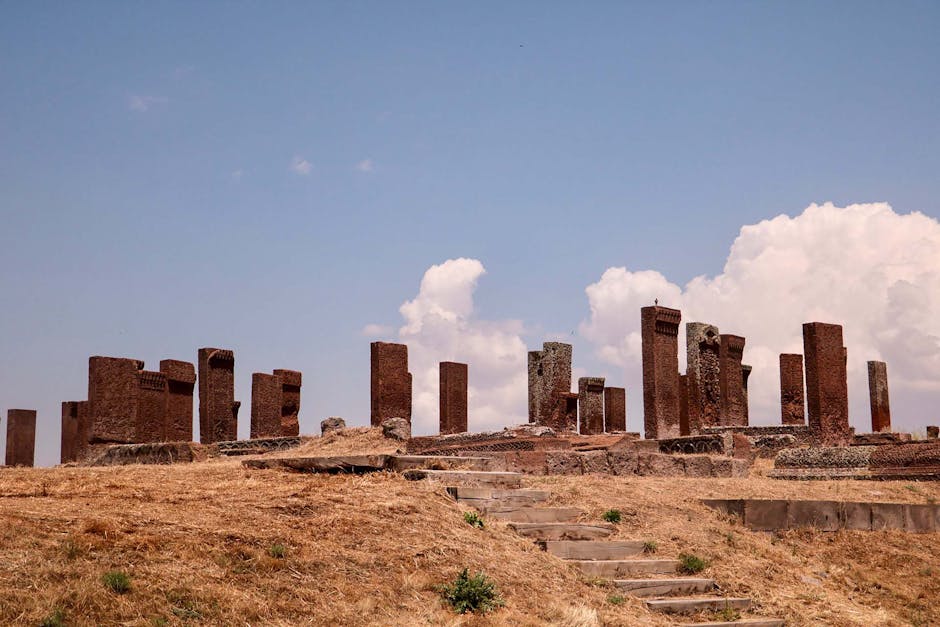
Self-guided audio tour in Paphos
Start Free on iPhone
Start free on iPhone to unlock this self-guided walking tour in Paphos. Hear all the stories that make it amazing, walk at your own pace, and begin whenever you want.
Your Private Tour Guide
Step into a world where the living city meets the silent majesty of the ancient dead. This self-guided walking route in Paphos invites you to explore the transition from the neoclassical elegance of the Paphos Town Hall to the subterranean wonders of the Tombs of the Kings. As a UNESCO World Heritage site, Paphos offers a unique window into the Hellenistic and Roman periods, where architecture was used to reflect the status of the elite. Begin your journey in the upper town, or Ktima, where the civic pride of Cyprus is on full display. From here, the route winds down toward the coast, leading you to the necropolis that gives this walk its name. Despite the title, no kings were ever buried here; instead, these monumental rock-cut tombs served as the final resting places for high-ranking officials and aristocrats. You will have the opportunity to wander through open-air atriums and admire Doric columns carved directly into the solid rock, a testament to the architectural ambition of the 4th century BC. The experience continues along the Mediterranean shore, where the Paphos Lighthouse stands as a sentinel over the Archaeological Park of Nea Paphos. This neighborhood stroll takes you past some of the finest Roman mosaics in the world at the House of Dionysus, before guiding you toward the medieval Saranda Kolones fortress. The layers of history are palpable as you move from the Roman era to the Byzantine and eventually to the Paphos Castle at the harbor. This walking route Paphos is perfect for those who want to discover the city's secrets at their own pace. Whether you are marvelling at the sacred atmosphere of the Agia Solomoni Catacombs or catching a glimpse of the MV Dimitrios II shipwreck on the horizon, this walk captures the enduring spirit of Cyprus. It is an essential walking tour Paphos for history enthusiasts and architecture lovers alike, offering a comprehensive look at the ruins and landmarks that define this coastal gem.
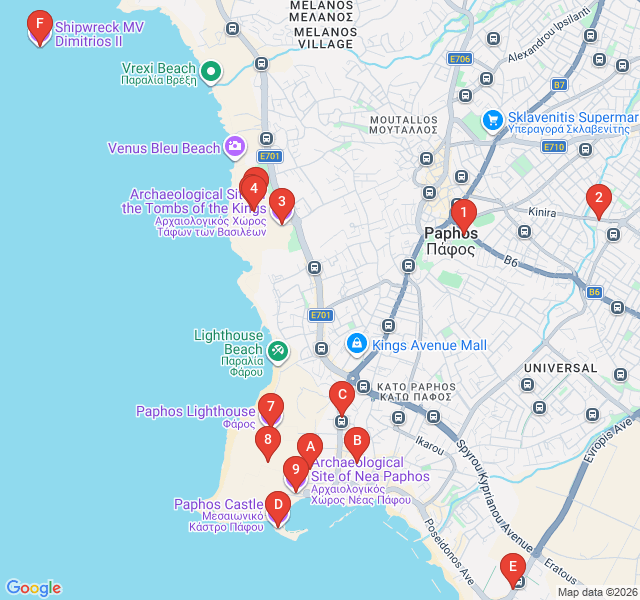
Numbers indicate the order of stops on the tour.
Welcome to the starting point of your walk in the upper town of Paphos, known as Ktima. The Paphos Town Hall is a stunning example of neoclassical architecture, built in 1955. Its design, featuring elegant columns and a symmetrical facade, reflects a period of Hellenic revival in Cyprus. The building sits at the edge of the central 28th October Square, a space named to commemorate the day Greece entered World War II. Take a moment to admire the surrounding gardens and the neoclassical schools nearby. This area serves as the administrative heart of the city, standing in contrast to the ancient ruins you will encounter later. It represents the modern identity of Paphos, a city that has been continuously inhabited for thousands of years.
As you continue through the upper town, you pass the Paphos campus of the Cyprus University of Technology. The integration of this modern educational institution into the historic center has revitalized the district. The university occupies several restored buildings, blending contemporary academic life with the traditional stone masonry of the area. This site highlights the city's commitment to preserving its architectural heritage while evolving into a hub for innovation and youth. The presence of the university ensures that the streets here remain vibrant throughout the year, bridging the gap between the town's storied past and its future as a center of learning in the Mediterranean.
You have reached the entrance to one of the most significant archaeological sites in Cyprus. Despite the name, no kings were ever buried here. This necropolis, dating back to the 4th century BC, was the final resting place for high-ranking administrative officers, Ptolemaic aristocrats, and their families. The 'Kings' moniker was likely inspired by the sheer size and architectural splendor of the tombs. Spread across a vast area overlooking the sea, these tombs were carved directly into the calcarenite rock. As you enter, you are stepping into a UNESCO World Heritage site that provides a rare look at the funerary customs of the Hellenistic and Roman periods, where the dead were housed in dwellings that mirrored the grand houses of the living.
Tomb 3 is arguably the most impressive structure within the necropolis. As you descend into the tomb, you find yourself in a sunken rectangular atrium. Look up at the well-preserved Doric columns that support the surrounding entablature, all carved from the solid bedrock. This architectural style is highly reminiscent of the houses found in Alexandria, Egypt, reflecting the close ties between Cyprus and the Ptolemaic Kingdom. The burial chambers are located off the colonnaded portico. The precision of the carving and the scale of the atrium suggest that the individual buried here held immense wealth and status. It is a hauntingly beautiful space that showcases the pinnacle of ancient rock-cut architecture.
Tomb 4 offers another variation of the peristyle tomb design. Like its neighbors, it features an open courtyard that allowed light and air to reach the burial chambers. Notice the remains of the staircase leading down into the tomb and the intricate niches, or 'loculi,' where the deceased were placed. The scale of these excavations is a testament to the labor-intensive processes of the ancient world. Over the centuries, these tombs were often reused by early Christians or served as shelters for squatters and hermits, which explains why many of the original artifacts and decorations have been lost. Nevertheless, the skeletal remains of the architecture provide a powerful sense of the site's original grandeur.
Tomb 8 is unique for its specific layout and the way it utilizes the natural topography of the coastline. Located closer to the sea, this tomb emphasizes the importance of the horizon in ancient funerary practices. The tombs were often oriented toward the setting sun, symbolizing the journey into the afterlife. As you explore this area, notice the weathered surfaces of the rock, shaped by centuries of salt air and wind. The contrast between the rugged, natural exterior and the meticulously carved interior spaces is a recurring theme throughout this site. Take a moment here to enjoy the panoramic views of the Mediterranean, which have remained largely unchanged since the tombs were first constructed.
Leaving the necropolis behind and moving toward the archaeological park of Nea Paphos, you will see the Paphos Lighthouse standing tall against the blue sky. Built in 1888 during the British administration of Cyprus, this lighthouse is still operational today. It was a vital landmark for ships navigating the treacherous coastline toward the harbor. The white tower stands on a small hill within the archaeological site, creating a striking juxtaposition between the 19th-century maritime history and the ancient ruins surrounding it. From its base, you can see the layout of the ancient theater nearby and the vast expanse of the Roman villas that once dominated this coastal city.
The House of Dionysus is a crown jewel of Paphos. This 2nd-century Roman villa, spanning over 2,000 square meters, is world-famous for its exceptionally well-preserved floor mosaics. Named after the god of wine, who appears in several of the scenes, the villa features intricate depictions of Greek mythology, hunting scenes, and geometric patterns. As you walk along the raised walkways, look for the 'Triumph of Dionysus' and the tragic story of Pyramus and Thisbe. These mosaics were crafted using small natural pebbles and cut stones, and their vibrant colors and detail have survived for nearly two millennia. They offer an intimate look at the luxury and artistic tastes of the Roman elite in Paphos.
You are now in the heart of Nea Paphos, the 'New Paphos' founded in the 4th century BC. This sprawling site was once the capital of Cyprus under the Ptolemies and the Romans. Beyond the famous villas, the park contains the remains of the Agora, the Odeon, and the Temple of Asclepius. The sheer scale of the ruins indicates the city's former importance as a Mediterranean trade hub. Walking through the site, you can trace the grid-like street plan typical of Hellenistic urban design. The site is a living history book, where every stone tells a story of earthquake destruction, reconstruction, and the eventual decline of the city after the Arab raids of the 7th century.
Known locally as Saranda Kolones, this site contains the ruins of a 7th-century Byzantine fortress. The name 'Forty Columns' refers to the numerous granite columns found on the site, which were actually salvaged from the nearby ancient Agora to build the castle. The fortress was designed to protect the harbor from Arab raids but was largely destroyed by a massive earthquake in 1222 and never rebuilt. As you explore the ruins, you can still see the remains of the dungeon, the towers, and the central courtyard. The site offers a fascinating look at medieval military architecture and the practice of 'spolia,' where ancient materials were repurposed for new defensive structures.
This site is a significant stop for those interested in religious history. According to tradition, the Apostle Paul was tied to this very pillar and flogged thirty-nine times by the Romans before he successfully converted the Roman governor, Sergius Paulus, to Christianity in 45 AD. This event made Cyprus the first Roman province to be ruled by a Christian governor. The pillar stands in the courtyard of the Panagia Chrysopolitissa church, which was built over the ruins of the largest early Christian basilica on the island. The site is a peaceful place of reflection, surrounded by ancient columns and intricate mosaic floors from the original 4th-century church.
Descend into the Agia Solomoni Catacomb, a site that has transitioned from a Hellenistic tomb to a Christian chapel and a place of pilgrimage. The catacomb is named after Saint Solomoni, who hid here with her seven sons to escape persecution. Inside, you can find small chambers with faded frescoes and a sacred spring. At the entrance stands a large terebinth tree, draped in hundreds of colorful pieces of cloth. These are votive offerings left by people hoping for a cure for various ailments, particularly those related to eyesight. The site is a poignant example of how ancient spaces have been continuously adapted for spiritual use over thousands of years.
Standing guard at the edge of the Paphos harbor, the Paphos Castle is an iconic symbol of the city. Originally built as a Byzantine fort to protect the harbor, it was rebuilt by the Lusignans in the 13th century, dismantled by the Venetians in 1570, and finally reconstructed by the Ottomans in 1780. Its thick stone walls and small windows reflect its role as a defensive stronghold and later as a prison and salt warehouse. Today, the castle's square serves as a venue for cultural events, including the annual Paphos Aphrodite Festival. You can walk across the stone bridge to the entrance and, if open, climb to the roof for a commanding view of the harbor and the sea.
A short walk from the harbor area brings you toward the Neapolis University campus. While a modern addition to the city, the university is part of Paphos's contemporary identity as a center for international education and research. The campus architecture is modern and functional, representing the city's growth beyond its historic and tourist centers. It serves as a reminder that Paphos is not just an open-air museum, but a living, breathing city with a thriving student population. The university's presence has encouraged the development of new cafes and residential areas in this part of town, marking the southern expansion of the urban landscape.
To conclude your journey, look out toward the sea to spot the MV Dimitrios II. This cargo ship ran aground in March 1998 during a heavy storm while carrying a cargo of timber from Greece to Syria. The ship remains perched precariously on a rocky reef about 500 meters from the shore. Over the years, it has become a local landmark and a popular subject for photographers, especially at sunset. The rusting hull against the backdrop of the Mediterranean waves serves as a modern memento mori, reminding us of the power of the sea that has shaped Paphos's history for millennia. It is a dramatic and fitting end to a walk that has spanned from ancient tombs to modern relics.
Start Free on iPhone
Explore “Necropolis of the Elite: Tombs of the Kings Walk” with your very own Private Tour Guide with Zigway. Start free on iPhone, skip the large group and the fixed routes, and hear the city come alive as you go.
Your Private Tour Guide
Don't miss the good stuff
Explore Freely
 Easy
EasyPaphos, Cyprus
Explore Paphos' maritime history on this self-guided walk from ancient tombs and Roman mosaics to the iconic harbor fort and a coastal shipwreck.
 Easy
EasyPaphos, Cyprus
Experience the vibrant pulse of Paphos after dark, from the neon lights of Bar Street to sophisticated harbor-side cocktails on this self-guided walk.
 Easy
EasyPaphos, Cyprus
Experience the stunning Mediterranean coastline, historic lighthouse, and medieval castle on this scenic self-guided audio walk in Kato Paphos.
 Easy
EasyPaphos, Cyprus
Discover UNESCO-listed ruins, Byzantine churches, and Roman mosaics on this self-guided audio walk through the historic heart of Paphos.
 Easy
EasySalzburg, Austria
Discover the 'Rome of the North' on this self-guided walk through the Baroque squares and monumental legacy of Salzburg’s Prince-Archbishops.
 Moderate
Gothenburg, Sweden
Discover Gothenburg’s maritime soul on this self-guided walk from the historic Central Station to the scenic riverfront at Stenpiren.
 Easy
EasyNairobi, Kenya
Explore Nairobi's architectural evolution from colonial-era landmarks to iconic Brutalist skyscrapers on this historic self-guided walking route.
 Easy
EasyNairobi, Kenya
Discover Nairobi's iconic skyline on this self-guided architecture walk through the CBD’s most famous modernist and Brutalist landmarks.
 Easy
EasyNicosia, Cyprus
Explore Nicosia's culinary heart! A self-guided stroll from historic coffee roasters to modern meze spots across the city's unique divided center.
 Easy
EasyNicosia, Cyprus
Capture the soul of the world's last divided capital on this self-guided walk through Nicosia's historic streets, street art, and panoramic views.
 Easy
EasyNicosia, Cyprus
Explore Nicosia's rich heritage on this self-guided walk through premier museums, Ottoman mansions, and world-class archaeological collections.
 Easy
EasyNicosia, Cyprus
Explore Nicosia’s modern side, from Zaha Hadid’s fluid architecture to vibrant street art and Jean Nouvel's iconic bioclimatic 'White Walls.'