Self-guided audio tour in Luxembourg City
Start Free on iPhone
Start free on iPhone to unlock this self-guided walking tour in Luxembourg City. Hear all the stories that make it amazing, walk at your own pace, and begin whenever you want.
Your Private Tour Guide
Step away from the medieval fortifications of the old town and discover the architectural grandeur of the Gare district on this self-guided walk. Often overlooked by visitors rushing toward the city center, the area surrounding the Luxembourg Railway Station is a masterclass in early 20th-century urban planning and design. This neighborhood stroll reveals a fascinating blend of Art Deco, Neo-Baroque, and Neo-Renaissance styles that emerged as Luxembourg expanded beyond its historic fortress walls. You will explore the 'Plateau Bourbon,' a district designed to impress visitors arriving by rail, featuring wide boulevards and imposing stone facades that reflect the country's industrial wealth. This walking route takes you through the heart of the district's evolution. You will encounter the striking Neo-Baroque railway station, explore the repurposed industrial heritage of the Rotondes, and admire the Parisian-style elegance of Place de Paris. The journey continues down the Avenue de la Liberté, once voted one of the most beautiful avenues in the world, where the scale of the buildings tells the story of a nation transforming into a modern financial and industrial power. Highlights include the intricate Sacré-Coeur Church and the massive ARBED building, a fortress-like palace dedicated to the steel industry. This walking tour Luxembourg City experience is perfect for those who appreciate architectural details, from ornate ironwork to sculptural reliefs. By choosing this audio walk, you can discover the district's hidden gems at your own pace, uncovering the stories of the architects and industrialists who shaped modern Luxembourg. Whether you are a photography enthusiast or a history buff, this neighborhood stroll offers a unique perspective on the city's identity beyond the typical tourist paths. Immerse yourself in the local atmosphere of this vibrant, multicultural area while enjoying a comprehensive walking tour Luxembourg City route that connects the industrial past with the creative present.
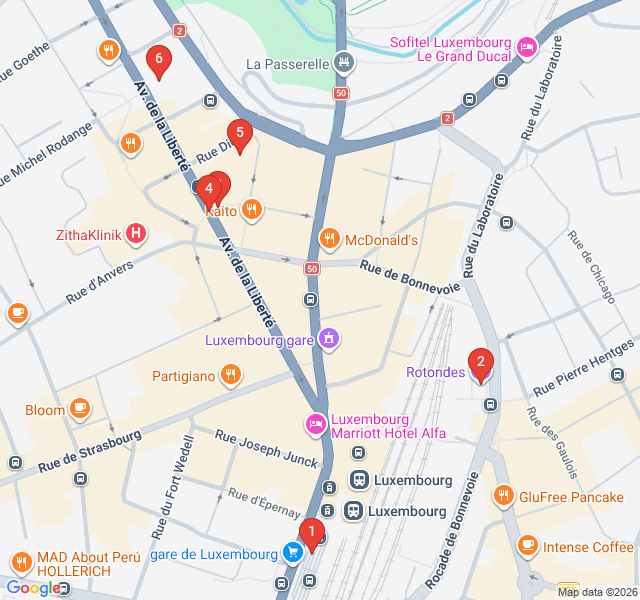
Numbers indicate the order of stops on the tour.
Welcome to the starting point of your exploration. Opened in 1912, this station replaced an earlier wooden structure. The architects chose a Neo-Baroque style to create a grand first impression for travelers. Look up at the clock tower, which mimics the style of traditional Luxembourgish church towers, and notice the intricate stone carvings on the facade. Inside the main hall, the stained-glass windows depict the city's skyline and industrial motifs. This building was more than just a transit hub; it was a statement of national pride during a period of rapid economic growth. As you begin this self-guided walk, imagine the thousands of commuters and travelers who have passed through these arches over the last century.
Just a short walk from the platforms, you will find these two circular buildings known as the Rotondes. Built in 1877 and 1904, these were originally locomotive sheds used for the maintenance and storage of steam engines. After the railway transitioned away from steam, these industrial giants fell into disrepair. However, they were saved and repurposed as a vibrant cultural center. Notice the contrast between the heavy industrial brickwork and the modern glass and metal interventions. Today, they host concerts, exhibitions, and community events, standing as a testament to Luxembourg's ability to blend its industrial heritage with contemporary creativity.
As you move into the heart of the district, you arrive at Place de Paris. This square was designed to evoke the grand plazas of the French capital, reflecting the cultural influence of France on Luxembourgish urban planning. The surrounding buildings showcase a mix of late 19th-century eclecticism and early 20th-century Art Deco. Observe the rounded corners of the buildings and the decorative iron balconies. This square underwent a major renovation recently to prioritize pedestrians and the modern tram system, making it a perfect spot to observe the daily rhythm of the city. It serves as the gateway between the station area and the grand boulevards ahead.
Stretching out before you is the Avenue de la Liberté, a boulevard that rivals the Champs-Élysées in its architectural harmony. This street was the centerpiece of the 'New Town' development. As you walk down the avenue, notice the 'Plateau Bourbon' style—grand, multi-story buildings with Mansard roofs and ornate stone carvings. Many of these structures were built by wealthy industrialists and banking institutions. The avenue has transitioned through several names, reflecting Luxembourg's turbulent 20th-century history, finally being named 'Liberty Avenue' after the liberation of the city in 1944. It remains the prestigious backbone of the Gare district.
Tucked just off the main avenue is the Église du Sacré-Coeur. Built between 1930 and 1932, it was designed to serve the rapidly growing population of the Railway District. The architecture is a fascinating example of Neo-Romanesque style with Art Deco influences. Unlike the gothic spires found in the old town, this church features cleaner lines and a more massive, block-like structure. The interior is known for its serene atmosphere and beautiful mosaics. It represents the spiritual heart of a neighborhood that was, at the time of its construction, the most modern and cosmopolitan part of Luxembourg.
Your walk concludes at one of the most impressive landmarks in the city: the ARBED building. This palace-like structure was the headquarters of Luxembourg's steel giant, ARBED (now part of ArcelorMittal). Completed in 1922, it was designed to show the world that Luxembourg was a global leader in steel production. The Neo-Renaissance facade is adorned with sculptures symbolizing mining and industry. Its position at the end of the Avenue de la Liberté, facing the Adolphe Bridge, makes it a symbolic link between the industrial Gare district and the administrative center of the Upper City. It stands as a monument to the 'Golden Age' of Luxembourgish industry.
Start Free on iPhone
Explore “The Railway District: Art Deco and Revival” with your very own Private Tour Guide with Zigway. Start free on iPhone, skip the large group and the fixed routes, and hear the city come alive as you go.
Your Private Tour Guide
Don't miss the good stuff
Explore Freely
 Easy
EasyLuxembourg City, Luxembourg
Explore the vibrant transformation of Luxembourg's brewery district into a nightlife hub on this scenic self-guided audio walk through Clausen.
 Moderate
Luxembourg City, Luxembourg
Discover the legends of Melusina and the echoes of Victor Hugo on this independent literary and historical stroll through Luxembourg's Ville Haute.
 Challenging
Luxembourg City, Luxembourg
Explore Luxembourg City's lush ravines. Discover dramatic bridges, hidden chapels, and peaceful gardens on this self-guided nature escape.
 Moderate
Luxembourg City, Luxembourg
Uncover the military secrets of Luxembourg City on this self-guided audio walk through historic forts, hidden tunnels, and cliffside ramparts.
 Easy
EasyHelsinki, Finland
Discover Helsinki's oldest neighborhood on this self-guided audio walk through Kruununhaka’s historic streets, hidden courtyards, and scenic shores.
 Easy
EasyGothenburg, Sweden
Explore Gothenburg's maritime soul on this self-guided walk from historic shipyards to sleek modern piers and iconic industrial landmarks.
 Easy
EasyKrakow, Poland
Explore the prestigious Jagiellonian University district, featuring Neo-Gothic architecture, Baroque churches, and Krakow's hidden scholarly gems.
 Easy
EasyKrakow, Poland
Discover Krakow’s creative soul in Zabłocie, exploring industrial heritage, contemporary art museums, and avant-garde architecture at your own pace.