Self-guided audio tour in Charleston
Start Free on iPhone
Start free on iPhone to unlock this self-guided walking tour in Charleston. Hear all the stories that make it amazing, walk at your own pace, and begin whenever you want.
Your Private Tour Guide
Charleston's skyline is famously defined not by skyscrapers, but by the elegant spires of its many churches. This self-guided walking route invites you to explore the heart of the Holy City, a nickname earned by its long-standing tradition of religious tolerance and architectural grandeur. As you wander through the Mazyck-Wraggborough neighborhood and the historic district, you will encounter some of the oldest and most significant houses of worship in the United States. This independent audio walk allows you to step back in time and witness the intersection of faith, struggle, and artistry that shaped the Lowcountry. The journey begins at Marion Square, where the towering spire of Citadel Square Baptist Church sets the stage for a narrative that spans centuries. You will visit Mother Emanuel AME Church, a beacon of civil rights and resilience that stands as a testament to the enduring spirit of Charleston’s African American community. The route continues past the Greek Revival beauty of Second Presbyterian and into the spiritual heritage of the Jewish community at Kahal Kadosh Beth Elohim, the birthplace of Reform Judaism in America. Each stop on this self-guided adventure offers a unique perspective on the city’s complex history. You will see the first Catholic church in the region and conclude in the hauntingly beautiful, overgrown cemetery of the Unitarian Church, where nature and memory intertwine. Whether you are an architecture enthusiast or a history buff, this walking route provides the freedom to explore at your own pace. This neighborhood stroll is more than just a sightseeing trip; it is an immersive experience into the soul of Charleston. By following this path, you will understand how these diverse congregations built the foundations of the city’s identity. The Sacred Spires walk is the perfect way to spend a morning or afternoon, offering a peaceful yet profound look at the spiritual landscape of one of America’s most historic cities.
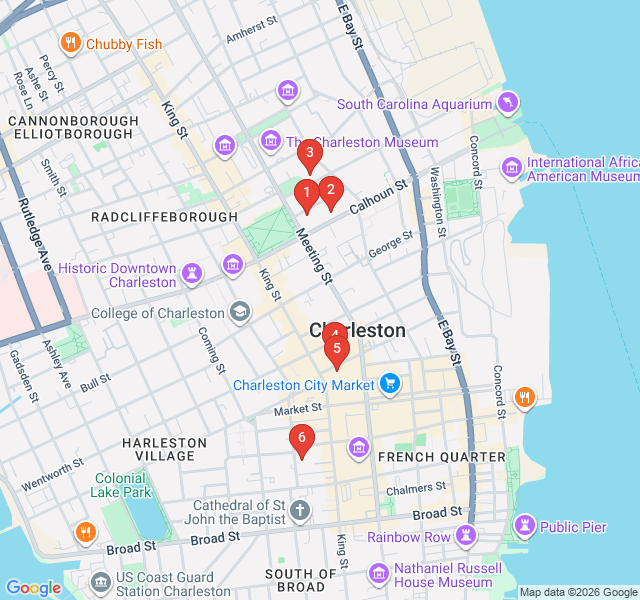
Numbers indicate the order of stops on the tour.
Welcome to the start of your self-guided walk. Standing before you is Citadel Square Baptist Church, often called the 'Cathedral of Southern Baptists.' Established in 1854, this building is a masterpiece of Norman Romanesque architecture. Notice the towering spire that pierces the Charleston skyline; it was once one of the tallest points in the city. The church was built during a period of great expansion for the Baptist denomination in the South. Over the decades, it has survived earthquakes, hurricanes, and the Civil War. While the exterior is imposing with its heavy stone and rounded arches, the interior is known for its incredible acoustics and grand pipe organ. This church serves as a perfect introduction to the architectural diversity you will encounter today.
Just a short walk away stands Mother Emanuel African Methodist Episcopal Church, one of the most significant historic sites in the United States. Founded in 1816, this is the oldest AME church in the South. Its history is one of incredible resilience. The congregation was born out of a protest against racial discrimination and was even forced underground for years when all-black churches were banned in Charleston. The current Gothic Revival building, completed in 1891, stands as a monument to faith and the fight for civil rights. It remains an active center for social justice and community gathering. As you stand here, reflect on the generations of Charlestonians who found strength and sanctuary within these walls.
Continuing north, you will reach Second Presbyterian Church, often referred to as 'Old Flinn’s Church' after its first pastor. Dedicated in 1811, this is the fourth-oldest church building in Charleston. The architectural style is a beautiful example of the Greek Revival influence that swept through the city in the early 19th century. Look up at the massive steeple; it was actually a later addition, completed years after the main sanctuary. The churchyard here is one of the most serene spots in the neighborhood, filled with historic markers that tell the stories of early Scottish and Scots-Irish immigrants who helped build Charleston's mercantile wealth and spiritual foundations.
As you move toward the historic center, you encounter Kahal Kadosh Beth Elohim, or KKBE. Founded in 1749, this is the fourth-oldest Jewish congregation in the United States. The current building, completed in 1840, is considered one of the finest examples of Greek Revival architecture in the country, designed to look like a classic Greek temple. More importantly, KKBE is known as the birthplace of Reform Judaism in America. In 1824, members of this congregation petitioned for changes to the traditional liturgy, leading to a new movement that would transform Jewish practice nationwide. The iron fence surrounding the property features stylized palmettos and dates back to the mid-19th century.
Tucked away on Hasell Street is St. Mary of the Annunciation, the mother church of Roman Catholicism in the Carolinas and Georgia. The parish was established in 1789, a time when Catholic worship was finally permitted in the newly independent United States. The current building, built in 1839, features a stunning Neoclassical facade. If you look closely at the graveyard surrounding the church, you will find headstones written in French, English, and Irish, reflecting the diverse origins of Charleston's early Catholic community, including many who fled the revolution in Saint-Domingue. Inside, the church is famous for its beautiful ceiling paintings and historic altar, representing a quiet pocket of European-style grandeur in the Lowcountry.
Your self-guided adventure concludes at the Unitarian Church Cemetery, perhaps the most atmospheric spot in all of Charleston. Unlike the manicured lawns of other churchyards, the Unitarian Cemetery is intentionally kept in a state of 'managed wilderness.' This creates a romantic, overgrown landscape where vines and wildflowers weave through crumbling 18th-century tombstones. It is widely believed that this hauntingly beautiful garden served as the inspiration for Edgar Allan Poe’s famous poem, 'Annabel Lee,' written while he was stationed at nearby Fort Moultrie. The church itself, with its fan-vaulted ceiling, is a Gothic Revival gem, but it is this lush, silent graveyard that captures the heart of visitors. Take a moment to wander the narrow paths and soak in the quiet beauty.
Start Free on iPhone
Explore “Sacred Spires: A Spiritual Heritage Walk” with your very own Private Tour Guide with Zigway. Start free on iPhone, skip the large group and the fixed routes, and hear the city come alive as you go.
Your Private Tour Guide
Don't miss the good stuff
Explore Freely
 Easy
EasyCharleston, United States
Explore the elegant streets of Harleston Village on this self-guided stroll through Charleston's most historic residential enclave.
 Easy
EasyCharleston, United States
Explore the neon lights and culinary gems of Upper King. Discover Charleston's modern nightlife and cultural evolution on this self-guided stroll.
 Easy
EasyCharleston, United States
Discover Charleston’s rich literary history on this self-guided walk past historic libraries, authors' homes, and iconic bookstores.
 Moderate
Charleston, United States
Discover the profound Gullah-Geechee influence and African American history of Charleston on this moving and educational self-guided walking route.
 Easy
EasySalzburg, Austria
Discover the 'Rome of the North' on this self-guided walk through the Baroque squares and monumental legacy of Salzburg’s Prince-Archbishops.
 Easy
EasyKrakow, Poland
Explore the historic heart of Kazimierz on this self-guided walk through synagogues, ancient cemeteries, and vibrant squares.
 Easy
EasyWarsaw, Poland
Explore the miracle of Warsaw's reconstructed Old Town on this self-guided walk through royal squares, medieval walls, and heroic monuments.
 Easy
EasyGothenburg, Sweden
Discover Gothenburg’s 17th-century Dutch foundations, historic canals, and military fortifications on this self-guided architectural walk.
 Easy
EasyNashville, United States
Explore the 'Athens of the South' on this self-guided walk through Centennial Park, featuring the world's only full-scale Parthenon replica.
 Easy
EasyNashville, United States
Explore Nashville's academic heart and Art Deco gems on this self-guided walk through historic Hillsboro Village.
 Easy
EasyNashville, United States
Explore the heart of Nashville's music industry. Discover iconic studios and the history of the legendary Nashville Sound at your own pace.
 Easy
EasyNashville, United States
Explore Nashville's oldest neighborhood! Discover Victorian architecture, Civil War history, and world-class craft beer on this self-guided walk.