Self-guided audio tour in Washington DC
Start Free on iPhone
Start free on iPhone to unlock this self-guided walking tour in Washington DC. Hear all the stories that make it amazing, walk at your own pace, and begin whenever you want.
Your Private Tour Guide
Standing amidst the grand monuments of the National Mall, one cannot help but feel the weight of history and the deliberate design of power. This walking route explores the architectural evolution of American democracy, transitioning from the sharp, modernist edges of the National Gallery of Art to the timeless Neoclassical majesty of the United States Capitol. While many visitors seek out a traditional guided tour Washington DC offers, this self-guided walk allows you to linger under the intricate murals of the Library of Congress or contemplate the scale of the Ulysses S. Grant Memorial at your own pace. You will discover how the city’s layout was inspired by European grandeur but adapted to express uniquely American ideals. This neighborhood stroll takes you through the heart of the federal city, where every marble column and sandstone turret tells a story of national identity. From the Beaux-Arts splendor of the Thomas Jefferson Building to the iconic red towers of the Smithsonian Castle, this route highlights the diversity of styles that define the capital. Whether you are interested in the engineering marvel of the Capitol dome or the geometric precision of I.M. Pei’s modernism, this experience provides a deep dive into the history and architecture of the United States. This walking tour Washington DC provides is designed for those who want to see beyond the postcards and understand the 'Architecture of Democracy.' You can begin your self-guided adventure at any time, moving through the expansive green spaces that have hosted everything from presidential inaugurations to historic protests. By the time you reach the final stop, you will have a newfound appreciation for how these structures serve as both functional government offices and enduring symbols of a nation’s aspirations.
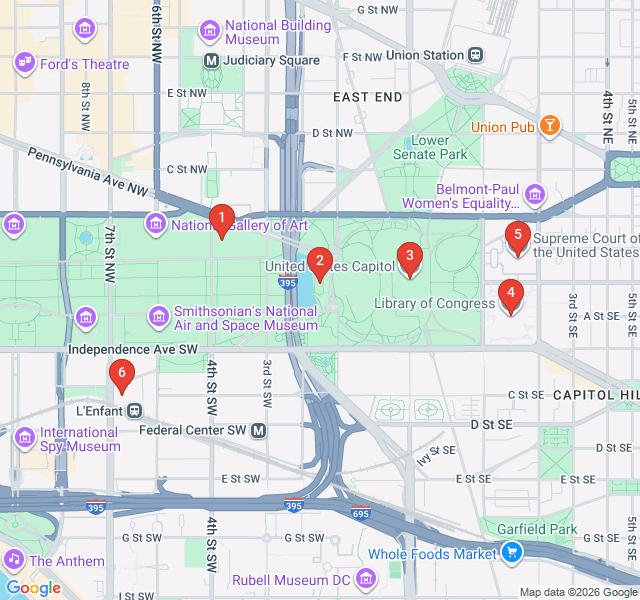
Numbers indicate the order of stops on the tour.
Begin your exploration at the East Building of the National Gallery of Art, a masterpiece of modern architecture designed by I.M. Pei. Opened in 1978, this building is famous for its sharp angles and use of Tennessee pink marble, the same stone used in the older West Building. Notice how the structure is composed of two triangles—one for gallery space and one for administrative offices. This design was a creative solution to the oddly shaped trapezoidal plot of land. The building serves as a bridge between the traditional Neoclassical styles found elsewhere on the Mall and the forward-looking spirit of modern art. It represents a moment in American history when the capital embraced bold, contemporary aesthetics to house its growing national art collection.
As you walk toward the Capitol, you will encounter the Ulysses S. Grant Memorial, one of the largest and most complex equestrian monuments in the world. Dedicated in 1922, this massive bronze sculpture honors the General of the Army who led the Union to victory in the Civil War. Take a moment to look at the flanking sculpture groups: the Cavalry and the Artillery. Unlike many static monuments, these groups capture the chaotic energy and brutal reality of combat. The memorial is strategically placed to face the Lincoln Memorial at the other end of the Mall, symbolically linking the two men who preserved the Union. It serves as a powerful reminder of the human cost required to maintain the democracy represented by the building just ahead.
Standing before you is the United States Capitol, the legislative heart of the nation. Its architectural history is as complex as the country itself, having been burned by the British in 1814 and expanded multiple times. The iconic cast-iron dome, completed during the Civil War, stands as a symbol of resilience. If you look closely at the top, you can see the Statue of Freedom. The building’s Neoclassical style was intended to evoke the democratic ideals of ancient Greece and the republican virtues of ancient Rome. This 'Temple of Liberty' has been the stage for every presidential inauguration since Thomas Jefferson. It remains the focal point of the city's grid system, with all four quadrants of Washington DC radiating from this very spot.
Just across from the Capitol is the Thomas Jefferson Building of the Library of Congress. Completed in 1897, this is widely considered one of the most beautiful interiors in America. Its Beaux-Arts style is a riot of marble, mosaics, murals, and gold leaf, celebrating the 'Greatest Achievements of Western Civilization.' This building was a statement to the world that the United States had moved beyond its frontier roots to become a global center of culture and knowledge. It houses the personal library of Thomas Jefferson, which served as the foundation for the collection after the original library was destroyed in 1814. Today, it is the largest library in the world, holding millions of books, recordings, and historical documents.
Adjacent to the Library of Congress sits the Supreme Court, the 'Temple of Justice.' Interestingly, the Court did not have its own dedicated building until 1935; before then, it met inside the Capitol. Architect Cass Gilbert designed this structure using classic Corinthian columns to convey a sense of permanence and impartiality. The facade is made of bright Vermont marble, and the motto 'Equal Justice Under Law' is carved above the entrance. The heavy bronze doors and the statues representing the 'Contemplation of Justice' and the 'Guardian of Law' reinforce the building's role as the final arbiter of American law. It stands as the third co-equal branch of government, completing the architectural triad of the legislative, executive, and judicial powers.
Conclude your walk at the Smithsonian Institution Building, affectionately known as 'The Castle.' Completed in 1855 using Seneca red sandstone, it stands in stark contrast to the white marble buildings you have seen so far. Designed by James Renwick Jr. in the Gothic Revival style, its towers and battlements were meant to evoke the great universities of Europe. This was the first building of the Smithsonian Institution, established with funds from James Smithson, a British scientist who never actually visited America. Today, the Castle serves as the administrative hub and visitor center for the world’s largest museum complex. It represents the democratic ideal that knowledge should be free and accessible to all citizens, a fitting end to our architectural journey.
Start Free on iPhone
Explore “Architecture of Democracy: The National Mall Route” with your very own Private Tour Guide with Zigway. Start free on iPhone, skip the large group and the fixed routes, and hear the city come alive as you go.
Your Private Tour Guide
Don't miss the good stuff
Explore Freely
 Easy
EasyWashington DC, United States
Trace the footsteps of Abraham Lincoln and his conspirators on this self-guided history walk through the heart of Washington D.C.
 Easy
EasyWashington DC, United States
Uncover the secrets of DC’s most infamous political scandals on this self-guided walk from the historic Octagon to the iconic Watergate Hotel.
 Moderate
Washington DC, United States
Explore Georgetown’s secret alleys, Kennedy family haunts, and cinematic landmarks on this self-guided walk through DC’s historic core.
 Easy
EasyWashington DC, United States
Uncover the scandals and secrets of Lafayette Square on this self-guided audio walk through the historic heart of Washington DC.
 Easy
EasyNairobi, Kenya
Discover Nairobi's iconic skyline on this self-guided architecture walk through the CBD’s most famous modernist and Brutalist landmarks.
 Easy
EasyGdansk, Poland
Discover the opulent Royal Way of Gdansk at your own pace. Explore Hanseatic history, gilded architecture, and the iconic Neptune's Fountain.
 Easy
EasyGothenburg, Sweden
Explore Gothenburg's elegant academic district, featuring grand 19th-century stone architecture and the iconic cultural hub of Götaplatsen.
 Easy
EasyNairobi, Kenya
Explore Nairobi's architectural evolution from colonial-era landmarks to iconic Brutalist skyscrapers on this historic self-guided walking route.
 Easy
EasyNashville, United States
Explore the 'Athens of the South' on this self-guided walk through Centennial Park, featuring the world's only full-scale Parthenon replica.
 Easy
EasyNashville, United States
Explore Nashville's academic heart and Art Deco gems on this self-guided walk through historic Hillsboro Village.
 Easy
EasyNashville, United States
Explore the heart of Nashville's music industry. Discover iconic studios and the history of the legendary Nashville Sound at your own pace.
 Easy
EasyNashville, United States
Explore Nashville's oldest neighborhood! Discover Victorian architecture, Civil War history, and world-class craft beer on this self-guided walk.