Self-guided audio tour in Shanghai
Start Free on iPhone
Start free on iPhone to unlock this self-guided walking tour in Shanghai. Hear all the stories that make it amazing, walk at your own pace, and begin whenever you want.
Your Private Tour Guide
Step into a world where science fiction becomes reality. This self-guided walk through Pudong’s Lujiazui district offers a front-row seat to one of the most rapid urban transformations in human history. Just three decades ago, this area was a marshy expanse of warehouses and shipyards. Today, it stands as the 'Wall Street of the East,' boasting a skyline that rivals Manhattan and Dubai. This neighborhood stroll invites you to weave through a forest of steel and glass, where skyscrapers don't just reach for the clouds—they pierce them. As you follow this walking route, you will encounter the 'Big Three' supertall structures that define the Shanghai skyline: the Jin Mao Tower, the Shanghai World Financial Center, and the record-breaking Shanghai Tower. Each building tells a story of architectural ambition and cultural symbolism, blending ancient Chinese motifs with cutting-edge engineering. Beyond the heights, the route takes you through the serene Lujiazui Central Greenland and concludes along the Binjiang Avenue promenade, offering breathtaking views of the historic Bund across the Huangpu River. Whether you are an architecture enthusiast or a first-time visitor, this exploration of Pudong’s vertical jungle provides a unique perspective on modern China's economic rise. This walking tour Shanghai provides the flexibility to explore at your own pace, allowing you to linger at observation decks or enjoy a coffee while gazing up at these giants. Discover the engineering marvels that have turned Shanghai into a global metropolis on this immersive audio walk. While many visitors opt for a traditional guided tour Shanghai, this self-guided format allows you to bypass the crowds and focus on the details that fascinate you most. From the futuristic spheres of the Oriental Pearl Tower to the sustainable 'double-skin' facade of the Shanghai Tower, prepare to be dwarfed by the sheer scale of the 21st century.
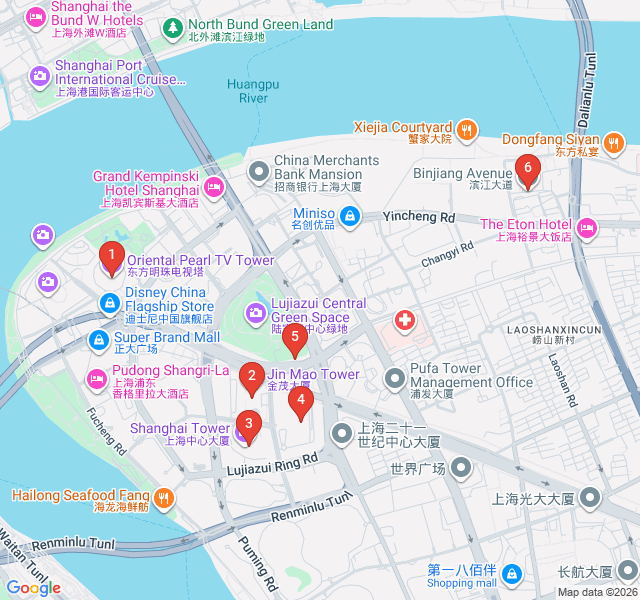
Numbers indicate the order of stops on the tour.
Standing 468 meters tall, the Oriental Pearl TV Tower was the first true icon of modern Pudong. Completed in 1994, its design is inspired by a verse from the Tang Dynasty poem 'Pipa Song,' describing the sound of pearls falling onto a jade plate. The tower features 11 spheres of varying sizes, linked by three massive columns. While it served as a functional broadcasting hub, it quickly became a symbol of Shanghai’s rebirth. Look closely at the base; the structure rests on a grassy plaza representing the jade plate. Its futuristic, space-age aesthetic was a bold statement of intent for a city ready to reclaim its status as a global financial powerhouse.
The Jin Mao Tower represents a perfect marriage between traditional Chinese aesthetics and modern engineering. Its tiered structure evokes the form of a classic Chinese pagoda, but its materials are strictly 21st-century. The number eight, considered lucky in Chinese culture, is woven into every aspect of its design: it has 88 floors, and its octagonal core is surrounded by eight exterior composite columns. When it opened in 1999, it was the tallest building in China. Inside, a staggering 33-story atrium starts from the 56th floor, creating a 'tunnel of light' that remains one of the most photographed interior spaces in the city.
The crowning jewel of the skyline is the Shanghai Tower, the second-tallest building in the world upon its completion. Rising 632 meters, its distinctive twisting shape isn't just for show; the 120-degree rotation reduces wind loads by 24%, saving millions in construction materials. This building is a marvel of sustainability, featuring a 'double-skin' glass facade that acts like a thermos, regulating temperature and reducing energy consumption. It is essentially a vertical city, divided into nine zones with sky lobbies, gardens, and shops. Its presence completes the 'Big Three' trio, symbolizing China’s transition into a high-tech, eco-conscious future.
Often referred to as the 'Bottle Opener' due to the large trapezoidal aperture at its peak, the Shanghai World Financial Center (SWFC) was built to be a hub of global commerce. Originally, the opening was designed to be circular, but it was changed to a trapezoid to avoid controversy regarding its resemblance to a specific national flag. This 492-meter giant was designed by Kohn Pedersen Fox and remains a masterpiece of structural minimalism. The aperture at the top serves a vital function: it reduces the pressure of wind gusts on the building, allowing for a lighter structural frame. It stands as a sharp, diagonal contrast to the ornate Jin Mao next door.
Amidst the concrete and steel of the financial district lies the Lujiazui Central Greenland, the largest open green space in the heart of Pudong. Spanning 100,000 square meters, this park was designed in the shape of a white magnolia, the official flower of Shanghai. It serves as the 'green lung' for the thousands of office workers in the surrounding towers. From the central lake, you get a unique 'worm's-eye view' of the skyscrapers, providing a sense of scale that is hard to grasp from the sidewalk. It is a peaceful sanctuary where the roar of the city fades into the rustling of willow trees.
Your walk concludes at Binjiang Avenue, a 2.5-kilometer riverside promenade. This is arguably the best spot in the city to witness the contrast between 'Old' and 'New' Shanghai. Looking across the Huangpu River, you see the Bund, with its colonial-era stone buildings representing the city's 19th-century history. Behind you, the neon-lit giants of Pudong represent the 21st century. The promenade is built on former wharf land and now features gardens, fountains, and open-air cafes. As the sun sets and the lights of the Bund flicker on, reflecting in the river, you are witnessing the pulse of a city that never stops moving.
Start Free on iPhone
Explore “Skyscrapers of the Future: Pudong's Vertical Jungle” with your very own Private Tour Guide with Zigway. Start free on iPhone, skip the large group and the fixed routes, and hear the city come alive as you go.
Your Private Tour Guide
Don't miss the good stuff
Explore Freely
 Moderate
Shanghai, China
Discover the 'Golden Mile' on this self-guided walking route through Shanghai's historic department stores and Art Deco landmarks.
 Easy
EasyShanghai, China
Explore Art Deco architecture, leafy boulevards, and hidden villas on this self-guided walk through the French Concession.
 Easy
EasyShanghai, China
Explore the intellectual heart of 1930s Shanghai on this self-guided stroll through Hongkou's historic literary landmarks and hidden alleys.
 Easy
EasyShanghai, China
Discover the 'Wall Street of the Orient' on this self-guided walk through Shanghai's legendary waterfront and its Art Deco architectural treasures.
 Easy
EasyGdansk, Poland
Discover the opulent Royal Way of Gdansk at your own pace. Explore Hanseatic history, gilded architecture, and the iconic Neptune's Fountain.
 Moderate
Gothenburg, Sweden
Discover Gothenburg’s maritime soul on this self-guided walk from the historic Central Station to the scenic riverfront at Stenpiren.
 Easy
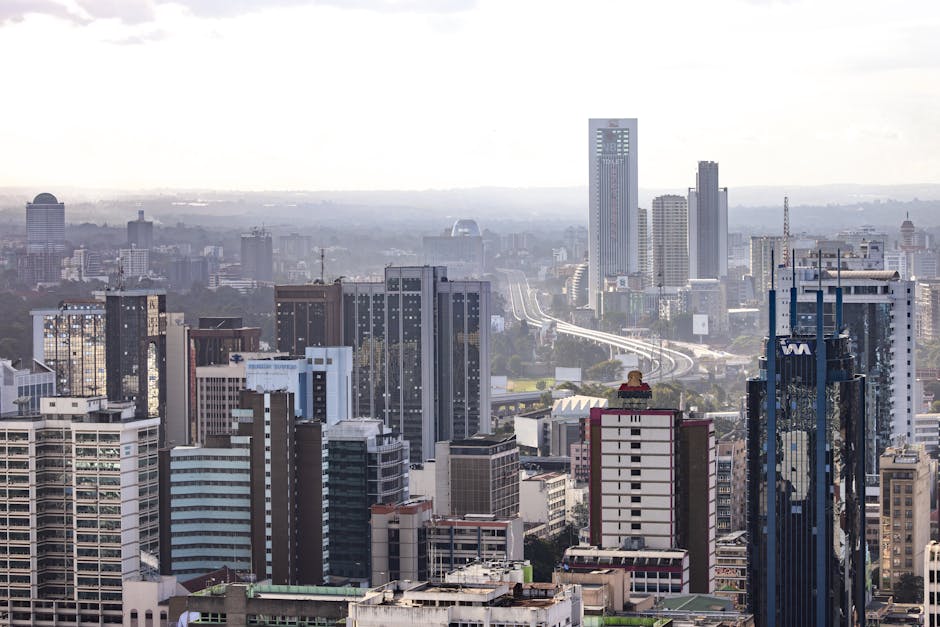
EasyNairobi, Kenya
Discover Nairobi's iconic skyline on this self-guided architecture walk through the CBD’s most famous modernist and Brutalist landmarks.
 Moderate
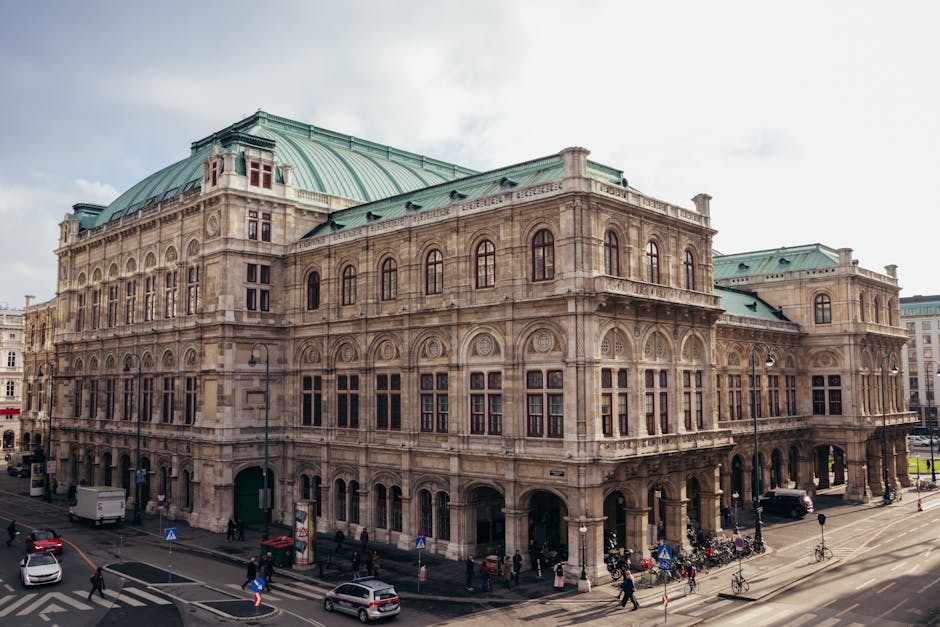
Vienna, Austria
Follow the footsteps of Mozart and Strauss through Vienna’s historic center on this self-guided walk through the city's rich musical history.
 Easy
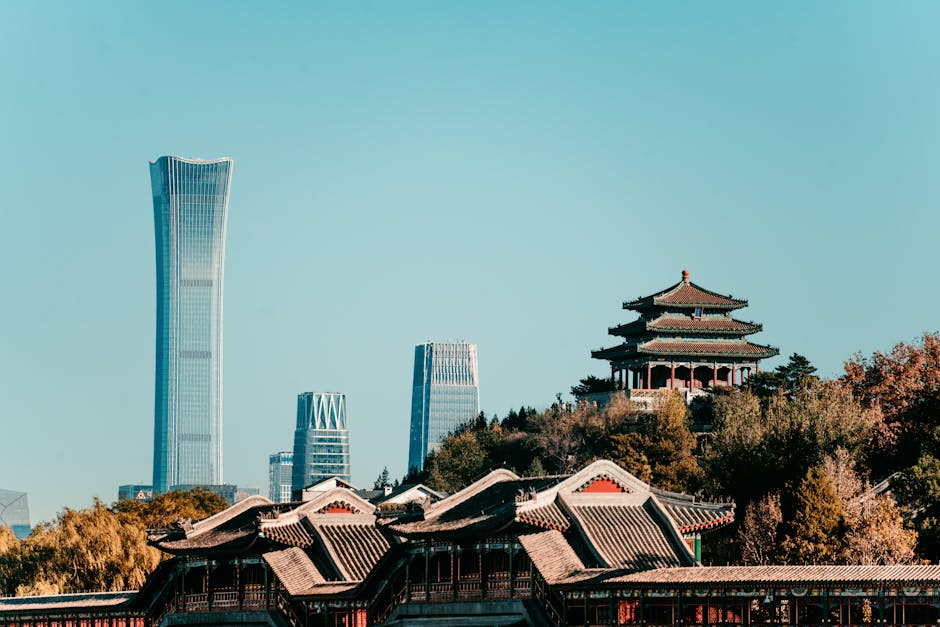
EasyBeijing, China
Explore Beijing's premier art district on this self-guided walk through the industrial-chic 798 Art Zone and the massive tanks of 751 D・PARK.
 Moderate
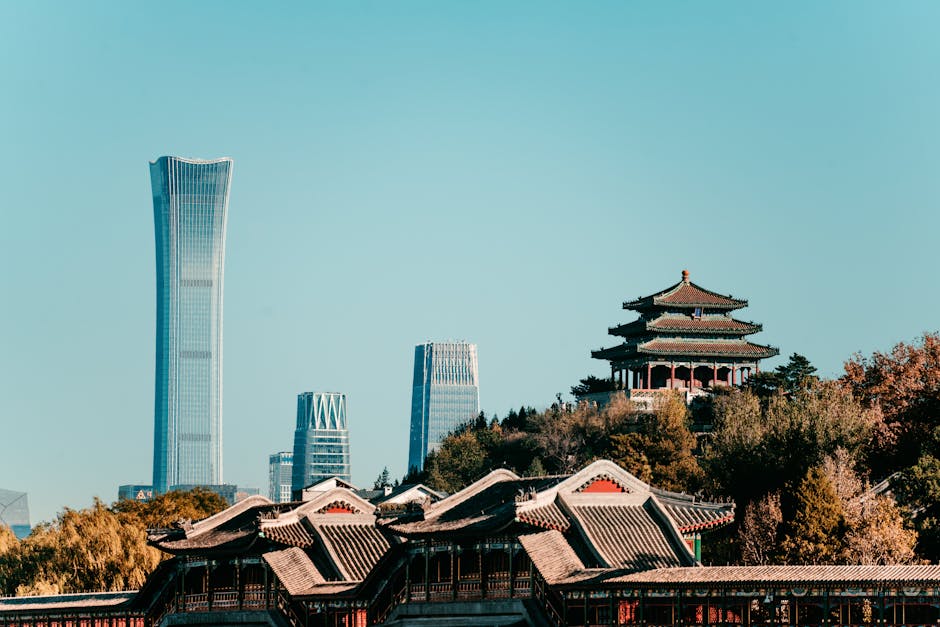
Beijing, China
Explore the majestic red walls, imperial moats, and hilltop vistas of Beijing's Forbidden City on this self-guided architectural walking route.
 Moderate
Beijing, China
Explore the spiritual heart of Beijing on this self-guided walk through the Temple of Heaven's iconic altars, ancient pines, and vibrant park life.
 Easy
EasyBeijing, China
A culinary and cultural self-guided walk through Beijing's historic Dongsi neighborhood, featuring ancient mosques, hutongs, and iconic local eats.