Self-guided audio tour in Valencia
Start Free on iPhone
Start free on iPhone to unlock this self-guided walking tour in Valencia. Hear all the stories that make it amazing, walk at your own pace, and begin whenever you want.
Your Private Tour Guide
Step back into a time when Valencia was shielded by formidable stone walls and grand entryways. This self-guided walking route through the Ciutat Vella (Old Town) focuses on the city's defensive legacy, specifically the two remaining medieval gates that once formed part of a circuit of twelve. For those seeking a walking tour Valencia style, this route offers a deep dive into the city's defensive past, beginning at the edge of the old city limits. You will explore how the city transformed from a fortified stronghold into a modern Mediterranean capital. The journey begins near the Art Modern Institute, where contemporary art meets the physical remains of the 14th-century Christian wall. From there, you will navigate the narrow, atmospheric streets of the El Carmen neighborhood to find the Portal de Valldigna, an open archway that once separated the Christian and Moorish quarters. The highlight for many is the Torres de Serranos, widely considered one of the finest examples of Gothic military architecture in Europe. Unlike a standard walking tour Valencia visitors might find elsewhere, this self-guided stroll allows you to linger at the cannonball scars of the Quart Towers, which still bear the marks of the Napoleonic siege of 1808. The route concludes with a transition from stone to greenery as you reach the historic Botanical Garden. While some might look for a guided tour Valencia, exploring independently via this audio walk provides a more intimate connection to the stone walls and the stories they hold. Whether you are a fan of medieval history or simply enjoy the architectural contrast of ancient gates against modern life, this route reveals the skeletal remains of a Valencia that once was, providing context to the vibrant city you see today.
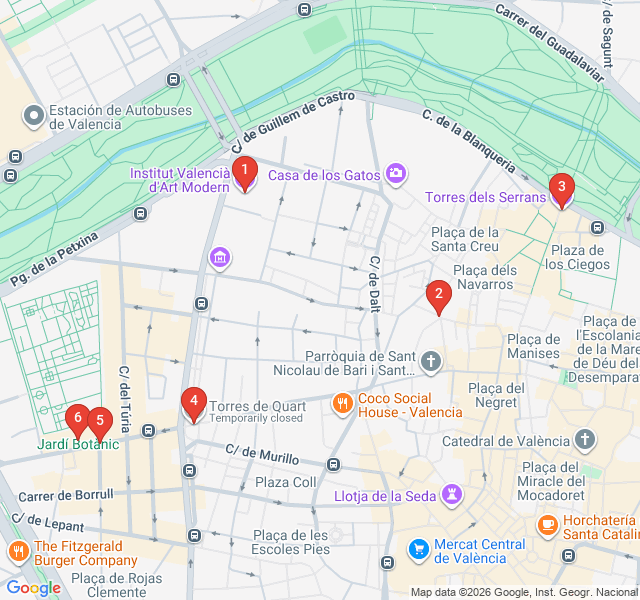
Numbers indicate the order of stops on the tour.
Start your exploration at the IVAM, a hub of contemporary art that holds a secret from the past. Inside the museum's basement, you can see a well-preserved stretch of the medieval Christian wall, which was built in the 14th century to protect the city during the War of the Two Peters. This wall originally spanned four kilometers and featured twelve gates. As you stand here, imagine the massive scale of the fortifications that once encircled the entire Ciutat Vella. The museum itself serves as a bridge between Valencia’s avant-garde present and its fortified history, providing the perfect context for a journey through the city's architectural evolution.
Tucked away in the labyrinthine streets of El Carmen, the Portal de Valldigna is a gateway that tells a story of social and religious division. Built in 1440, this archway was not a military gate but a passage that separated the Christian city from the 'Morería' or Moorish quarter. After the Christian reconquest, the remaining Muslim population was relocated to this specific area. The portal is named after the Cistercian Abbey of Valldigna. Look up to see the decorative tilework representing the Virgin, a 16th-century addition. It remains one of the most evocative spots in the old town, symbolizing the complex layers of Valencia's medieval society.
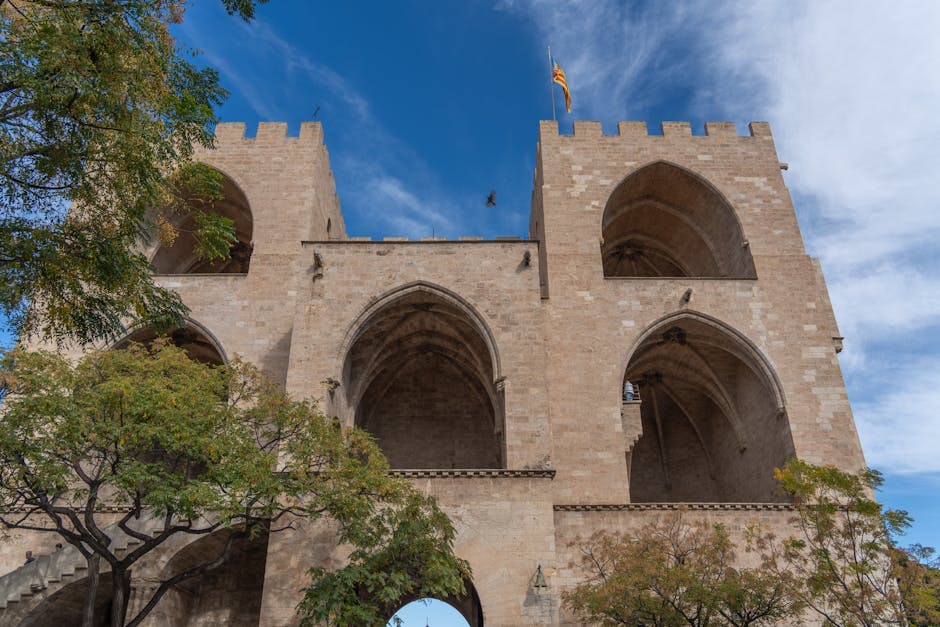
You are now standing before the Torres de Serranos, the grandest of Valencia's surviving gates. Constructed between 1392 and 1398 by architect Pere Balaguer, these towers were designed to impress as much as to defend. This was the main entrance for travelers arriving from the north. Its Valencian Gothic style is characterized by the massive polygonal towers and intricate stonework. Interestingly, the towers survived the demolition of the city walls in 1865 because they were being used as a prison at the time. During the Spanish Civil War, they served a different purpose: protecting precious artworks from the Prado Museum from aerial bombardment. Take a moment to admire the sheer scale of the masonry.
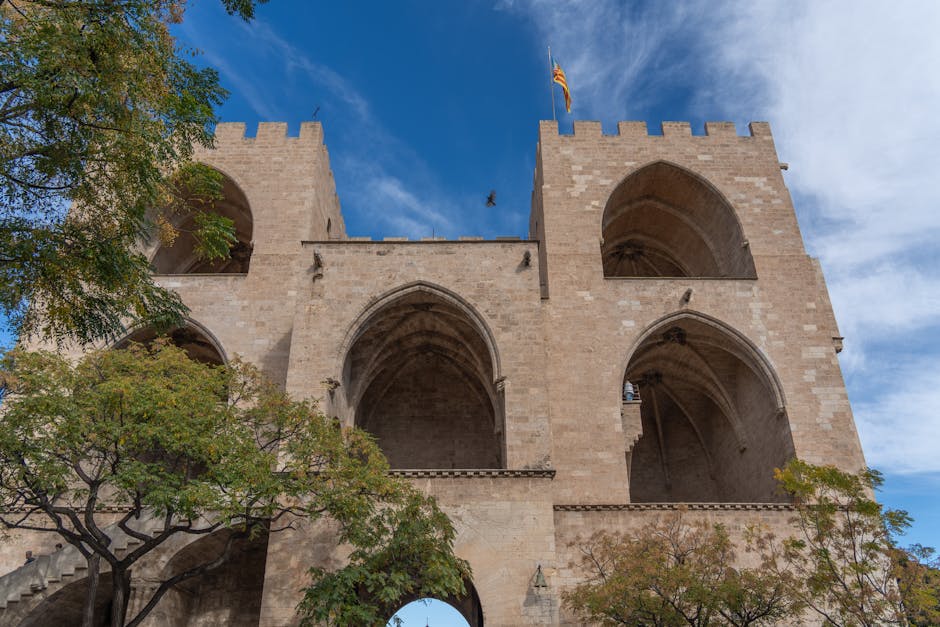
If the Serranos Towers were built for prestige, the Torres de Quart were built for war. Completed in the mid-15th century, these towers were inspired by the Castel Nuovo in Naples. If you look closely at the exterior stone, you will see deep indentations and craters. These are not the result of erosion, but actual cannonball impacts from the French siege during the Peninsular War in 1808. The towers stood firm against Napoleon's troops, becoming a symbol of Valencian resistance. Like their counterparts at Serranos, these towers also served as a women's prison for a period, which contributed to their preservation when the surrounding walls were leveled.
As you walk along Carrer de Quart, you are following an ancient path. This street follows the alignment of the decumanus maximus, one of the main roads of the original Roman city of Valentia Edetanorum. During the medieval period, this was a bustling artery filled with workshops and residences. The street connects the city's heart to the western gate, and the architecture here offers a mix of 18th and 19th-century facades built over much older foundations. It is a perfect place to observe the daily life of the Ciutat Vella, where the historic weight of the city meets the modern energy of local shops and cafes.
Your journey through Valencia's historic defenses ends in a place of tranquility. The University of Valencia's Botanical Garden was established in 1567 for the study of medicinal plants, making it one of the oldest in Spain. It moved to this current location, known as 'Tramoyeres,' in 1802. After the intensity of the stone towers and military history, this garden offers a lush contrast with its collection of palms, cacti, and historic greenhouses. It represents the city's shift from a fortified enclave to an enlightened center of science and nature. It is the perfect spot to rest and reflect on the many layers of Valencia’s history.
Start Free on iPhone
Explore “The Last Medieval Gates” with your very own Private Tour Guide with Zigway. Start free on iPhone, skip the large group and the fixed routes, and hear the city come alive as you go.
Your Private Tour Guide
Don't miss the good stuff
Explore Freely
 Easy
EasyValencia, Spain
Discover Valencia's 'Sistine Chapel' and ornate Baroque palaces on this self-guided walk through the historic Ciutat Vella.
 Easy
EasyValencia, Spain
Explore Valencia's Roman roots and Gothic masterpieces on this self-guided audio walk through the historic Ciutat Vella district.
 Easy
EasyValencia, Spain
Explore Valencia’s oldest quarter where ancient medieval gates meet world-class street art on this self-guided neighborhood stroll.
 Easy
EasyValencia, Spain
Explore Ruzafa, Valencia's bohemian heart. Discover vibrant markets, street art, and eclectic cafes at your own pace on this self-guided stroll.
 Easy
EasyGothenburg, Sweden
Discover Gothenburg’s 17th-century Dutch foundations, historic canals, and military fortifications on this self-guided architectural walk.
 Moderate
Vienna, Austria
Follow the footsteps of Mozart and Strauss through Vienna’s historic center on this self-guided walk through the city's rich musical history.
 Moderate
Vienna, Austria
Discover the noir world of The Third Man and Cold War Vienna on this atmospheric self-guided audio walk through the historic Innere Stadt.
 Easy
EasyGdansk, Poland
Discover the opulent Royal Way of Gdansk at your own pace. Explore Hanseatic history, gilded architecture, and the iconic Neptune's Fountain.
 Moderate
Barcelona, Spain
Explore the elegant 'village' of Sarrià, where Gothic monasteries and Gaudí's hidden gems meet charming local markets and narrow streets.
 Moderate
Barcelona, Spain
Discover the revolutionary history and haunting scars of the Spanish Civil War on this self-guided walk through Barcelona's historic streets.
 Easy
EasyBarcelona, Spain
Discover the architectural wonders of Barcelona's Golden Square on this self-guided stroll through Eixample's most luxurious Modernista streets.
 Challenging
Barcelona, Spain
Explore Montjuïc’s lush gardens, historic fortress, and iconic Olympic venues on this scenic self-guided walk with panoramic Mediterranean views.