Self-guided audio tour in San Antonio
Start Free on iPhone
Start free on iPhone to unlock this self-guided walking tour in San Antonio. Hear all the stories that make it amazing, walk at your own pace, and begin whenever you want.
Your Private Tour Guide
San Antonio is a city where the echoes of the past harmonize with a vibrant, modern pulse. This neighborhood stroll takes you through the heart of its transformation, focusing on the Pearl District—a place where 19th-century industrial grit has been polished into a world-class culinary and architectural destination. Your journey begins in the bustling downtown core, near the historic River Walk, before moving through corridors of education and heritage toward the crown jewel: the former Pearl Brewery complex. What makes this route special is the contrast between the old world and the new. You will see how the city has repurposed its historic structures, such as the stunning Hotel Emma, once the state's largest brewery, now a beacon of luxury and design. Along the way, you'll encounter the flavors that define the region, from the traditional pan dulce of La Panadería to the legendary barbecue at Pinkerton's. This self-guided walk explores the layers of San Antonio’s identity, from the sacred grounds of the Alamo to the bustling stalls of the Bottling Department Food Hall. As you explore independently, you’ll discover the story of Emma Koehler, the powerhouse behind the brewery’s survival during Prohibition, and see how the Culinary Institute of America has turned this district into a global foodie landmark. Whether you are interested in the industrial-heritage of the brew-houses or the lush greenery of the Pearl Amphitheater, this walking route provides a comprehensive look at how San Antonio honors its roots while embracing a creative future. This is not just a walk through a neighborhood; it is a journey through the evolution of a city that refuses to forget its history while constantly reinventing itself. **Note:** This area is known for its ever-changing character. Street art, pop-up venues, and temporary exhibitions may differ from what's described. That's part of the adventure - you might discover something entirely new!
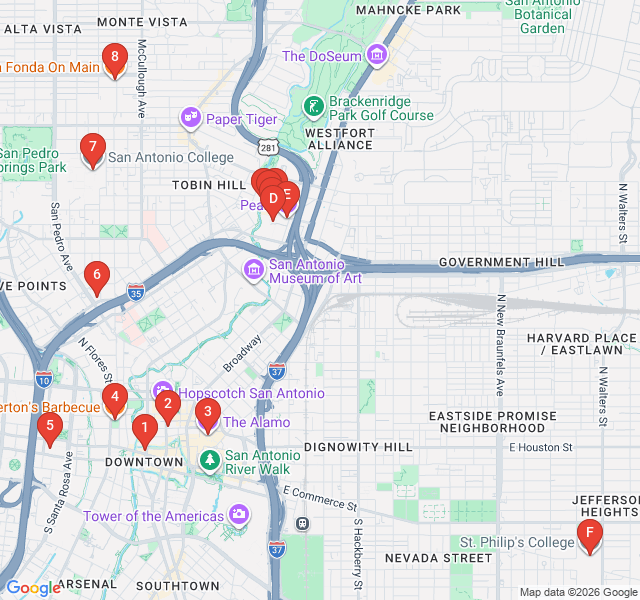
Numbers indicate the order of stops on the tour.
Start your self-guided adventure at Domingo, a spot that perfectly captures the modern spirit of the San Antonio River Walk. Nestled in a historic building that once housed a trade school, this restaurant celebrates the flavors of South Texas. As you look around, notice how the design blends contemporary aesthetics with rugged, historic masonry. It serves as a reminder that San Antonio's history isn't just in museums; it's lived in every day through its food and communal spaces. This area marks the transition from the city's commercial center to its more relaxed, riverside atmosphere.
A short stroll brings you to La Panadería, where the aroma of sourdough and pan dulce fills the air. Founded by brothers José and David Cáceres, this bakery is a tribute to the 'Cultura de Pan' they learned from their mother in Mexico City. Their unique long-fermentation process makes their bread some of the best in the country. This stop highlights the deep-rooted influence of Mexican culinary traditions on San Antonio's identity. It’s a perfect example of how local entrepreneurs are elevating traditional crafts into world-class culinary experiences.
No walking route in San Antonio is complete without passing the Alamo. This former Spanish mission became the site of a pivotal battle in 1836 and remains a symbol of Texas independence. While the chapel is the most famous structure, the entire plaza tells a story of shifting empires—from Spanish friars to Mexican soldiers and Texas revolutionaries. Take a moment to appreciate the limestone walls that have stood for centuries. The Alamo serves as the historical anchor of the city, providing context for the industrial and cultural growth you will see as you head north.
As you move toward the newer developments, you'll encounter Pinkerton's Barbecue. Set in a beautiful urban park, this stop represents the high-end evolution of Texas BBQ. While the tradition of smoking meat is as old as the state itself, Pinkerton’s brings a refined touch to the pitmaster’s craft. The surrounding green space is part of San Antonio's commitment to creating walkable, community-focused areas. It’s a great spot to observe how the city is integrating modern dining with public recreation spaces, making the urban core more livable and vibrant.
Heading slightly west toward Market Square, you find Mi Tierra. Since 1941, this family-owned landmark has been the heart of the city’s Mexican market district. Known for its year-round Christmas lights and elaborate murals, it’s a sensory explosion. The murals here tell the story of the Mexican-American experience in San Antonio, featuring local legends and historic figures. It’s a place that honors the working-class roots of the city and remains a beloved gathering spot for locals and visitors alike, operating 24/7 for decades as a beacon of hospitality.
While it may seem like a simple convenience stop, this location on North Main represents the modern infrastructure that connects the downtown core to the historic residential and educational districts. In a city that is rapidly expanding, these hubs of daily life are essential. As you pass through, consider the scale of San Antonio's growth. From a small mission settlement to the seventh-largest city in the United States, the development of these transit and service corridors has been vital in linking the various cultural pockets you are exploring today.
San Antonio College, or SAC, is one of the oldest public junior colleges in Texas. The campus architecture reflects the city's mid-century expansion and its dedication to accessible education. As you walk near the campus, you are entering the Monte Vista and Tobin Hill areas, neighborhoods known for their diverse architectural styles, from Victorian to Spanish Revival. The college has been a cornerstone of the community since 1925, providing a bridge to higher education for generations of San Antonians and contributing to the intellectual life of the city.
Established in 1932, La Fonda on Main is the oldest Mexican restaurant in San Antonio that has remained in its original location. The building itself, with its charming patio and classic architecture, feels like a step back in time to the 'Old San Antonio.' It has hosted everyone from movie stars to presidents. The restaurant’s longevity is a testament to the city's deep appreciation for its culinary heritage. It serves as a perfect transition point as you move from the historic residential areas toward the industrial transformation of the Pearl District.
You have now arrived at the Pearl District. The Pearl Amphitheater sits right on the edge of the Museum Reach of the River Walk. This outdoor stage hosts everything from jazz festivals to yoga classes. Notice how the steps lead directly down to the water, integrating the river into the social fabric of the neighborhood. This area was once part of the brewery's shipping and receiving operations, but today it is a lush, green space designed for community connection. It’s the perfect place to pause and enjoy the breeze off the river.
This is the architectural centerpiece of the district. Hotel Emma is housed in the 19th-century Brewhouse of the Pearl Brewery. Named after Emma Koehler, who ran the brewery through the Great Depression and Prohibition, the hotel is a masterpiece of 'industrial chic' design. Inside, you can still see the massive ammonia compressors and brass machinery integrated into the lobby and bar. It is a stunning example of adaptive reuse, proving that historic industrial buildings can be transformed into spaces of incredible beauty and luxury without losing their original character.
The presence of the Culinary Institute of America (CIA) here is no accident. When the Pearl was redeveloped, the goal was to create a 'culinary village.' The CIA’s San Antonio campus is one of only three in the United States and focuses specifically on Latin American cuisines. As you walk by, you might see students in their chef whites. The institute has acted as a catalyst for the local food scene, training the next generation of chefs who continue to make San Antonio a UNESCO City of Gastronomy.
Located in the original 1894 brewhouse building, Southerleigh brings brewing back to the Pearl. While the large-scale industrial production ended in 2001, this establishment keeps the tradition alive with its on-site microbrewery. Look up at the intricate brickwork and the towering stack; this was the heart of the Pearl Brewery for over a century. The menu here focuses on coastal Texas cuisine, bridging the gap between the city’s German brewing roots and its proximity to the Gulf of Mexico. It’s a literal taste of the building's history.
This modern building sits on the site of the original brewery's bottling plant, which was destroyed by a fire. Today, it serves as San Antonio's first food hall. It’s a vibrant, communal space where you can find everything from Caribbean flavors to artisanal donuts. The Bottling Department is the social hub of the Pearl, reflecting the modern trend of flexible, diverse dining. It’s a great place to see locals and visitors mixing in a shared space that honors the site’s industrial past through its name and location.
The Pearl itself is more than just a collection of buildings; it is a 22-acre site that serves as a model for urban renewal. Once a derelict industrial site, it is now a bustling neighborhood with a weekly farmers market, independent shops, and residential apartments. As you walk through the central plaza, notice the attention to detail in the landscaping and the preservation of old brewery artifacts. It represents a new era for San Antonio—one that values sustainability, history, and local craftsmanship. It is the definitive end-point for understanding the city's modern transformation.
To conclude the broader context of San Antonio’s heritage, we look toward St. Philip's College. Founded in 1898, it is one of the oldest and most diverse community colleges in the nation and holds a unique dual designation as a Historically Black College and a Hispanic-Serving Institution. While a bit further from the Pearl, its history is deeply intertwined with the city’s commitment to progress and civil rights. It stands as a reminder that San Antonio's strength lies in its diverse communities and the educational institutions that empower them.
Start Free on iPhone
Explore “Brewing History: The Pearl District Transformation” with your very own Private Tour Guide with Zigway. Start free on iPhone, skip the large group and the fixed routes, and hear the city come alive as you go.
Your Private Tour Guide
Don't miss the good stuff
Explore Freely
 Easy
EasySan Antonio, United States
Discover Gilded Age mansions and modern art on this self-guided stroll through San Antonio's historic King William neighborhood.
 Easy
EasySan Antonio, United States
Explore the cradle of Texas liberty on this self-guided walk through San Antonio's historic Alamo Plaza and downtown landmarks.
 Moderate
San Antonio, United States
Explore the soul of San Antonio's Westside through its legendary murals and historic Tejano landmarks on this self-guided walk.
 Moderate
San Antonio, United States
Explore San Antonio’s Spanish colonial legacy and modern landmarks on this comprehensive self-guided audio walk from the Alamo to Mission San José.
 Easy
EasyWarsaw, Poland
Discover the hidden courtyards and grand pre-war architecture of Warsaw's most atmospheric neighborhood on this self-guided stroll.
 Easy
EasyGothenburg, Sweden
Explore Gothenburg’s historic wooden houses, legendary giant cinnamon buns, and panoramic fortress views on this self-guided neighborhood stroll.
 Easy
EasyGothenburg, Sweden
Explore Gothenburg's maritime soul on this self-guided walk from historic shipyards to sleek modern piers and iconic industrial landmarks.
 Easy
EasyGdansk, Poland
Discover the 'Baltic Gold' on this self-guided walk through Gdansk's historic mills, massive cathedrals, and the magical Mariacka Street.
 Easy
EasyNashville, United States
Explore the 'Athens of the South' on this self-guided walk through Centennial Park, featuring the world's only full-scale Parthenon replica.
 Easy
EasyNashville, United States
Explore Nashville's academic heart and Art Deco gems on this self-guided walk through historic Hillsboro Village.
 Easy
EasyNashville, United States
Explore the heart of Nashville's music industry. Discover iconic studios and the history of the legendary Nashville Sound at your own pace.
 Easy
EasyNashville, United States
Explore Nashville's oldest neighborhood! Discover Victorian architecture, Civil War history, and world-class craft beer on this self-guided walk.