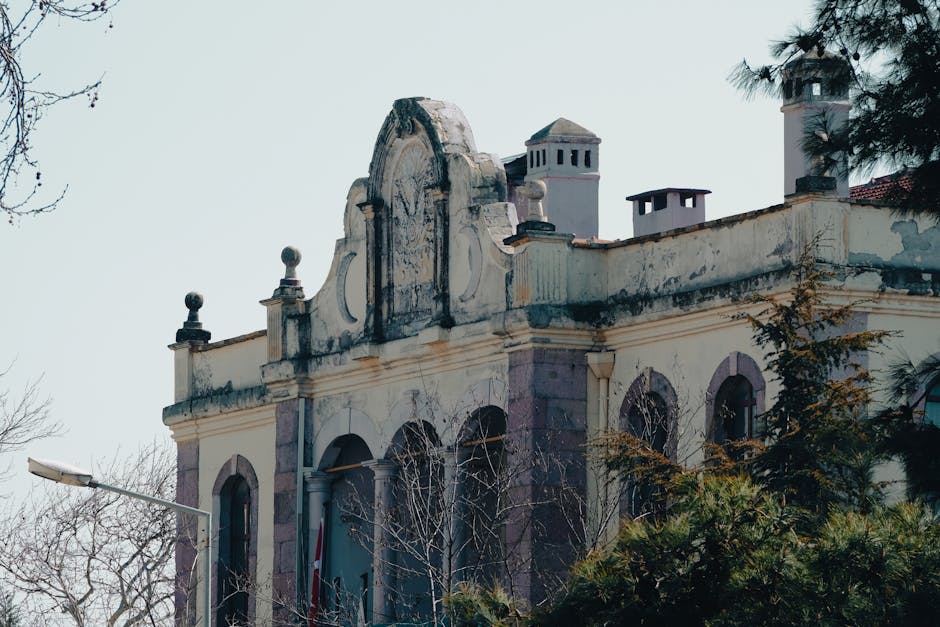
Self-guided audio tour in Paphos
Start Free on iPhone
Start free on iPhone to unlock this self-guided walking tour in Paphos. Hear all the stories that make it amazing, walk at your own pace, and begin whenever you want.
Your Private Tour Guide
While many visitors head straight for the harbor, the true heart of Paphos beats in the streets of Ktima. This self-guided walk invites you to explore the fascinating layers of Paphos Old Town, where neoclassical elegance meets ancient UNESCO World Heritage sites. This walking route bridges the gap between the administrative upper town and the archaeological treasures of the coast, offering a comprehensive look at the city's evolution from a Roman capital to a modern Mediterranean hub. Begin your self-guided adventure in Kennedy Square, the bustling center of Ktima. As you wander through the upper town, you will encounter the grand architecture of the Paphos Town Hall and the Municipal Library, both reflecting a deep-seated appreciation for Hellenic style. The route then leads you down toward the sea, transitioning from the colonial-era charm of Makariou Avenue to the rugged beauty of the Tombs of the Kings. What makes this neighborhood stroll unique is its sheer historical range. You will discover the Agia Solomoni Catacomb, where early Christians worshipped in secret, and stand beside Saint Paul's Pillar, a site steeped in biblical tradition. The journey continues into the Archaeological Site of Nea Paphos, home to some of the most exquisite Roman mosaics in the world. As you reach the harbor, the medieval Paphos Castle stands as a sentinel over the water, while the nearby lighthouse offers panoramic views of the coastline. This walking tour Paphos provides the flexibility to linger at the House of Dionysus or speed up as you head toward the dramatic finale: the shipwreck of the MV Dimitrios II. Whether you are a fan of ancient history or simply enjoy the sea breeze, this walking tour Paphos ensures you see the most iconic landmarks without the constraints of a traditional guided tour Paphos. Explore independently and uncover the stories that define this ancient Cypriot city.
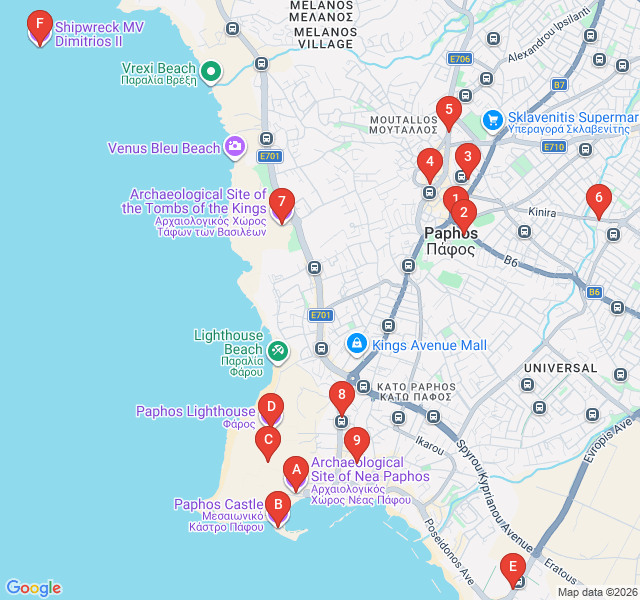
Numbers indicate the order of stops on the tour.
Welcome to Kennedy Square, the vibrant heart of Paphos's upper town, known as Ktima. This central hub has long served as the meeting point for locals and the site of major civic celebrations. As you stand here, notice the blend of modern life and historic surroundings. The square is named after John F. Kennedy, reflecting the international connections of the city during the mid-20th century. This area underwent significant renovation for the Paphos 2017 European Capital of Culture project, creating the pedestrian-friendly space you see today. It is the perfect place to begin your self-guided adventure, surrounded by cafes and administrative buildings that represent the transition from colonial Paphos to a modern European city.
Just a short walk from the square is the Paphos Town Hall, one of the most beautiful examples of neoclassical architecture in Cyprus. Built in 1955, its design is heavily influenced by the Parthenon in Athens, featuring grand columns and a symmetrical facade that projects a sense of civic pride and continuity with Hellenic tradition. The Town Hall is situated within the Public Garden, a peaceful green space that often hosts weddings and local ceremonies. This building symbolizes the administrative heart of the city and serves as a reminder of the architectural movement that sought to connect modern Cyprus with its classical past during the mid-20th century.
The Markideio Theatre is the cultural cornerstone of Paphos. Originally an old warehouse, it was transformed into a modern performance space that hosts everything from classical music concerts to contemporary drama. Its recent renovation has made it an architectural highlight of Ktima, blending industrial heritage with sleek, modern design elements. The theatre is named after Sotirakis Markides, a prominent local figure in the arts. As you look at the building, consider how Paphos has invested in its cultural infrastructure, ensuring that the 'City of Culture' title remains a living reality long after the official celebrations have ended. It represents the creative spirit of the local community.
Standing proudly near the Town Hall is the Paphos Municipal Library, another neoclassical gem. With its distinctive columns and pediment, it looks more like an ancient temple than a repository for books. This style was intentionally chosen to honor the city’s intellectual heritage. The library houses a significant collection of rare books and documents related to Cypriot history. It stands as a testament to the community's dedication to education and the preservation of knowledge. Even if you don't head inside, the exterior offers one of the best photo opportunities in the upper town, capturing the 'learned' atmosphere of the Ktima district.
Makariou Avenue is the primary commercial artery of Ktima. This street has seen Paphos change from a quiet colonial town to a bustling tourist destination. As you walk along this pedestrianized stretch, you'll see a mix of traditional shops, modern boutiques, and charming cafes tucked into historic buildings. The avenue is named after Archbishop Makarios III, the first president of Cyprus. It’s a great place to observe daily life; you might see elderly locals enjoying a traditional Cypriot coffee while younger generations move between the modern shops. The architecture here is a patchwork of styles, reflecting the various eras of Paphos’s urban development over the last century.
The presence of the Cyprus University of Technology (TEPAK) has breathed new life into the old town. By repurposing historic buildings for academic use, the city has created a vibrant student atmosphere in Ktima. This specific campus focus on tourism and hospitality management is fitting for a city that relies so heavily on those industries. The integration of a modern university into the historic fabric of the town helps prevent the 'museumification' of the area, ensuring that these old streets remain lived-in and dynamic. The sight of students moving between lectures adds a youthful energy to the neoclassical surroundings of the administrative district.
Now we move toward the coast to one of the most impressive UNESCO World Heritage sites in Cyprus. Despite the name, no kings were actually buried here; the 'Tombs of the Kings' earned its title from the sheer scale and grandeur of the burial chambers. Dating back to the 4th century BC, these underground tombs were carved directly into the solid rock for high-ranking officials and aristocrats. Many of the tombs feature Doric columns and frescoed walls, mimicking the houses of the living. As you explore this vast necropolis, you are walking through a silent city of the dead that has overlooked the Mediterranean for over two millennia.
Located on the edge of Kato Paphos, the Agia Solomoni Catacomb is a site of deep religious significance. Originally a Hellenistic tomb, it was later used by early Christians as a subterranean chapel. As you descend the steps, you'll feel a noticeable drop in temperature and a shift in atmosphere. Look for the sacred 'wishing tree' at the entrance, adorned with ribbons and pieces of cloth left by the faithful seeking healing or divine intervention. Inside, you can still see remnants of 12th-century frescoes. The site is named after Solomoni, a mother who, according to tradition, took refuge here with her seven sons during a period of persecution.
According to Christian tradition, the Apostle Paul was tied to this very pillar and whipped 39 times before he converted the Roman governor, Sergius Paulus, to Christianity in 45 AD. This event made Cyprus the first province in the Roman Empire to be ruled by a Christian. The pillar is located within the grounds of the Panagia Chrysopolitissa church, which was built over the ruins of a massive 4th-century Byzantine basilica. As you walk along the raised wooden walkways, you can see intricate floor mosaics and the foundations of what was once one of the largest churches on the island. It is a powerful site where biblical history and archaeology intersect.
Nea Paphos was the capital of Cyprus during the Hellenistic and Roman periods. Today, it is a sprawling archaeological park that offers a window into the ancient world. Founded in the late 4th century BC, the city was once surrounded by massive walls. While much of the city remains unexcavated, the parts that have been revealed are breathtaking. This site contains the remains of villas, palaces, a theatre, and an odeon. It is the centerpiece of the UNESCO World Heritage listing for Paphos. Walking through these ruins, you get a sense of the scale and sophistication of a Roman provincial capital that thrived on maritime trade.
Guarding the entrance to the harbor, Paphos Castle has a long and turbulent history. Originally built as a Byzantine fort to protect the port, it was destroyed by an earthquake in 1222, then rebuilt by the Lusignans, dismantled by the Venetians, and finally reconstructed by the Ottomans in the 16th century. Its thick walls and small windows reflect its role as a defensive bastion and later as a prison and salt warehouse. Today, it serves as a dramatic backdrop for cultural festivals. Standing at its base, you can look out over the Mediterranean and imagine the centuries of ships—from Roman galleys to Venetian merchant vessels—that have sought shelter in this harbor.
Located within the Archaeological Park, the House of Dionysus is world-famous for its exceptionally preserved mosaic floors. These mosaics, dating from the 2nd century AD, decorated the floors of a wealthy Roman villa. They primarily depict scenes from Greek mythology, with a particular focus on Dionysus, the god of wine. The level of detail and the vibrancy of the natural stone colors are staggering, considering they are nearly 2,000 years old. These 'stone paintings' are considered among the finest in the Eastern Mediterranean. They offer a rare glimpse into the luxury, artistry, and storytelling that defined the lives of the Roman elite in Paphos.
The Paphos Lighthouse stands on a hill within the archaeological site, a 19th-century addition to an ancient landscape. Built by the British in 1888, it was a vital navigational aid for ships traveling between the Suez Canal and the UK. While much newer than the surrounding Roman ruins, the lighthouse has become an iconic part of the Paphos skyline. From this vantage point, you have the best view in the city: the ancient ruins in the foreground, the medieval castle to the side, and the vast blue expanse of the sea beyond. It serves as a bridge between the ancient maritime power of Paphos and its modern history.
As we move toward the modern eastern edge of the city, we find Neapolis University. This private institution represents the modern academic ambition of Paphos. While the city is rightfully proud of its ancient past, institutions like Neapolis focus on the future, specializing in business, law, and environmental science. The campus architecture is modern and functional, contrasting with the neoclassical and ancient sites you've seen so far. It highlights Paphos's role as a regional educational center, attracting students from across the Mediterranean and beyond, and contributing to the city's diverse and international character.
Our final stop takes us to the rugged coastline to see the MV Dimitrios II. This cargo ship ran aground in March 1998 during a heavy storm while carrying a cargo of timber from Greece to Syria. The crew was rescued, but the ship was deemed a total loss and has remained perched on the rocks ever since. Over the decades, the sea and salt have rusted the hull, creating a hauntingly beautiful silhouette against the sunset. It has become a favorite spot for photographers and a stark reminder of the power of the Mediterranean. This modern 'ruin' provides a dramatic conclusion to a journey that began with ancient stone and ends with rusted steel.
Start Free on iPhone
Explore “Ktima Uncovered: A Walk Through Paphos Old Town” with your very own Private Tour Guide with Zigway. Start free on iPhone, skip the large group and the fixed routes, and hear the city come alive as you go.
Your Private Tour Guide
Don't miss the good stuff
Explore Freely
 Easy
EasyPaphos, Cyprus
Explore Paphos' maritime history on this self-guided walk from ancient tombs and Roman mosaics to the iconic harbor fort and a coastal shipwreck.
 Easy
EasyPaphos, Cyprus
Experience the vibrant pulse of Paphos after dark, from the neon lights of Bar Street to sophisticated harbor-side cocktails on this self-guided walk.
 Easy
EasyPaphos, Cyprus
Experience the stunning Mediterranean coastline, historic lighthouse, and medieval castle on this scenic self-guided audio walk in Kato Paphos.
 Easy
EasyPaphos, Cyprus
Discover UNESCO-listed ruins, Byzantine churches, and Roman mosaics on this self-guided audio walk through the historic heart of Paphos.
 Moderate
Gothenburg, Sweden
Discover Gothenburg’s maritime soul on this self-guided walk from the historic Central Station to the scenic riverfront at Stenpiren.
 Moderate
Vienna, Austria
Follow the footsteps of Mozart and Strauss through Vienna’s historic center on this self-guided walk through the city's rich musical history.
 Moderate
Gdansk, Poland
Discover the origins of WWII in Gdansk on this self-guided walk through heroic last stands, massive museums, and strategic hilltop fortifications.
 Moderate
Warsaw, Poland
A powerful self-guided walk through Warsaw's WWII history, tracking the 1944 Uprising from ruined skyscrapers to solemn memorials.
 Easy
EasyNicosia, Cyprus
Explore Nicosia's culinary heart! A self-guided stroll from historic coffee roasters to modern meze spots across the city's unique divided center.
 Easy
EasyNicosia, Cyprus
Capture the soul of the world's last divided capital on this self-guided walk through Nicosia's historic streets, street art, and panoramic views.
 Easy
EasyNicosia, Cyprus
Explore Nicosia's rich heritage on this self-guided walk through premier museums, Ottoman mansions, and world-class archaeological collections.
 Easy
EasyNicosia, Cyprus
Explore Nicosia’s modern side, from Zaha Hadid’s fluid architecture to vibrant street art and Jean Nouvel's iconic bioclimatic 'White Walls.'