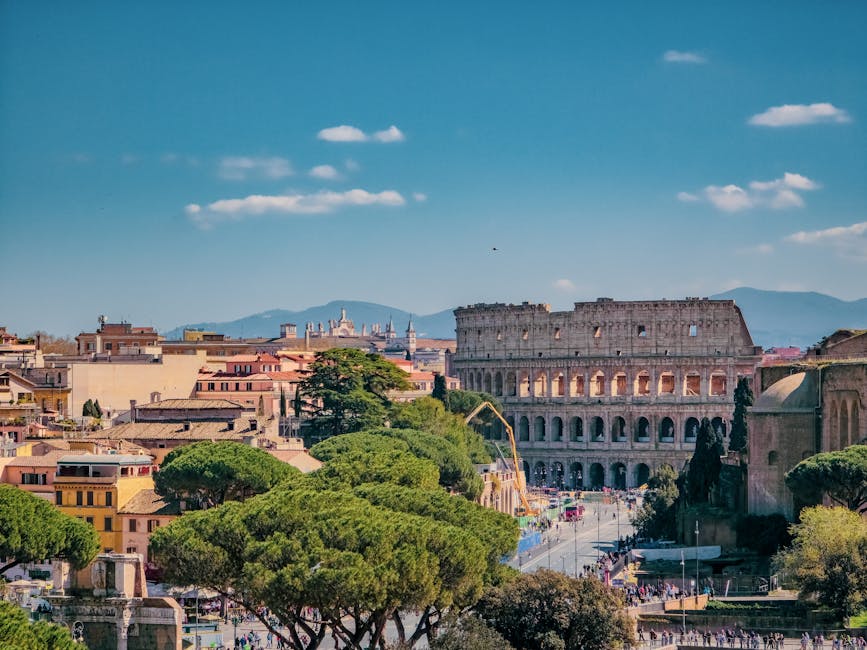
Self-guided audio tour in Rome
Start Free on iPhone
Start free on iPhone to unlock this self-guided walking tour in Rome. Hear all the stories that make it amazing, walk at your own pace, and begin whenever you want.
Your Private Tour Guide
The Tiber River is the silver thread that weaves through the tapestry of Rome's three-millennium history. This self-guided walk invites you to explore the city from its most scenic vantage points: the historic bridges that have connected its banks since antiquity. While many visitors stick to the crowded piazzas, this walking route offers a more contemplative perspective on the Eternal City, blending ancient engineering with Renaissance artistry and dramatic waterfront views. You will begin near the ancient Jewish Ghetto, crossing the oldest original bridge in the city, before navigating the unique Isola Tiberina—a boat-shaped island that has been a place of healing for over two thousand years. As you continue along the Lungotevere, the riverside boulevards lined with majestic plane trees, the history of Rome unfolds through its architecture. You'll encounter Ponte Sisto, a Renaissance masterpiece that connects the historic center with the vibrant Trastevere neighborhood. The route culminates at the breathtaking Ponte Sant'Angelo, often called the most beautiful bridge in the world, where Bernini’s sculpted angels lead the way toward the massive cylindrical bulk of Castel Sant'Angelo. This stroll is particularly special for photography enthusiasts, as the light reflecting off the Tiber at sunset creates a golden glow against the travertine stone. This self-guided adventure allows you to set your own pace, stopping to admire the river's flow or capture the perfect shot of St. Peter’s Basilica in the distance. Whether you are a first-time visitor or a seasoned traveler, this walking tour Rome experience provides a refreshing escape from the urban bustle while keeping you immersed in the city's legendary past.
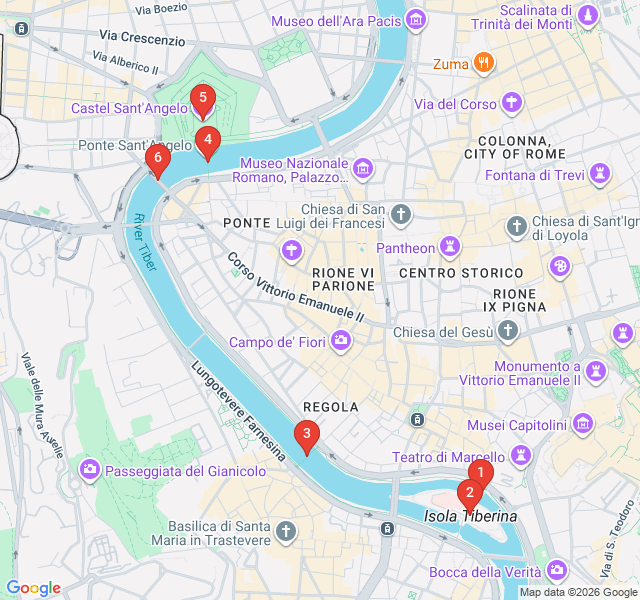
Numbers indicate the order of stops on the tour.
Step back over two thousand years as you walk across Ponte Fabricio. Built in 62 BC by Lucius Fabricius, this is the oldest bridge in Rome that still exists in its original state. Look closely at the travertine and tuff structure; it has withstood two millennia of floods and traffic. Notice the 'four-headed' herms (statues) on the parapets, which gave it the local nickname 'Ponte dei Quattro Capi.' Legend says these represent four architects who were beheaded by the Pope for their constant arguing during a restoration, though historians suggest they are simply ancient boundary markers. This bridge serves as the gateway from the historic Jewish Ghetto to the Isola Tiberina.
You are now standing on the only island in the Tiber within Rome's city limits. Isola Tiberina has a fascinating boat-like shape, which the ancient Romans enhanced with stone to resemble a trireme (a galley ship). For centuries, this island has been associated with healing. In the 3rd century BC, the Temple of Aesculapius, the god of medicine, was established here to combat a plague. Today, that legacy continues with the Fatebenefratelli Hospital. As you walk across the island, enjoy the sound of the rushing water and the unique view of the 'Ponte Rotto' (Broken Bridge) just downstream—the remains of the ancient Ponte Aemilius, destroyed by a flood in 1598.
Ponte Sisto is one of the most beloved bridges in Rome, known for its elegant central 'oculus' or eye, designed to relieve water pressure during floods. Commissioned by Pope Sixtus IV for the Jubilee of 1475, it was built on the foundations of an ancient Roman bridge. This pedestrian-only span is a favorite for street musicians and locals moving between the Campo de' Fiori area and the Trastevere district. As you cross, take a moment to look North; on a clear day, you can see the dome of St. Peter's Basilica framed perfectly by the river banks. It is a quintessential spot for photography.
Widely considered Rome's most beautiful bridge, Ponte Sant'Angelo was originally built by Emperor Hadrian in 134 AD to provide access to his mausoleum. However, the bridge you see today is defined by the Baroque period. The ten magnificent angels lining the walkway were designed by Gian Lorenzo Bernini in the 17th century. Each angel carries an instrument of Christ's Passion, such as the crown of thorns or the cross. These 'Bernini's Angels' were intended to prepare pilgrims spiritually as they crossed the river toward St. Peter's. The interplay of white marble against the blue Roman sky makes this one of the most iconic sights in the city.
Standing before you is the massive fortress of Castel Sant'Angelo. Originally built as a mausoleum for Emperor Hadrian, it has lived many lives: a fortress, a papal residence, and even a prison. It famously connects to the Vatican via the 'Passetto di Borgo,' an elevated secret passage used by Popes to escape during times of siege. The statue of the Archangel Michael atop the castle commemorates a vision of the angel sheathing his sword, signaling the end of a plague in 590 AD. While you can admire its exterior and the impressive ramparts from here, it remains one of Rome's most significant historical layers.
This bridge represents a newer chapter in Rome's history. Completed in 1911 to celebrate the 50th anniversary of Italian Unification, Ponte Vittorio Emanuele II connects the city center to the Borgo district and the Vatican. It is heavily decorated with colossal bronze statues and travertine groups representing themes like 'Liberty,' 'Loyalty to the Statuto,' and 'Victory.' From this bridge, you get one of the best wide-angle views of Ponte Sant'Angelo and the castle you just visited. It serves as a grand conclusion to your riverside walk, sitting at the doorstep of St. Peter's Square.
Start Free on iPhone
Explore “Tiber River & Historic Bridges” with your very own Private Tour Guide with Zigway. Start free on iPhone, skip the large group and the fixed routes, and hear the city come alive as you go.
Your Private Tour Guide
Don't miss the good stuff
Explore Freely
 Easy
EasyRome, Italy
Explore Rome’s industrial heart on this self-guided walk featuring massive murals, the 'Iron Colosseum,' and unique industrial archaeology.
 Easy
EasyRome, Italy
Explore Rome’s whimsical Fairytale District. A self-guided walk through Art Nouveau palaces, mythical fountains, and the magical Coppedè architecture.
 Moderate
Rome, Italy
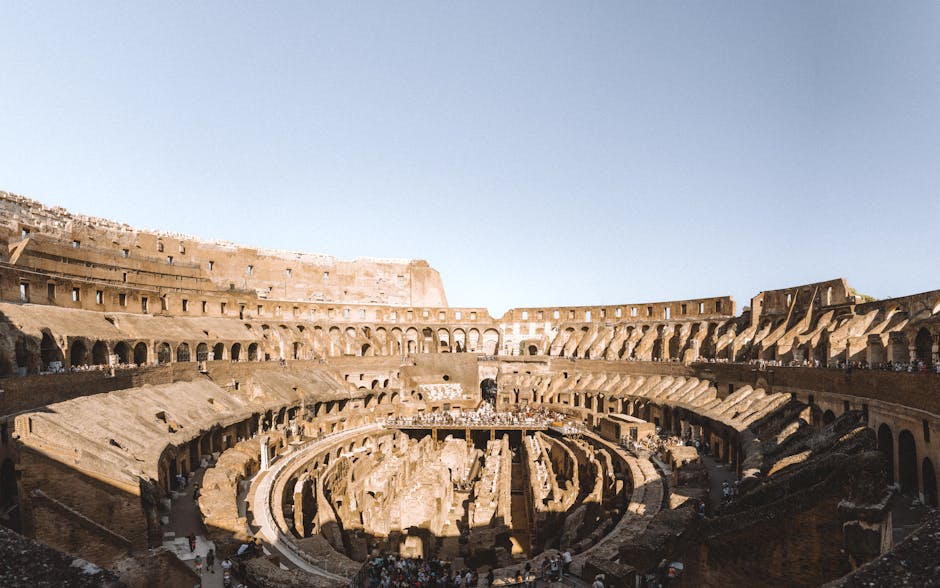
Uncover Rome's hidden history on this self-guided walk through ancient gladiator pits, subterranean temples, and buried Roman houses.
 Challenging
Rome, Italy
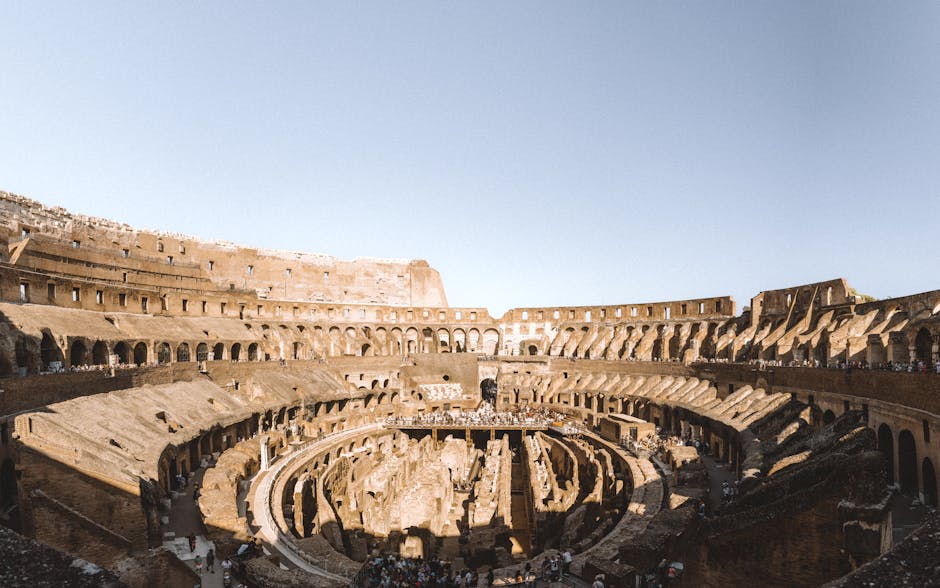
Walk the 'Queen of Roads.' Explore ancient catacombs, imperial villas, and historic basalt stones on this scenic self-guided Roman adventure.
 Easy
EasyNairobi, Kenya
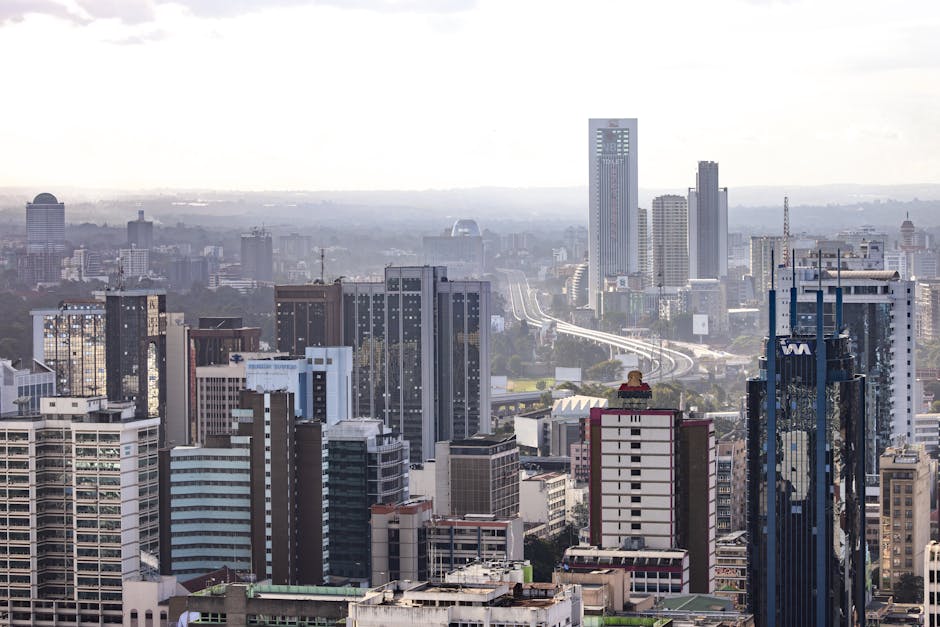
Discover Nairobi's iconic skyline on this self-guided architecture walk through the CBD’s most famous modernist and Brutalist landmarks.
 Easy
EasyGdansk, Poland
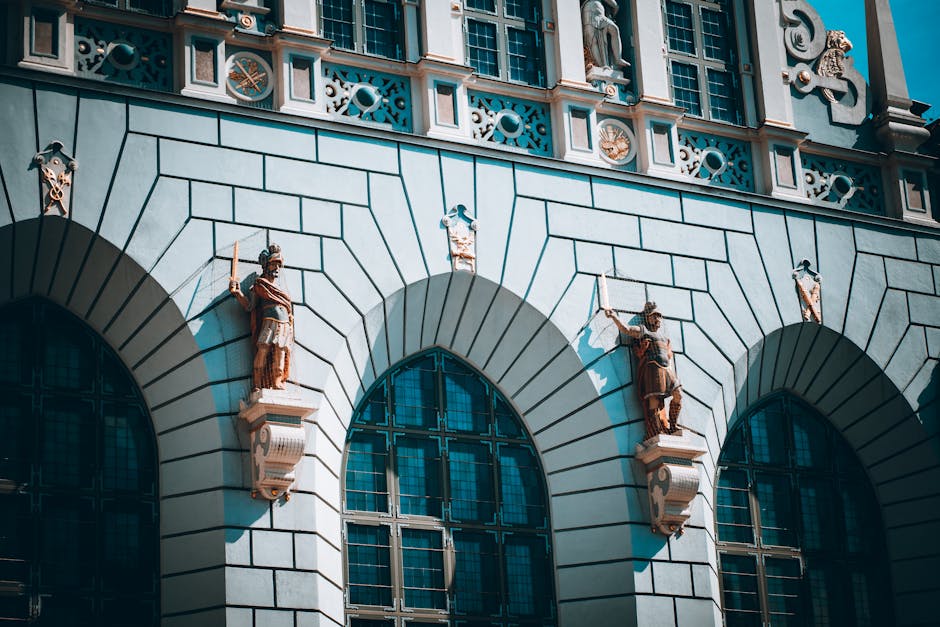
Discover the opulent Royal Way of Gdansk at your own pace. Explore Hanseatic history, gilded architecture, and the iconic Neptune's Fountain.
 Easy
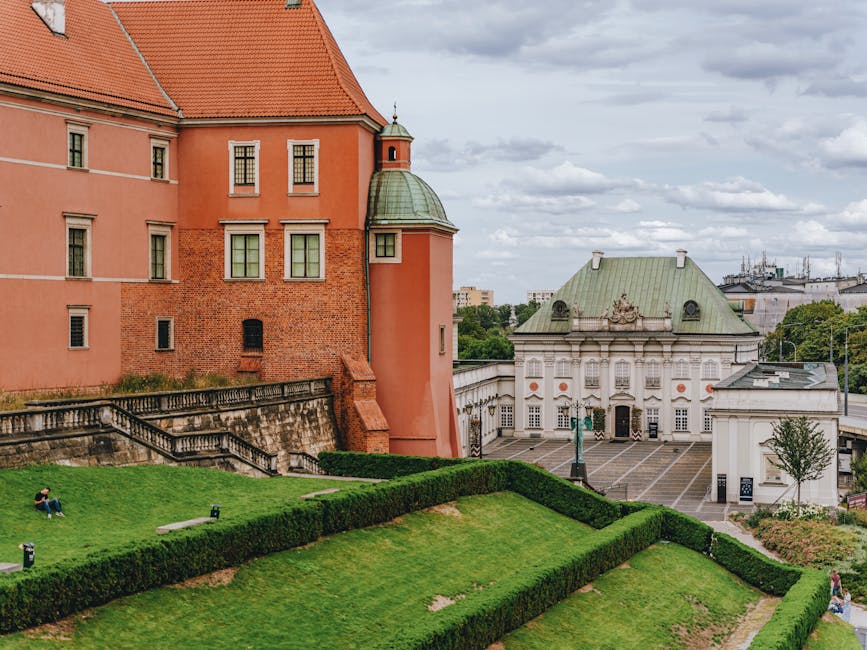
EasyWarsaw, Poland
Explore the miracle of Warsaw's reconstructed Old Town on this self-guided walk through royal squares, medieval walls, and heroic monuments.
 Easy
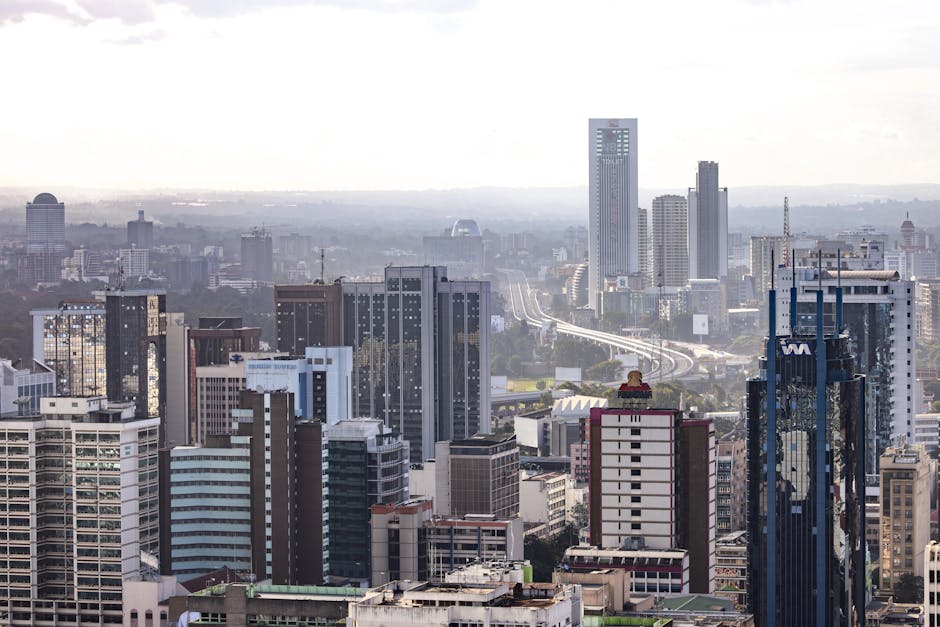
EasyNairobi, Kenya
Explore Nairobi's architectural evolution from colonial-era landmarks to iconic Brutalist skyscrapers on this historic self-guided walking route.
 Easy
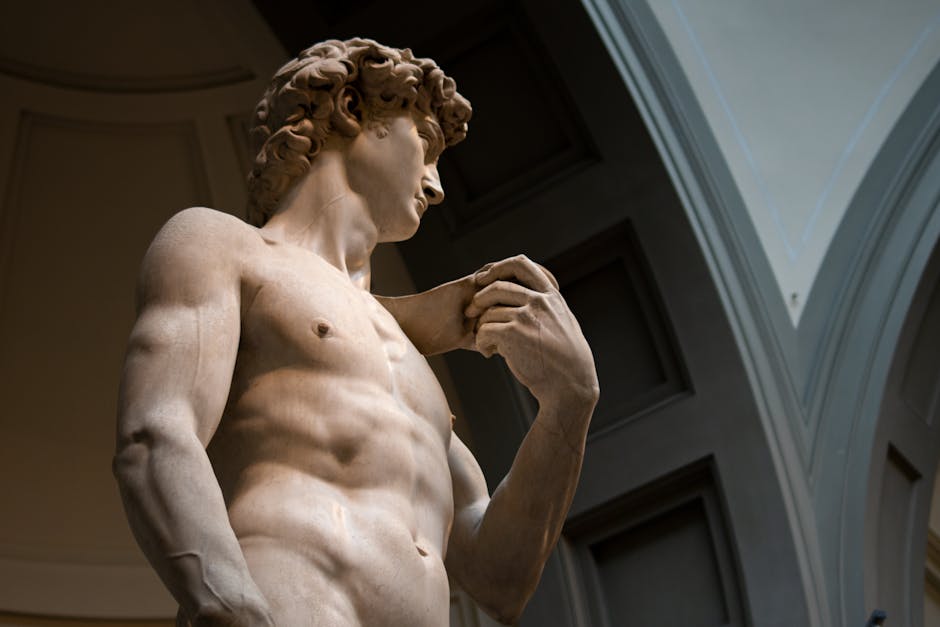
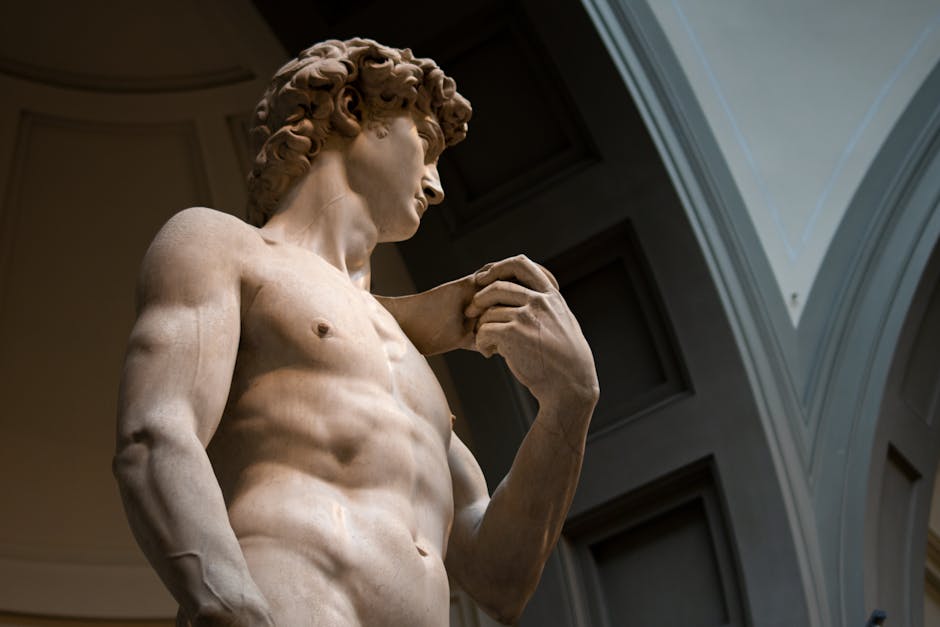
EasyFlorence, Italy
Discover the intersection of Renaissance architecture and modern luxury on this self-guided walk through Florence’s high-fashion districts.
 Easy
EasyFlorence, Italy
Explore the medieval streets of Florence through the eyes of Dante Alighieri on this self-guided literary and historical walking route.
 Easy
EasyFlorence, Italy
Experience the magic of Florence at sunset. Discover iconic bridges and breathtaking river views on this romantic self-guided audio walk.
 Easy
EasyFlorence, Italy
Discover the 'buchette del vino'—Florence's unique Renaissance wine windows—on this self-guided walk through the city's historic streets.