Self-guided audio tour in Toronto
Start Free on iPhone
Start free on iPhone to unlock this self-guided walking tour in Toronto. Hear all the stories that make it amazing, walk at your own pace, and begin whenever you want.
Your Private Tour Guide
Step into a neighborhood where the rhythmic clanging of heavy machinery has been replaced by the soft hum of creative studios and the chatter of lively patios. Liberty Village is one of Toronto's most successful examples of urban revitalization, a self-contained campus of 19th-century industrial architecture reimagined for the 21st century. This self-guided walk invites you to explore the red-brick corridors and hidden courtyards that once defined Toronto’s manufacturing heart. As you navigate the route, you will discover how former carpet mills, toy factories, and even a reformatory for women have been transformed into a vibrant community of tech innovators and design professionals. What makes this walking route special is the tangible sense of history that lingers in the masonry. You aren't just walking past modern condos; you are tracing the evolution of Canadian industry. Highlights of this neighborhood stroll include the iconic Toronto Carpet Factory, a sprawling complex that occupies an entire city block, and the Toy Factory Lofts, where the remnants of a playful past meet luxury living. You will also uncover the deeper, sometimes darker, origins of the area’s name at Liberty Village Park, which marks the spot where prisoners once took their first steps of freedom. This walking tour Toronto experience allows you to appreciate the architectural details at your own pace, from the intricate brickwork of the Victorian era to the sleek glass of the modern skyline. Whether you are an architecture enthusiast, a history buff, or simply looking for a unique way to travel through Toronto’s west end, this route offers a fascinating glimpse into a city constantly reinventing itself. Discover the intersection of heritage and innovation in a neighborhood that truly echoes the industrial spirit of the past while looking firmly toward the future.
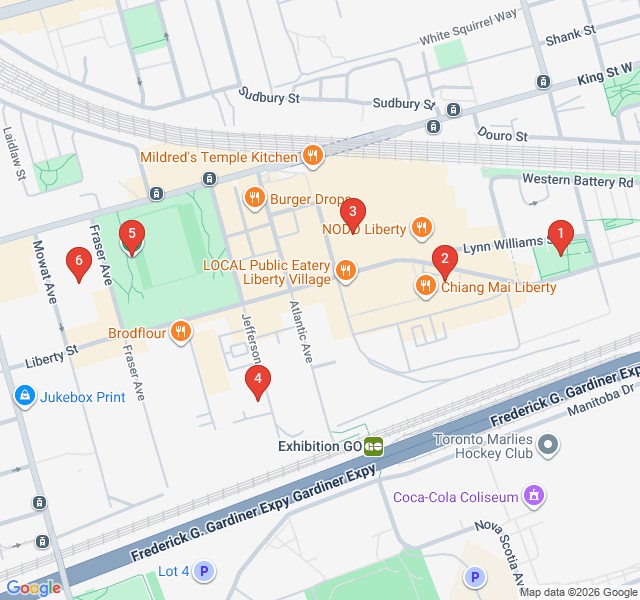
Numbers indicate the order of stops on the tour.
Welcome to the starting point of your self-guided walk. Liberty Village Park may look like a modest green space, but it holds the key to the neighborhood's name. In the 19th century, this area was home to the Central Prison and the Andrew Mercer Reformatory for Women. When prisoners were released, they were let out onto Liberty Street—their first steps as free citizens. This irony isn't lost on the modern residents who now walk their dogs here. As you look around, notice how the park is framed by towering glass and historic brick, a perfect introduction to the contrast of old and new that defines this district.
As you pass by the Brazen Head, you're seeing the social heart of the modern village. This pub is situated in a building that reflects the neighborhood's architectural transition. While Liberty Village was once strictly for labor, it is now a place of leisure. The multi-level patios here offer some of the best views of the surrounding industrial rooftops. It serves as a reminder that the revitalization of this area wasn't just about offices and homes, but about creating a community where people could gather. The 'village' in the name is quite literal here; almost everything a resident needs is within a five-minute walk.
Stand before the Toy Factory Lofts, one of the most famous examples of adaptive reuse in Toronto. Long before it was luxury housing, this was the Irwin Toy factory, where generations of Canadian children’s playthings were manufactured. If you look closely at the facade, you can see the original heavy timber construction and thick masonry walls designed to support massive industrial machinery. When it was converted in the early 2000s, many of the original features were preserved, including the large windows that once let in natural light for factory workers. It stands as a monument to the neighborhood's shift from manufacturing goods to hosting the creative class.
This massive structure, currently used for storage, represents the sheer scale of the industry that once dominated the western edge of the city. Originally part of the Hinde & Dauch Paper Company, this building helped fuel Toronto’s growth by producing the packaging needed for the city's various exports. The utilitarian design, with its repetitive window patterns and sturdy concrete frame, is a classic example of early 20th-century industrial functionalism. While it lacks the decorative flourishes of earlier Victorian factories, its presence is a testament to the period when Liberty Village was a powerhouse of Canadian production and logistics.
The site where Lamport Stadium now stands has a somber history. Before the cheering fans of the Toronto Wolfpack or local soccer leagues arrived, this was the location of the Andrew Mercer Reformatory for Women, which opened in 1872. The reformatory was known for its strict and often harsh conditions. The facility was demolished in 1969 to make way for this 9,600-seat stadium, named after a former Toronto mayor. Today, the stadium serves as a major community hub for sports, representing a complete transformation of the land from a place of confinement to a place of active, public celebration.
You have reached the architectural crown jewel of the neighborhood: the Toronto Carpet Factory. Built between 1899 and 1920, this complex was once the home of the Toronto Carpet Manufacturing Company. At its peak, it was a self-contained industrial city where wool was spun, dyed, and woven into carpets. Take a moment to walk through the internal courtyards. The elaborate brickwork, arched windows, and cobblestone-style pathways were designed to mimic a traditional English village. Today, it houses over 100 design, tech, and media firms, proving that beautiful old buildings can remain the most desirable workspaces in the modern city.
Start Free on iPhone
Explore “Industrial Echoes: Liberty Village Reimagined” with your very own Private Tour Guide with Zigway. Start free on iPhone, skip the large group and the fixed routes, and hear the city come alive as you go.
Your Private Tour Guide
Don't miss the good stuff
Explore Freely
 Challenging
Toronto, Canada
Explore Toronto's crown jewel with this self-guided walk through High Park’s hidden gardens, historic lodges, and scenic waterfront trails.
 Easy
EasyToronto, Canada
Explore Toronto's iconic skyline on this self-guided walk through the Financial District's historic stone halls and golden glass towers.
 Easy
EasyToronto, Canada
Explore North America's largest collection of Victorian homes and peaceful green spaces on this self-guided stroll through Toronto's Cabbagetown.
 Easy
EasyToronto, Canada
Explore Yorkville’s transformation from 1960s hippie haven to Toronto’s premier luxury district on this self-guided audio walk.
 Easy
EasyGothenburg, Sweden
Explore Gothenburg's maritime soul on this self-guided walk from historic shipyards to sleek modern piers and iconic industrial landmarks.
 Easy
EasyWarsaw, Poland
Discover the hidden courtyards and grand pre-war architecture of Warsaw's most atmospheric neighborhood on this self-guided stroll.
 Easy
EasyGothenburg, Sweden
Explore Gothenburg’s historic wooden houses, legendary giant cinnamon buns, and panoramic fortress views on this self-guided neighborhood stroll.
 Easy
EasyKrakow, Poland
Explore the prestigious Jagiellonian University district, featuring Neo-Gothic architecture, Baroque churches, and Krakow's hidden scholarly gems.
 Easy
EasyVancouver, Canada
Explore Vancouver’s transformation from industrial hub to futuristic urban oasis on this self-guided audio walk along the scenic False Creek Seawall.
 Moderate
Vancouver, Canada
Discover the cinematic secrets of Hollywood North on this self-guided walk through Downtown Vancouver’s most famous filming locations.
 Easy
EasyVancouver, Canada
Explore Vancouver's oldest neighborhood, from Victorian homes to the historic heart of the city's multicultural pioneer communities.
 Easy
EasyVancouver, Canada
Discover how historic rail warehouses became Vancouver’s trendiest district on this self-guided stroll through Yaletown’s chic streets and parks.