Self-guided audio tour in Tel Aviv
Start Free on iPhone
Start free on iPhone to unlock this self-guided walking tour in Tel Aviv. Hear all the stories that make it amazing, walk at your own pace, and begin whenever you want.
Your Private Tour Guide
Step back through four millennia of history with a neighborhood stroll through Old Jaffa, the ancient gateway to the Holy Land. This self-guided walk invites you to explore a labyrinth of limestone alleys where biblical legends meet modern artistic flair. As you navigate the winding paths, you will discover how Jaffa has transformed from a strategic Mediterranean port into one of the most vibrant cultural hubs in the region. This walking route is designed for those who prefer to explore independently, allowing you to linger over a view of the Mediterranean or delve into a hidden gallery at your own pace. The journey begins atop the hill in Abrasha Park, offering a panoramic introduction to the coastline before descending into the heart of the Old City. Along the way, you will encounter architectural marvels that reflect the city's diverse heritage, from the Ottoman-era Mahmoudiya Mosque to the striking red facade of St. Peter's Church. This walking tour Tel Aviv experience highlights the seamless blend of the old and the new, featuring whimsical modern art installations like the Suspended Orange Tree tucked away in quiet courtyards. Whether you are interested in maritime history, religious significance, or simply the charm of ancient stone walls, this route provides a comprehensive look at Jaffa’s enduring legacy. By choosing this self-guided adventure, you avoid the rigid schedules of a traditional walking tour Tel Aviv visitors often encounter, giving you the freedom to pause for a coffee at the Clock Tower or watch the fishing boats return to the harbor. It is a journey through time that captures the soul of one of the world's oldest continuously inhabited cities.
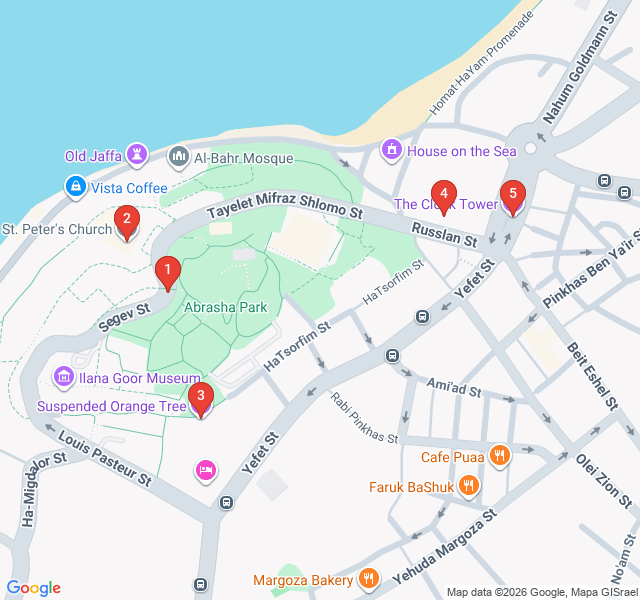
Numbers indicate the order of stops on the tour.
Start your journey at the Wishing Bridge in Abrasha Park. This wooden bridge is adorned with bronze plaques representing the twelve signs of the zodiac. According to local legend, if you hold your zodiac sign, look out toward the Mediterranean Sea, and make a wish, it will come true. Beyond the myth, the bridge offers one of the most stunning vantage points in the city. To your north, the modern skyline of Tel Aviv stretches along the coast, a sharp contrast to the ancient stones beneath your feet. This park sits on the site of ancient fortifications, where archaeologists have uncovered remains dating back to the Egyptian era of Ramses II, reminding us that Jaffa has been a coveted prize for empires for thousands of years.
Standing prominently in Kedumim Square is St. Peter's Church, a Franciscan Mediterranean-style basilica easily recognized by its vibrant red brick facade. Built in the late 19th century over the ruins of a 13th-century Crusader fortress, the church is dedicated to the Apostle Peter. It commemorates the New Testament story of Peter raising Tabitha from the dead and his vision on the rooftop of Simon the Tanner’s house nearby. Interestingly, the church's altar faces east toward the sea and Rome, rather than west toward Jerusalem, reflecting its connection to the Papacy. The interior, when open, reveals stunning Baroque-style decorations and stained glass that feel more like Southern Europe than the Middle East.
Tucked away in a quiet alley of the Artists' Quarter, you will find one of Jaffa's most curious sights: an orange tree growing out of a large, seed-shaped bronze pot suspended in mid-air by steel cables. Created by artist Ran Morin in 1993, this living sculpture is a tribute to the famous Jaffa Orange, which was once the city's primary export and a global symbol of the land. The tree, which continues to grow and bear fruit, represents the tension between nature and urbanization, and the uprooted history of the region. It is a favorite for photographers and a perfect example of how Old Jaffa has reinvented itself as a center for contemporary creativity and thought-provoking art.
The Mahmoudiya Mosque is the largest and most significant mosque in Jaffa. Its complex of buildings, gates, and courtyards was primarily constructed in the early 19th century by the Ottoman governor Abu Nabbut. Look closely at the exterior walls and the ornate Sabil (water fountain) embedded in the southern wall; you might notice that many of the columns and stones were scavenged from ancient Roman sites like Caesarea and Ashkelon. This reuse of materials was a common Ottoman practice, blending the glory of past empires into the fabric of the new city. The mosque’s minaret remains a dominant feature of the Jaffa skyline, signaling the enduring presence of the city's Muslim heritage and its role as a regional administrative center during the Ottoman era.
The Jaffa Clock Tower is one of seven such towers built across the region to commemorate the silver jubilee of Ottoman Sultan Abdul Hamid II in 1900. Built with local limestone, it features two clocks—originally one showing European time and the other showing local time—and beautiful stained-glass windows that depict the history of Jaffa. For over a century, this tower has served as the central landmark for the city, marking the entrance to the Old City and the nearby Flea Market. It stands as a testament to the modernization efforts of the late Ottoman Empire and remains a bustling meeting point for locals and travelers alike, surrounded by bakeries and cafes that fill the air with the scent of fresh pita and coffee.
Finish your walk at the Jaffa Port, a place that has seen over 4,000 years of maritime history. This is the harbor where, according to the Bible, Jonah set sail before being swallowed by a whale, and where the cedars of Lebanon arrived for the construction of Solomon's Temple. Today, it is a charming mix of a working fishing port and a cultural destination. You can see local fishermen mending their nets alongside converted warehouses that now house art galleries, seafood restaurants, and theaters. As you walk along the pier, look out for Andromeda's Rock just offshore, where, in Greek mythology, the hero Perseus rescued the princess Andromeda from a sea monster. It is the perfect place to sit, enjoy the sea breeze, and reflect on the layers of history you have traversed.
Start Free on iPhone
Explore “Jaffa's Ancient Echoes and Hidden Alleys” with your very own Private Tour Guide with Zigway. Start free on iPhone, skip the large group and the fixed routes, and hear the city come alive as you go.
Your Private Tour Guide
Don't miss the good stuff
Explore Freely
 Easy
EasyTel Aviv, Israel
Explore a hidden New England-style village in Tel Aviv. Discover wooden houses and 19th-century history on this peaceful self-guided walk.
 Easy
EasyTel Aviv, Israel
Explore the literary heart and stunning architecture of Tel Aviv's most beautiful historic street on this self-guided neighborhood stroll.
 Easy
EasyTel Aviv, Israel
Experience the sea breeze on this self-guided walk through Tel Aviv's historic port, featuring iconic boardwalks, markets, and sunset views.
 Easy
EasyTel Aviv, Israel
Explore the birthplace of Tel Aviv on a self-guided adventure through Bauhaus architecture and the historic site of Israel's independence.
 Moderate
Gothenburg, Sweden
Discover Gothenburg’s maritime soul on this self-guided walk from the historic Central Station to the scenic riverfront at Stenpiren.
 Moderate
Helsinki, Finland
Explore the 'Gibraltar of the North' on this independent walking route through the historic bastions and hidden gardens of Suomenlinna Sea Fortress.
 Moderate
Vienna, Austria
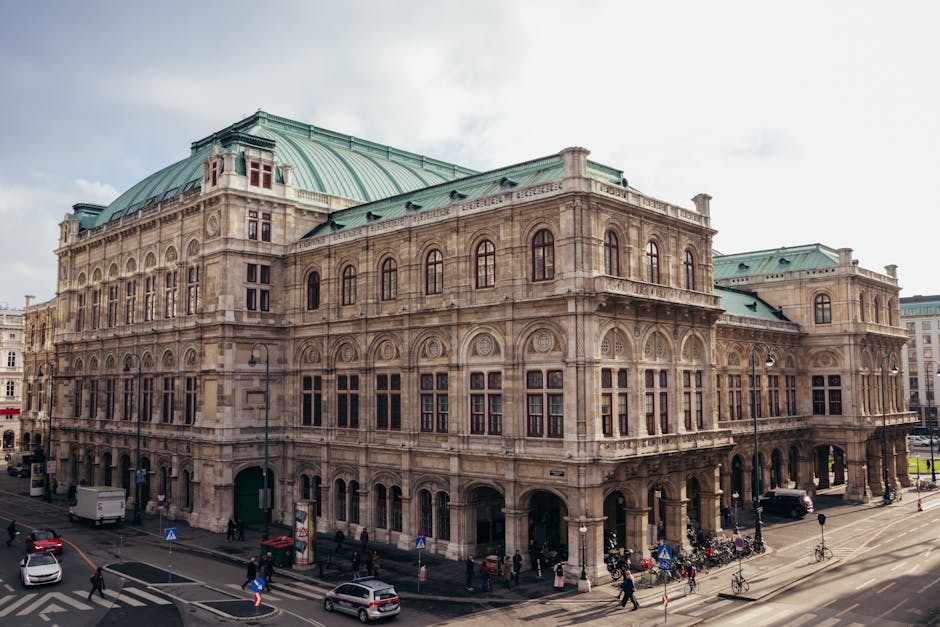
Follow the footsteps of Mozart and Strauss through Vienna’s historic center on this self-guided walk through the city's rich musical history.
 Easy
EasyNairobi, Kenya
Discover Nairobi's iconic skyline on this self-guided architecture walk through the CBD’s most famous modernist and Brutalist landmarks.
 Easy
EasyJerusalem, Israel
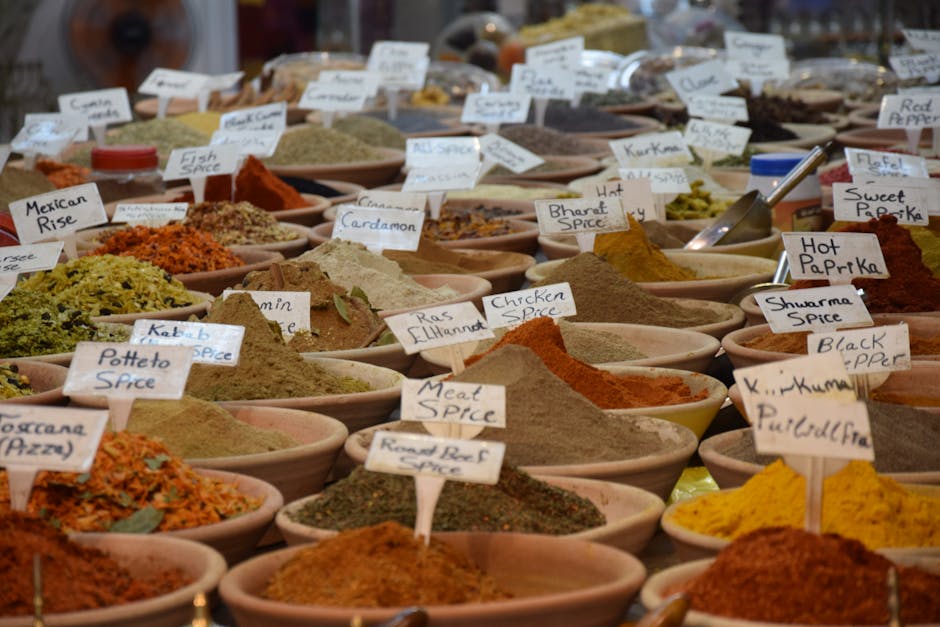
Taste the heart of Jerusalem on this self-guided walk through the legendary stalls and hidden gems of Mahane Yehuda Market.
 Easy
EasyJerusalem, Israel
Explore the secluded world of Mea Shearim on this self-guided walk through Jerusalem’s historic ultra-Orthodox district and 19th-century courtyards.
 Easy
EasyJerusalem, Israel
Explore Jerusalem's nightlife and street art, from the shutter murals of the Shuk to secret speakeasies and creative hubs in the City Center.
 Easy
EasyJerusalem, Israel
Explore the 'Garden Suburb' of Jerusalem's elite. Discover Bauhaus architecture, historic residences of prime ministers, and intellectual landmarks.