Self-guided audio tour in Charleston
Start Free on iPhone
Start free on iPhone to unlock this self-guided walking tour in Charleston. Hear all the stories that make it amazing, walk at your own pace, and begin whenever you want.
Your Private Tour Guide
Step into the atmospheric streets of South Carolina's most storied city with this self-guided walk through the heart of historic Charleston. Known as the 'Holy City' for its skyline of steeples, Charleston hides a darker, more complex past beneath its charming exterior. This neighborhood stroll focuses on the 'Gothic' side of the city—where colonial defense meets 19th-century incarceration and silent graveyards offer a window into the lives of those who shaped the South. You will begin at the city's oldest public building, the Powder Magazine, and wind your way through narrow, brick-lined passages like Philadelphia Alley, where the echoes of past duels still linger. This walking route is designed for those who appreciate architecture, history, and a touch of the macabre. As you explore independently, you will encounter the imposing steeples of St. Michael's and the hauntingly beautiful, overgrown gardens of the Unitarian Churchyard. The route culminates at the Old City Jail, a building that looks more like a medieval fortress than a prison, known for its grim history and architectural significance. This isn't just a simple travel experience; it is an immersion into the textures of the past. Along the way, you can discover hidden gems tucked behind wrought-iron gates and learn about the figures—both legendary and infamous—who walked these same cobblestones centuries ago. Whether you are a first-time visitor or a repeat traveler looking for a deeper connection to the city's nightlife and history, this self-guided adventure allows you to move at your own pace. You can linger in the quiet churchyards or find a nearby tavern for a break. By focusing on the Gothic and historic elements of Downtown, this route provides a comprehensive look at the evolution of Charleston from a fortified colonial outpost to a center of Southern culture and mystery. This is one of the most evocative ways to experience a walking tour Charleston style, focusing on the shadows that define the Holy City.
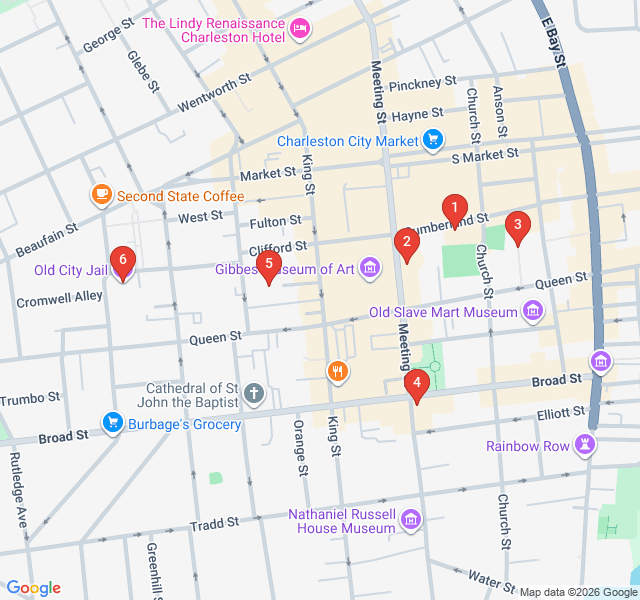
Numbers indicate the order of stops on the tour.
Welcome to the oldest public building in South Carolina. Completed in 1713, this thick-walled structure was designed to store gunpowder for the defense of the walled city of Charlestowne. Its architecture is functional and sturdy, built to withstand potential explosions from within and attacks from without. As you stand before it, imagine the early colonial days when this was the edge of the known world for English settlers. The Powder Magazine survived the Revolutionary War and remains a rare example of early 18th-century military architecture. It sets the stage for our walk by grounding us in the city's early struggles for survival and its strategic importance in the American colonies.
This site has been a place of worship since the 1680s, though the current building reflects a mix of styles. The real treasure here is the graveyard, which contains some of the oldest gravestones in the city. Look for the 'soul effigies' carved into the slate—winged skulls and cherubs that tell us much about early American views on mortality. The church's name comes from its unique circular design, intended to ensure every member of the congregation could hear the sermon clearly. It’s a peaceful yet poignant stop that showcases the 'Holy City's' religious diversity and the long continuity of life and death in this historic district.
Tucked away between Queen and Cumberland Streets, Philadelphia Alley is one of Charleston’s most picturesque hidden gems. Originally named 'Cow Alley,' it was renamed after the city of Philadelphia sent aid following a devastating fire. This narrow brick path was famously a site for duels, where gentlemen settled scores of honor in the early morning mist. Today, it offers a quiet respite from the busier streets, lined with ivy-covered walls and the back gates of historic residences. It captures the essence of the 'Gothic stroll,' where the beauty of the surroundings is often intertwined with a history of conflict and secret encounters.
Standing at the intersection of Meeting and Broad Streets, St. Michael’s is the oldest church building in Charleston, dating back to 1752. Its massive white steeple has served as a landmark for sailors for centuries and has survived fires, hurricanes, and the shelling of the Civil War. Inside, you’ll find the original bells, which have crossed the Atlantic Ocean multiple times due to being captured as war prizes and later returned. The churchyard here is the final resting place of two signers of the U.S. Constitution. The architecture is a classic example of the colonial Georgian style, standing as a testament to the city's enduring spirit and social hierarchy.
Prepare to enter one of the most atmospheric spots in the city. Unlike the manicured lawns of other churches, the Unitarian Churchyard is intentionally kept in a state of 'wild beauty.' Overgrown with vines, ferns, and towering oaks, the gravestones seem to emerge naturally from the earth. This site is often linked to the legend of Annabel Lee, made famous by Edgar Allan Poe, who was stationed nearby at Fort Moultrie. The lush, slightly chaotic greenery creates a romantic, Gothic atmosphere that feels worlds away from the modern city. It’s a perfect place to reflect on the layers of history and the literary inspirations found in Charleston’s landscape.
Our final stop is the imposing Old City Jail. Built in 1802, this Gothic Revival structure housed some of Charleston’s most notorious figures, including the alleged serial killer Lavinia Fisher and various pirates and Civil War prisoners. With its crenelated towers and narrow windows, it looks like a medieval fortress. Conditions here were notoriously harsh, and the building remained in use until 1939. Today, it stands as a grim reminder of the city’s judicial history and is a centerpiece of local folklore. The jail’s architecture and its dark reputation make it the perfect conclusion to our Gothic stroll through the shadows of the Holy City.
Start Free on iPhone
Explore “Shadows of the Holy City: A Gothic Charleston Stroll” with your very own Private Tour Guide with Zigway. Start free on iPhone, skip the large group and the fixed routes, and hear the city come alive as you go.
Your Private Tour Guide
Don't miss the good stuff
Explore Freely
 Easy
EasyCharleston, United States
Explore the elegant streets of Harleston Village on this self-guided stroll through Charleston's most historic residential enclave.
 Easy
EasyCharleston, United States
Explore the neon lights and culinary gems of Upper King. Discover Charleston's modern nightlife and cultural evolution on this self-guided stroll.
 Easy
EasyCharleston, United States
Discover Charleston’s rich literary history on this self-guided walk past historic libraries, authors' homes, and iconic bookstores.
 Moderate
Charleston, United States
Discover the profound Gullah-Geechee influence and African American history of Charleston on this moving and educational self-guided walking route.
 Moderate
Vienna, Austria
Discover the noir world of The Third Man and Cold War Vienna on this atmospheric self-guided audio walk through the historic Innere Stadt.
 Easy
EasyNairobi, Kenya
Explore Nairobi's architectural evolution from colonial-era landmarks to iconic Brutalist skyscrapers on this historic self-guided walking route.
 Easy
EasyNairobi, Kenya
Discover Nairobi's iconic skyline on this self-guided architecture walk through the CBD’s most famous modernist and Brutalist landmarks.
 Easy
EasyKrakow, Poland
Explore Krakow's hidden nightlife with this self-guided walk through medieval cellars, jazz clubs, and bohemian bars in the Old Town and Kazimierz.
 Easy
EasyNashville, United States
Explore the 'Athens of the South' on this self-guided walk through Centennial Park, featuring the world's only full-scale Parthenon replica.
 Easy
EasyNashville, United States
Explore Nashville's academic heart and Art Deco gems on this self-guided walk through historic Hillsboro Village.
 Easy
EasyNashville, United States
Explore the heart of Nashville's music industry. Discover iconic studios and the history of the legendary Nashville Sound at your own pace.
 Easy
EasyNashville, United States
Explore Nashville's oldest neighborhood! Discover Victorian architecture, Civil War history, and world-class craft beer on this self-guided walk.