Self-guided audio tour in Oaxaca
Start Free on iPhone
Start free on iPhone to unlock this self-guided walking tour in Oaxaca. Hear all the stories that make it amazing, walk at your own pace, and begin whenever you want.
Your Private Tour Guide
Step away from the bustling Zócalo and into the oldest neighborhood in Oaxaca City. Xochimilco, founded by the Mexica people in the 15th century and later developed during the colonial era, remains a sanctuary of quiet cobblestone streets, vibrant bougainvillea, and traditional craftsmanship. This self-guided walk invites you to explore a side of the city that many travelers overlook, focusing on the architectural marvel of the 18th-century aqueduct and the artisan heritage that still thrives here today. Unlike the more tourist-heavy districts, Xochimilco maintains a village-like atmosphere where you can hear the rhythmic tapping of looms and the scent of fresh leather. Your walking route begins at the historic Parroquia de Santo Tomás Xochimilco, the spiritual heart of the barrio, before leading you toward modern cultural landmarks like the BS Biblioteca Infantil. This library is a masterpiece of contemporary design integrated into a historic structure, showcasing how the neighborhood respects its past while embracing the future. As you stroll down Calle José López Alavez, one of the most picturesque streets in the city, you will be surrounded by colorful facades and murals that capture the spirit of Oaxacan identity. The centerpiece of this neighborhood stroll is the San Felipe Aqueduct. You will walk alongside these majestic stone arches, which once served as the city's primary water source, providing a unique perspective on colonial engineering. The experience concludes near the Plaza Cruz de Piedra and a legendary local huaracheria, where traditional sandals are still crafted by hand. This independent exploration allows you to discover the intersection of art, history, and daily life at your own pace. Whether you are a photography enthusiast looking for the perfect play of light on old stone or a history buff interested in the hydraulic systems of New Spain, this neighborhood offers a deep dive into the soul of Oaxaca. This travel experience is perfect for those seeking a peaceful alternative to the main tourist circuit while still staying within walking distance of the city center.
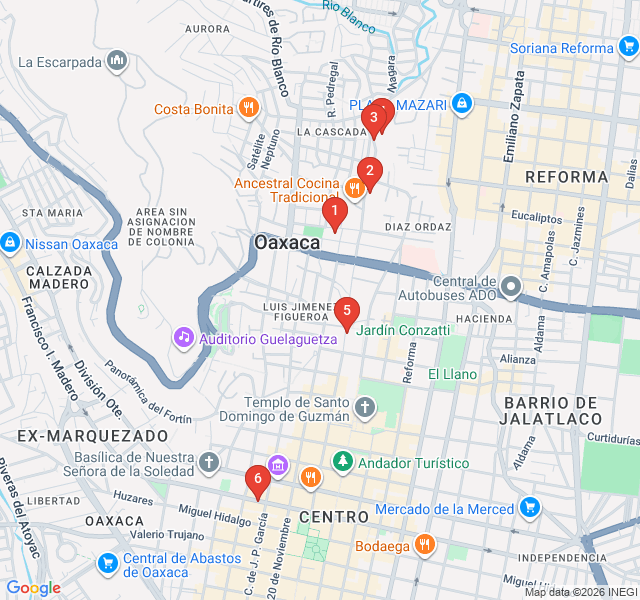
Numbers indicate the order of stops on the tour.
Welcome to the heart of Oaxaca's oldest neighborhood. This church, dedicated to Saint Thomas, dates back to the late 16th century, though much of what you see today was reconstructed in the 18th century after earthquake damage. Notice the green cantera stone, a hallmark of Oaxacan architecture. This plaza is the center of community life; for centuries, the residents here—originally specialized in weaving—gathered here for festivals and trade. The quiet atmosphere here offers a stark contrast to the busy downtown area, setting the tone for your self-guided walk through these historic streets.
This isn't just a library; it is a stunning example of how Oaxaca blends modern utility with historic preservation. Located in a refurbished colonial-era building, the BS Biblioteca Infantil (Children's Library) features beautiful courtyards and innovative wooden structures. It serves as a cultural hub for the neighborhood's youth. Take a moment to peek inside the courtyards to see how the architects used local materials to create a space that feels both ancient and cutting-edge. It represents the neighborhood's commitment to education and the arts.
As you walk down this street, you are entering one of the most photographed corridors in Oaxaca. Named after the composer of the famous 'Canción Mixteca,' this street perfectly encapsulates the charm of Xochimilco. The walls are a palette of deep ochres, vibrant blues, and warm reds, often adorned with contemporary street art and traditional murals. Look up to see the bougainvillea spilling over the walls. This street follows the path of the aqueduct, and the sound of your footsteps on the cobblestones is the same sound heard by residents hundreds of years ago.
Standing before you are the Arcos de Xochimilco. Built in the mid-1700s, this aqueduct was a monumental engineering feat designed to bring fresh water from the springs of San Felipe del Agua down into the city center. The arches are built from the local green volcanic stone. If you look closely at the base of some arches, you can still see where water was once channeled into private homes and public fountains. While it no longer carries water, the structure remains one of the most iconic remnants of colonial infrastructure in southern Mexico.
This plaza marks the symbolic entrance to the Xochimilco neighborhood. The 'Stone Cross' for which it is named has stood as a landmark for generations. This spot was historically significant as it sat at the edge of the Spanish-designed city grid. It is a popular gathering place for locals in the evenings. From here, the aqueduct begins its final stretch toward the Carmen Alto church. The plaza is often a site for small markets or community events, bridging the gap between the artisan barrio and the colonial city center.
To wrap up your neighborhood stroll, visit this traditional workshop. The barrio of Xochimilco is famous for its leatherwork, specifically the 'huarache'—a traditional Mexican sandal. At this huaracheria, you can see the intricate process of weaving leather strips into durable, stylish footwear. The craft has been passed down through families for decades. It is a living piece of history; unlike mass-produced shoes, these are made to last and reflect the specific aesthetic of the region. This is the perfect place to appreciate the manual skill that still defines this historic district.
Start Free on iPhone
Explore “Xochimilco’s Ancient Aqueducts and Artisans” with your very own Private Tour Guide with Zigway. Start free on iPhone, skip the large group and the fixed routes, and hear the city come alive as you go.
Your Private Tour Guide
Don't miss the good stuff
Explore Freely
 Easy
EasyOaxaca, Mexico
Explore Oaxaca's vibrant modern art scene, from revolutionary printmaking collectives to world-class contemporary museums, at your own pace.
 Moderate
Oaxaca, Mexico
Explore the heights of Oaxaca on this self-guided walk, featuring panoramic city views, cultural landmarks, and the iconic Cerro del Fortín.
 Easy
EasyOaxaca, Mexico
Explore Oaxaca's 'Green City' at your own pace. Discover Baroque masterpieces and the vibrant Zócalo on this self-guided neighborhood stroll.
 Easy
EasyOaxaca, Mexico
Discover the soul of Oaxaca on this self-guided evening stroll through the city's most iconic and traditional mezcal bars.
 Easy
EasyWarsaw, Poland
Discover the hidden courtyards and grand pre-war architecture of Warsaw's most atmospheric neighborhood on this self-guided stroll.
 Easy
EasySalzburg, Austria
Discover Salzburg's oldest medieval alley, the birthplace of the 'Silent Night' author, and breathtaking views on this quiet self-guided walk.
 Easy
EasyGothenburg, Sweden
Explore Gothenburg's maritime soul on this self-guided walk from historic shipyards to sleek modern piers and iconic industrial landmarks.
 Easy
EasyNairobi, Kenya
Discover Nairobi's iconic skyline on this self-guided architecture walk through the CBD’s most famous modernist and Brutalist landmarks.
 Easy
EasyMexico City, Mexico
Explore Mexico City's most glamorous district on this self-guided walk through Polanco's luxury boutiques, lush parks, and iconic art museums.
 Easy
EasyMexico City, Mexico
Explore the Art Deco architecture and gourmet food scene of Roma Norte on this self-guided neighborhood stroll through Mexico City’s creative heart.
 Easy
EasyMexico City, Mexico
Explore the epic murals of Rivera, Orozco, and Siqueiros on this self-guided walking route through the heart of Mexico City’s historic center.
 Moderate
Mexico City, Mexico
Taste the legendary tacos and cantina culture of Narvarte on this self-guided walk through Mexico City's most authentic foodie neighborhood.