Self-guided audio tour in Nashville
Start Free on iPhone
Start free on iPhone to unlock this self-guided walking tour in Nashville. Hear all the stories that make it amazing, walk at your own pace, and begin whenever you want.
Your Private Tour Guide
Lower Broadway is the neon-lit heart of Music City, a legendary stretch of pavement where every doorway echoes with the sounds of pedal steel guitars and soulful voices. This self-guided walk invites you to explore the foundations of country music history, from the riverfront warehouses of the 19th century to the 'Mother Church' that broadcasted icons to the world. As you navigate these blocks, you will encounter the legacies of the pioneers who defined the Nashville sound, including the 'Man in Black' and the 'Texas Troubadour.' This walking route Nashville offers is a sensory journey through the evolution of American music, focusing on the historic venues and museums that preserve these stories today. The route begins near the Cumberland River, highlighting the architectural transition of the city from a shipping hub to a global music capital. You will pass by some of the most famous honky-tonks in the world, including the iconic purple facade of Tootsie's Orchid Lounge, which famously served as a backstage retreat for performers. The walk culminates at the Ryman Auditorium, a site of spiritual and musical pilgrimage. Exploring at your own pace allows you to soak in the atmosphere of 'Honky Tonk Highway' while understanding the deep historical roots beneath the modern nightlife. Whether you are a lifelong country fan or a curious traveler, this self-guided adventure provides a comprehensive look at the legends of Lower Broadway without the constraints of a group schedule. Discover the hidden stories behind the flashing signs and find out why this neighborhood remains the soul of Tennessee's capital.
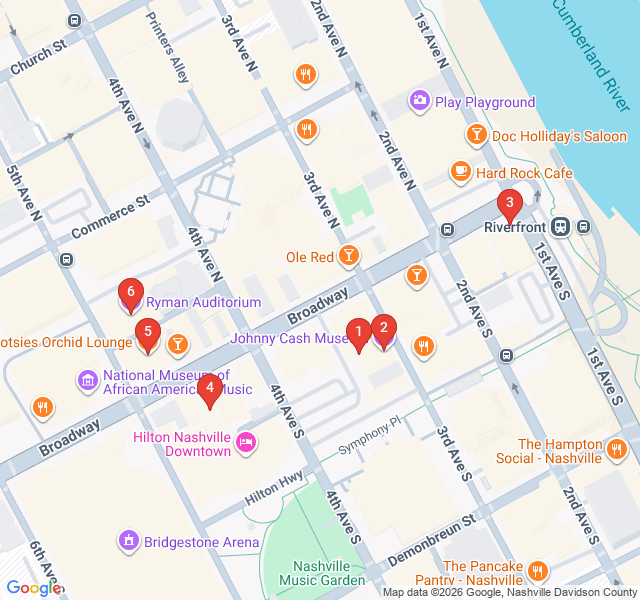
Numbers indicate the order of stops on the tour.
Begin your exploration at the museum dedicated to one of the most influential vocalists of the 20th century. Patsy Cline was a pioneer for women in country music, successfully crossing over into the pop charts with hits like 'Crazy' and 'I Fall to Pieces.' Inside this space, the story of her meteoric rise and tragic end in a 1963 plane crash is told through personal artifacts, costumes, and rare recordings. Her velvet voice helped define the 'Nashville Sound' of the late 1950s, which traded raw honky-tonk for sophisticated arrangements. Even decades after her passing, she remains a benchmark for every aspiring singer who arrives in this city with a guitar and a dream.
Just steps away lies a tribute to the 'Man in Black.' Johnny Cash is a figure who transcends genre, blending country, rock and roll, blues, and gospel into a career that spanned nearly five decades. This museum houses the world's most comprehensive collection of Cash artifacts, documenting his life from a cotton farm in Arkansas to his legendary Folsom Prison concert. As you stand outside, consider how Cash's rebellious spirit and deep baritone voice became synonymous with American music. His impact on Nashville is immeasurable, and this site serves as a reminder of his enduring influence on songwriters and social justice advocates alike.
Located at the foot of Broadway near the river, this building dates back to 1890 and represents Nashville's commercial roots. Long before it was a destination for live music and rooftop views, it served as a grocery warehouse and a feed store. In the 20th century, it was a hub for the city's blue-collar workers. Today, it has been preserved to maintain its industrial character while hosting musicians on its various floors. The transition of this building mirrors the evolution of Nashville itself—from a river-dependent trade town to a world-class entertainment destination. Look up at the rooftop; it offers one of the best vantage points of the Cumberland River and the Nissan Stadium across the water.
This shop is more than just a place to buy vinyl; it is a monument to the 'Texas Troubadour.' Ernest Tubb was one of the first stars of the Grand Ole Opry to embrace the electric guitar, helping to create the honky-tonk style. He opened this record shop in 1947 to give fans a place to buy the music they heard on the radio. Notably, it became the home of the 'Midnite Jamboree,' a live radio show that started right after the Opry finished. For decades, legendary artists would walk from the Ryman Auditorium to this shop to perform. The wooden floors and vintage shelves still carry the spirit of an era when radio was the primary way the world discovered country music.
Recognizable by its bold orchid-purple paint, Tootsie's is perhaps the most famous honky-tonk in the world. It was purchased in 1960 by Hattie 'Tootsie' Bess, who became a mother figure to struggling songwriters. Its back door is legendary; it sits directly across the alley from the Ryman Auditorium's stage entrance. During the Opry's heyday, performers like Willie Nelson and Kris Kristofferson would slip out of the Ryman and into Tootsie’s for a drink between sets. The walls inside are covered with photos of the stars who have graced its small stage. It remains a cornerstone of the Nashville nightlife scene, where live music plays from early morning until the early hours of the next day.
Your walk concludes at the Ryman Auditorium, often called the 'Mother Church of Country Music.' Originally built in 1892 as the Union Gospel Tabernacle by riverboat captain Thomas Ryman, the building was intended for religious revivals. However, its world-class acoustics soon made it a premier venue for speakers and performers. From 1943 to 1974, it was the home of the Grand Ole Opry, broadcasting the sounds of country music across the nation. It was here that bluegrass was born on stage and where stars like Hank Williams and Dolly Parton became legends. Even today, performing at the Ryman is considered the pinnacle of a musician's career. Its red brick facade and stained-glass windows stand as a testament to Nashville's spiritual and musical heritage.
Start Free on iPhone
Explore “Legends of Lower Broadway” with your very own Private Tour Guide with Zigway. Start free on iPhone, skip the large group and the fixed routes, and hear the city come alive as you go.
Your Private Tour Guide
Don't miss the good stuff
Explore Freely
 Easy
EasyNashville, United States
Explore the 'Athens of the South' on this self-guided walk through Centennial Park, featuring the world's only full-scale Parthenon replica.
 Easy
EasyNashville, United States
Explore Nashville's academic heart and Art Deco gems on this self-guided walk through historic Hillsboro Village.
 Easy
EasyNashville, United States
Explore the heart of Nashville's music industry. Discover iconic studios and the history of the legendary Nashville Sound at your own pace.
 Easy
EasyNashville, United States
Explore Nashville's oldest neighborhood! Discover Victorian architecture, Civil War history, and world-class craft beer on this self-guided walk.
 Easy
EasyNairobi, Kenya
Explore the history of Kenya’s independence through the statues, monuments, and parks that define Nairobi’s political heart on this self-guided walk.
 Easy
EasySalzburg, Austria
Discover the 'Rome of the North' on this self-guided walk through the Baroque squares and monumental legacy of Salzburg’s Prince-Archbishops.
 Easy
EasyWarsaw, Poland
Explore the miracle of Warsaw's reconstructed Old Town on this self-guided walk through royal squares, medieval walls, and heroic monuments.
 Easy
EasyGothenburg, Sweden
Discover Gothenburg’s 17th-century Dutch foundations, historic canals, and military fortifications on this self-guided architectural walk.
 Easy
EasyNew York City, United States
Explore the golden age of Manhattan architecture on this self-guided walk through Midtown's iconic Art Deco skyscrapers and historic landmarks.
 Easy
EasyNew York City, United States
Discover the literary legends, jazz haunts, and revolutionary history of Greenwich Village on this immersive self-guided walking route.
 Easy
EasyNew York City, United States
Explore Manhattan's transformation on this self-guided walk from the High Line to Hudson Yards.
 Easy
EasyNew York City, United States
Discover the world's finest cast-iron architecture and the evolution of fashion on this self-guided walking route through NYC's iconic SoHo district.