Self-guided audio tour in Bratislava
Start Free on iPhone
Start free on iPhone to unlock this self-guided walking tour in Bratislava. Hear all the stories that make it amazing, walk at your own pace, and begin whenever you want.
Your Private Tour Guide
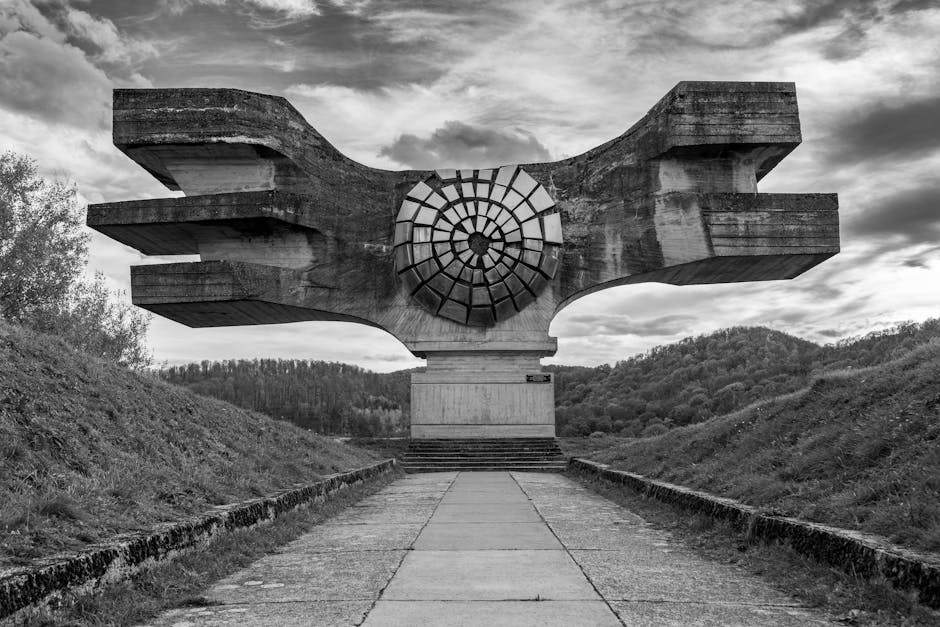
Bratislava is often celebrated for its charming medieval center, but beyond the cobblestone streets of the Old Town lies a starkly different world of concrete, steel, and grand socialist ambition. This self-guided walk invites you to explore the 'other' side of the Slovak capital, where the shadows of the Cold War era still loom large in the form of monumental Brutalist structures and Socialist Modernist landmarks. By following this route, you will discover why Bratislava is considered one of the most intriguing outdoor museums of 20th-century architecture in Central Europe. Your journey begins at Freedom Square, a massive public space designed to host thousands of citizens for state rallies. Here, the sheer scale of the architecture sets the tone for the experience. You will encounter the 'Inverted Pyramid' of the Slovak Radio Building, a structure so unique it has become a symbol of the city's experimental architectural spirit. The route then climbs toward Slavín, a solemn war memorial that offers both a lesson in Stalinist monumentalism and the most breathtaking panoramic views of the city skyline. As you descend back toward the Danube, the walk highlights the controversial Bridge Wing of the Slovak National Gallery, a bold statement of late-modernist design that sparked decades of debate. The experience culminates at the world-famous Most SNP, better known as the UFO Bridge. This engineering marvel stands as a testament to the futuristic visions of the 1970s. Throughout this walking route, you are free to explore at your own pace, stopping to photograph the sharp angles and raw textures of these concrete giants. This neighborhood stroll provides a deep dive into the political and social history that shaped the Bratislava of today, making it a must-see for fans of history, design, and urban exploration.
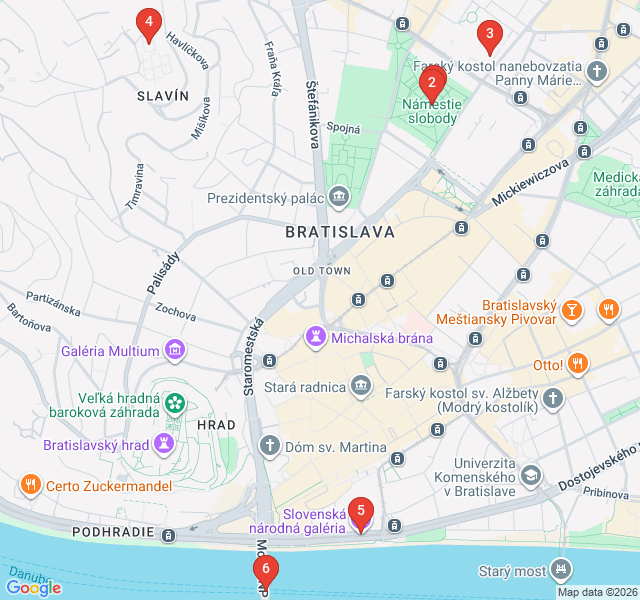
Numbers indicate the order of stops on the tour.
Welcome to Freedom Square, or Námestie slobody. This is one of Bratislava's largest public squares, and its vast, open design is a classic hallmark of socialist urban planning. Originally named Gottwald Square after Czechoslovakia’s first communist president, it was designed to accommodate massive state gatherings and parades. The surrounding buildings, including the Government Office of the Slovak Republic, reflect the austere, authoritative style of the era. Look around at the scale of the space; it was built to make the individual feel small in the face of the state. Following a major renovation in 2023, the square has been revitalized as a popular local hangout, blending its rigid history with a new, relaxed public energy.
At the heart of Freedom Square stands the Fountain of Union, known in Slovak as Družba. Completed in 1980, it is the largest fountain in the entire city. The central sculpture is a massive stainless steel linden flower, a symbol of the Slavic people, weighing over 12 tons. During the socialist era, the fountain symbolized the friendship and unity of the Eastern Bloc nations. For many years, the fountain was dry and neglected, but its recent restoration has brought the water back to life. It remains a masterpiece of late-modernist sculpture, representing the era's fascination with industrial materials like steel and concrete.
Rising nearby is perhaps the most famous piece of Brutalist architecture in Slovakia: the Slovak Radio Building. Often called the 'Inverted Pyramid,' this structure was designed by Štefan Svetko, Štefan Ďurkovič, and Barnabáš Kissling. Construction began in 1967 but wasn't completed until 1983. The design was highly experimental for its time, intended to minimize external noise for the recording studios located in the center of the structure. While it has appeared on lists of the 'ugliest buildings in the world,' it is a beloved national cultural monument. Inside, it houses one of the largest concert organs in Central Europe and remains a fully functioning broadcasting hub.
To reach our next stop, you will walk uphill to Slavín. This is the official memorial and cemetery for the thousands of Soviet Army soldiers who fell during the liberation of Bratislava in April 1945. Opened in 1960, the monument is a prime example of Stalinist architectural style, featuring a 39-meter-high pylon topped with a statue of a soldier holding a flag. The site is somber and grand, surrounded by the graves of nearly 7,000 soldiers. Beyond its historical weight, Slavín offers one of the best vantage points in the city, providing an unobstructed view of the Bratislava Castle and the sprawling housing estates of Petržalka across the river.
Heading back down toward the Danube, you will find the Slovak National Gallery. Specifically, look at the 'Bridge' (Premostenie)—the bold, red-and-white structure that seems to hover over the street. Designed by Vladimír Dedeček in the 1970s, this addition to the historical Water Barracks was incredibly controversial. Dedeček wanted to create a modern gateway to the city from the river. For decades, the building suffered from technical issues and was closed to the public, but a massive reconstruction completed in 2022 has restored its futuristic glory. It stands as a symbol of the tension between Bratislava's imperial past and its socialist modernist ambitions.
Our final stop is the Most SNP, or the Bridge of the Slovak National Uprising. Built between 1967 and 1972, this is the world's longest cable-stayed bridge to have only one pylon and one cable plane. However, its construction came at a high cost: a significant portion of Bratislava’s historic Jewish quarter and Old Town was demolished to make way for the access roads. The flying-saucer-shaped structure at the top of the pylon houses a restaurant and observation deck, earning it the nickname 'UFO.' It is a definitive landmark of the city's skyline, representing the space-age optimism of the late 1960s.
Start Free on iPhone
Explore “Brutalist Bratislava and Socialist Shadows” with your very own Private Tour Guide with Zigway. Start free on iPhone, skip the large group and the fixed routes, and hear the city come alive as you go.
Your Private Tour Guide
Don't miss the good stuff
Explore Freely
 Easy
EasyBratislava, Slovakia
Discover Bratislava’s soul through its historic pubs and traditional flavors on this self-guided walk through the atmospheric Old Town.
 Moderate
Bratislava, Slovakia
Explore the resilient history of Pressburg's Jewish community on this poignant self-guided walk through Bratislava's Old Town and Castle Hill.
 Moderate
Bratislava, Slovakia
Discover Bratislava’s transformation from industrial heartland to a hub of street art and futuristic Zaha Hadid architecture on this self-guided walk.
 Easy
EasyBratislava, Slovakia
Follow the path of Hungarian kings through Bratislava's Old Town. Discover Michael's Gate, royal palaces, and the cathedral of coronations.
 Moderate
Gothenburg, Sweden
Discover Gothenburg’s maritime soul on this self-guided walk from the historic Central Station to the scenic riverfront at Stenpiren.
 Moderate
Vienna, Austria
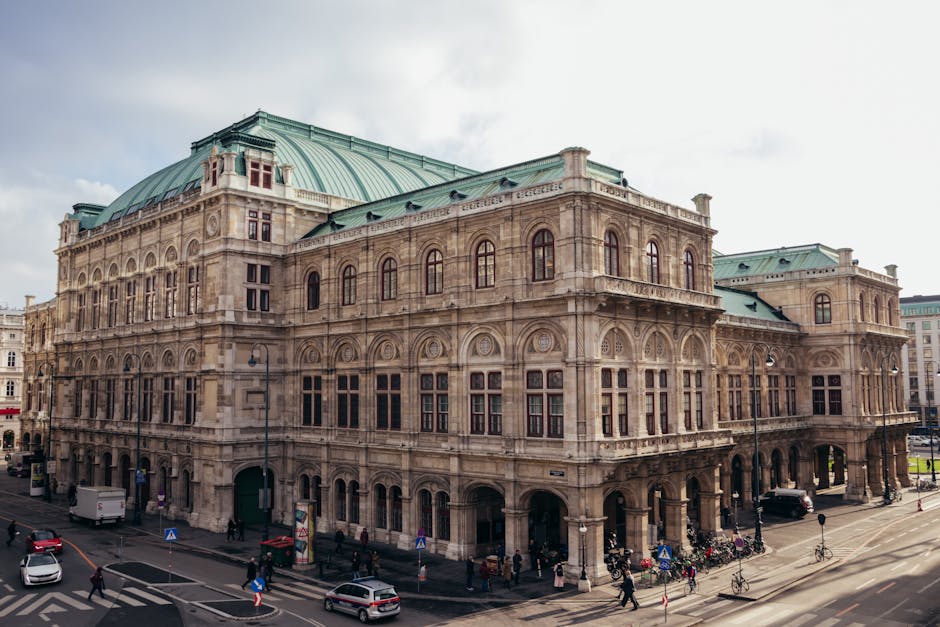
Follow the footsteps of Mozart and Strauss through Vienna’s historic center on this self-guided walk through the city's rich musical history.
 Moderate
Vienna, Austria
Discover the noir world of The Third Man and Cold War Vienna on this atmospheric self-guided audio walk through the historic Innere Stadt.
 Easy
EasyGdansk, Poland
Discover the opulent Royal Way of Gdansk at your own pace. Explore Hanseatic history, gilded architecture, and the iconic Neptune's Fountain.