Self-guided audio tour in Riga
Start Free on iPhone
Start free on iPhone to unlock this self-guided walking tour in Riga. Hear all the stories that make it amazing, walk at your own pace, and begin whenever you want.
Your Private Tour Guide
Step back into the 13th century and discover the legacy of the Hanseatic League on this self-guided walk through Riga’s Old Town. For centuries, Riga was a powerhouse of Northern European commerce, where wealthy merchants and skilled artisans shaped the city's skyline and its laws. This walking route invites you to explore the architectural remnants of that golden age, from the towering spires of the cathedral to the ornate meeting halls of the city’s powerful guilds. Unlike a traditional walking tour Riga might offer, this independent journey lets you linger under the Gothic arches and hidden alleyways at your own pace. Your exploration begins in Dome Square, the beating heart of the medieval city, before leading you to the architectural rivalry of the Great and Small Guilds. You will uncover the legends etched into the city's stone, such as the famous Cat House—a monument to a merchant's spite—and the Swedish Gate, a rare surviving piece of the city’s defensive fortifications. The route concludes at the Mentzendorff House, where the daily life of a wealthy 17th-century trader comes into focus. As you navigate the narrow, cobbled streets of Vecrīga, you will see how the Hanseatic influence blended with local Latvian culture to create a unique urban tapestry. This audio walk provides the historical context needed to understand Riga's rise as a maritime giant without the constraints of a rigid schedule. Whether you are interested in the intricate details of Neo-Gothic facades or the gritty history of medieval defense, this neighborhood stroll offers a comprehensive look at the city’s mercantile soul. While a guided tour Riga visitors often take might rush through these sites, Zigway allows you to soak in the atmosphere of the Baltics' largest medieval center independently.
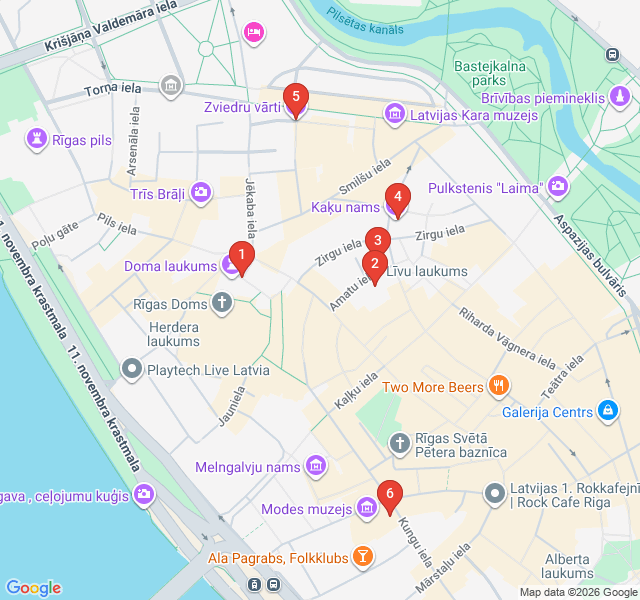
Numbers indicate the order of stops on the tour.
Welcome to Dome Square, the largest square in Old Riga and the symbolic center of the city’s religious and civic life. Standing here, you are surrounded by centuries of history, dominated by the massive Riga Dome Cathedral. Founded in 1211, this cathedral served as the seat of the Archbishop and a beacon for the Hanseatic merchants arriving by sea. The square itself was created much later, in the 19th century, by clearing away medieval buildings to provide a better view of the cathedral’s portals. Look around at the diverse architecture—from the 19th-century Stock Exchange building to the various styles of the surrounding townhouses. This open space was once a dense network of narrow streets where traders from across the Baltic region would meet to negotiate deals and exchange news.
Just a short walk from the square, you will find the Small Guild, a masterpiece of Neo-Gothic architecture. Built in the mid-19th century, this building served as the headquarters for Riga's master craftsmen. In the medieval hierarchy, the Small Guild represented the 'lower' tier of the elite—the artisans, blacksmiths, and weavers who kept the city running. Despite its name, there is nothing small about its ambition. The facade is adorned with intricate stone carvings and pointed arches, reflecting the guild's pride and wealth. Inside, the interiors are even more lavish, featuring stained glass and ornate woodwork that showcase the very skills these guilds protected. It stands as a testament to the period when craft regulations were the law of the land.
Directly across the way sits the Great Guild, the historic home of Riga’s wealthy merchants. While the current building dates primarily to the 19th century, it incorporates parts of the original 14th-century Münster Hall. The Great Guild was the most powerful organization in the city, controlling trade and often influencing local politics. Only the wealthiest German merchants were granted membership, creating an exclusive circle that dictated the city’s economic fate for centuries. Today, the building serves as a concert hall, but its exterior still conveys the formidable status of the men who once walked these halls. Notice the contrast between the Great Guild’s more reserved, stately appearance and the decorative flair of its neighbor, the Small Guild.
Look up at the yellow building nearby to see one of Riga’s most famous landmarks: the Cat House. While the building itself is a beautiful example of Art Nouveau architecture, it is the two black cats on the roof that steal the show. Legend has it that a wealthy Latvian merchant, who was denied membership in the Great Guild across the street, commissioned these statues as a form of architectural revenge. Originally, the cats were placed with their tails pointing directly toward the Guild’s windows—a medieval 'insult' in bronze. After a long legal battle, the merchant was eventually admitted, and the cats were turned around to face the building. It is a whimsical reminder of the fierce pride and social politics of Riga's mercantile history.
As you move toward the edge of the old city walls, you will encounter the Swedish Gate. Built in 1698 during the period of Swedish rule, it is the only one of Riga’s eight original city gates that remains standing today. Unlike the grand ceremonial gates of other European capitals, this gate was built directly into a row of residential houses to provide access to the barracks outside the wall. Local legend says the building above the gate once belonged to the city executioner, who would leave a red rose on the windowsill the morning of an execution. Walking through the archway, you can still see the grooves where the heavy wooden doors would have been barred shut at sunset to protect the city from intruders.
Our final stop is the Mentzendorff House, a remarkably preserved merchant’s residence dating back to 1695. This building offers a rare glimpse into the private life of Riga’s wealthy elite during the late Hanseatic era. Unlike the grand public guild halls, this was a home where business and family life intersected. The ground floor often served as a shop or warehouse, while the upper floors housed the family's living quarters. Inside, you can find original wall paintings, a historic kitchen with a massive chimney, and period furniture. It serves as the perfect bookend to our walk, showing the tangible results of the trade and craft industry that built the magnificent city you see today.
Start Free on iPhone
Explore “Hanseatic Trade and Medieval Guilds” with your very own Private Tour Guide with Zigway. Start free on iPhone, skip the large group and the fixed routes, and hear the city come alive as you go.
Your Private Tour Guide
Don't miss the good stuff
Explore Freely
 Moderate
Riga, Latvia
Discover Riga's Soviet-era architecture and history, from the KGB building to the iconic Stalinist Academy of Sciences on this self-guided walk.
 Easy
EasyRiga, Latvia
Explore Riga's lush 'Green Belt,' a scenic chain of historic parks, monuments, and romantic canals along the city's grand 19th-century boulevards.
 Easy
EasyRiga, Latvia
Explore Riga's poetic soul through its grand parks and iconic libraries on this self-guided literary walking route.
 Moderate
Riga, Latvia
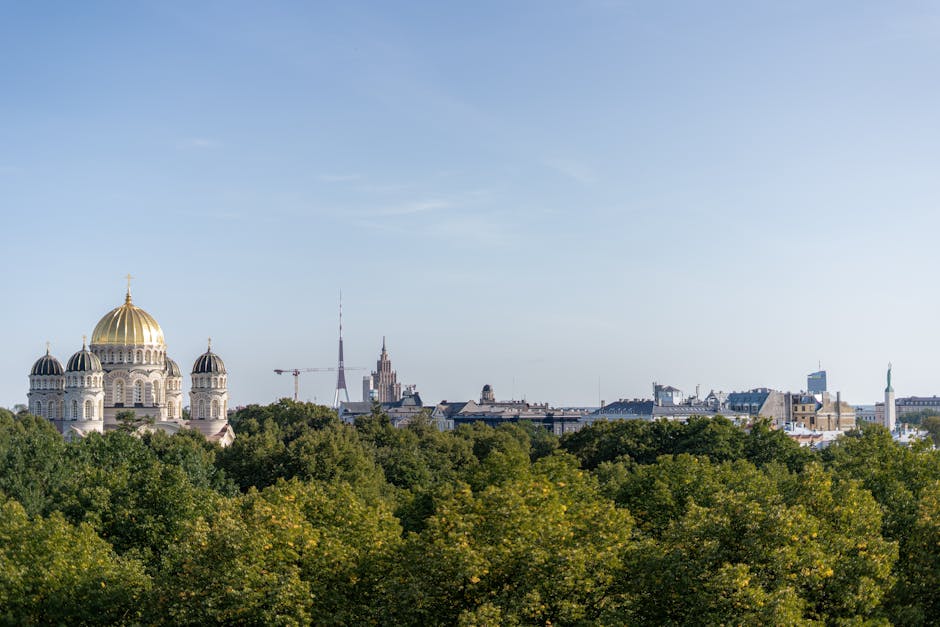
Discover Riga's modern skyline and historic wooden architecture on a scenic island walk with stunning river views and futuristic design.
 Easy
EasyGothenburg, Sweden
Discover Gothenburg’s 17th-century Dutch foundations, historic canals, and military fortifications on this self-guided architectural walk.
 Easy
EasyNairobi, Kenya
Explore Nairobi's architectural evolution from colonial-era landmarks to iconic Brutalist skyscrapers on this historic self-guided walking route.
 Easy
EasyNairobi, Kenya
Discover Nairobi's iconic skyline on this self-guided architecture walk through the CBD’s most famous modernist and Brutalist landmarks.
 Easy
EasyKrakow, Poland
Explore the prestigious Jagiellonian University district, featuring Neo-Gothic architecture, Baroque churches, and Krakow's hidden scholarly gems.