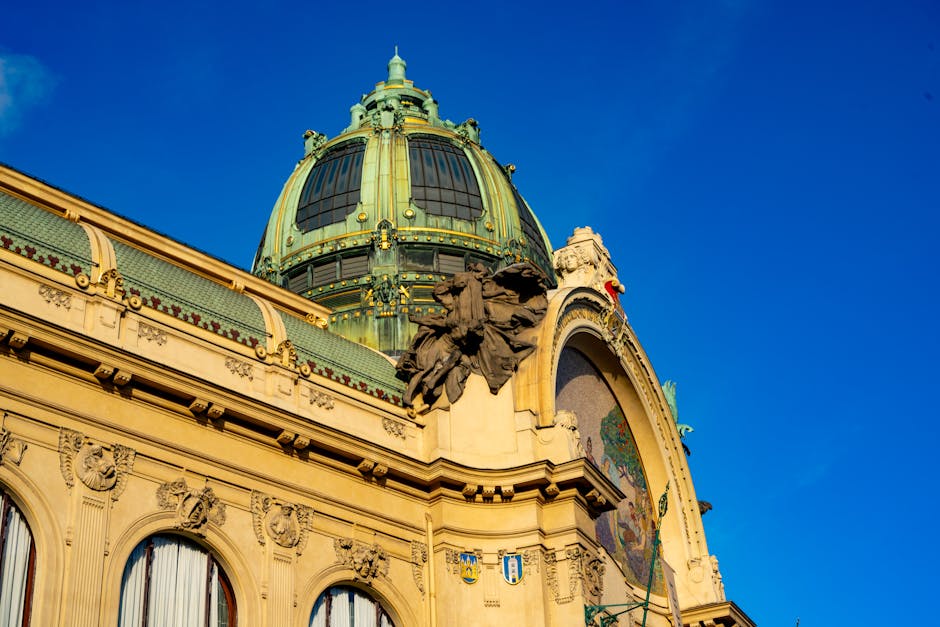
Self-guided audio tour in Riga
Start Free on iPhone
Start free on iPhone to unlock this self-guided walking tour in Riga. Hear all the stories that make it amazing, walk at your own pace, and begin whenever you want.
Your Private Tour Guide
Riga is often celebrated as the world's Art Nouveau capital, and this self-guided walk through the Quiet Center (Klusais centrs) reveals why. Around one-third of the city center’s buildings are designed in this flamboyant style, reflecting a period of immense wealth and creative explosion at the turn of the 20th century. This neighborhood stroll focuses on the most decorated streets, where architecture becomes theater, featuring stone faces that scream, sphinxes that guard doorways, and intricate floral patterns that climb up facades. This walking route is designed for those who want to explore independently and at their own pace, moving away from the medieval Old Town into a district defined by elegance and intellectual history. As you begin your self-guided adventure, you will encounter the works of Mikhail Eisenstein, the most famous architect of the movement in Riga. His designs are known for their 'Eclectic Art Nouveau' style, characterized by a horror vacui—a fear of empty spaces—that results in buildings covered from ground to roof in symbolic sculpture. You will see how these structures were more than just homes; they were statements of status for the rising middle class of the 1900s. Beyond the dramatic facades, this stroll also highlights the 'National Romantic' style, which sought to create a uniquely Latvian architectural identity by incorporating folk motifs and natural materials. Key landmarks along the way include the world-famous Alberta iela, where every building is a protected monument, and the stunning blue-and-white facade of Elizabetes iela 10b. You will also pass the Riga Art Nouveau Centre, housed in a building famous for its magnificent spiral staircase. Whether you are a photography enthusiast looking for the perfect shot of a stone gargoyle or an art lover curious about the Belle Époque in Northern Europe, this walking route provides a deep dive into the soul of Riga. This is not a traditional walking tour Riga might offer in a group; instead, it is a curated journey through a living museum, allowing you to linger under the watchful eyes of the stone giants that define the city's skyline.
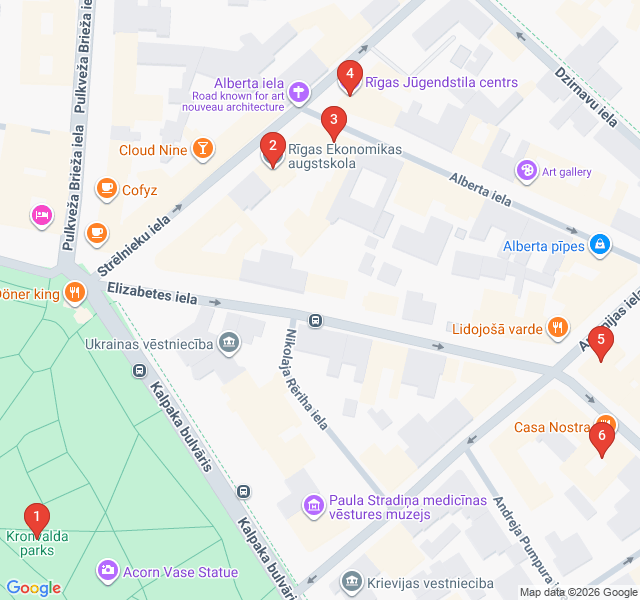
Numbers indicate the order of stops on the tour.
Start your self-guided walk in Kronvalda Park, a green oasis that was once part of the city's defensive fortifications. In the mid-19th century, the city walls were demolished and replaced with these beautiful boulevards and parks, setting the stage for the architectural boom that followed. As you walk toward the Quiet Center, notice the city canal. This area became the most prestigious part of Riga, where the wealthy elite built their summer houses and later, their grand Art Nouveau apartments. The park serves as a perfect transition from the medieval core to the modern, artistic heights of the early 1900s.
Arriving at Strēlnieku iela 4a, you encounter one of Mikhail Eisenstein's most theatrical creations. Built in 1905, this building is a masterpiece of Eclectic Art Nouveau. Look up to see the dense ornamentation: screaming masks, floral wreaths, and geometric patterns. Eisenstein, who was actually a civil engineer by trade and the father of the famous film director Sergei Eisenstein, used these facades to express deep emotion and narrative. The blue tiles and white plasterwork create a striking contrast that is a favorite for photography. This building currently houses the Stockholm School of Economics in Riga, continuing the building's legacy of prestige.
Alberta iela is the heart of Riga's Art Nouveau district, and number 13 is one of its most complex jewels. Designed by Eisenstein during a period of personal and social upheaval, the facade is laden with symbolism. You'll see figures representing grief, strength, and defiance. The building was restored with help from the Soros Foundation, and it stands as a testament to the city's resilience. Take a moment to look at the balconies and the way the stone seems to flow like liquid. Every inch of this street is a protected UNESCO World Heritage site, making it one of the most significant architectural clusters in Europe.
Located at Alberta iela 12, this building was the private residence of the renowned Latvian architect Konstantīns Pēkšēns. While the exterior is impressive, the real treasure is just inside the doorway. The building features one of the most spectacular spiral staircases in the world, decorated with ceiling paintings that reflect the organic, flowing lines of the 'Jugendstil' movement. If you choose to enter the museum, you can see a fully restored early 20th-century apartment, complete with original furniture and kitchenware, offering a glimpse into the daily life of Riga's upper class during the golden age of Art Nouveau.
As you turn onto Elizabetes iela, look for the two massive sphinxes guarding the entrance to number 33. In the language of Art Nouveau, the sphinx represents mystery, wisdom, and the unknown. These mythical creatures were a popular motif, blending the era's obsession with ancient civilizations and the subconscious. The scale of these sculptures is intentional, designed to make the pedestrian feel small and the building feel like a temple of modern living. This stop highlights the 'Symbolist' branch of the movement, where every figure and animal depicted on a building had a specific, often philosophical, meaning.
We conclude our neighborhood stroll at what is perhaps the most photographed building in Riga. Elizabetes iela 10b, designed by Eisenstein in 1903, features a stunning blue ceramic facade topped with two massive stone heads looking out over the city. These faces are said to represent the sun and the moon, or perhaps the dual nature of humanity. The composition is perfectly symmetrical, creating a sense of grand harmony. The use of bright blue tiles was a signature of the era, intended to make the building stand out even on Riga's many overcast days. It remains a definitive icon of the city's artistic heritage.
Start Free on iPhone
Explore “Art Nouveau Masterpieces of the Quiet Center” with your very own Private Tour Guide with Zigway. Start free on iPhone, skip the large group and the fixed routes, and hear the city come alive as you go.
Your Private Tour Guide
Don't miss the good stuff
Explore Freely
 Moderate
Riga, Latvia
Discover Riga's Soviet-era architecture and history, from the KGB building to the iconic Stalinist Academy of Sciences on this self-guided walk.
 Easy
EasyRiga, Latvia
Explore Riga's lush 'Green Belt,' a scenic chain of historic parks, monuments, and romantic canals along the city's grand 19th-century boulevards.
 Easy
EasyRiga, Latvia
Explore Riga's poetic soul through its grand parks and iconic libraries on this self-guided literary walking route.
 Moderate
Riga, Latvia
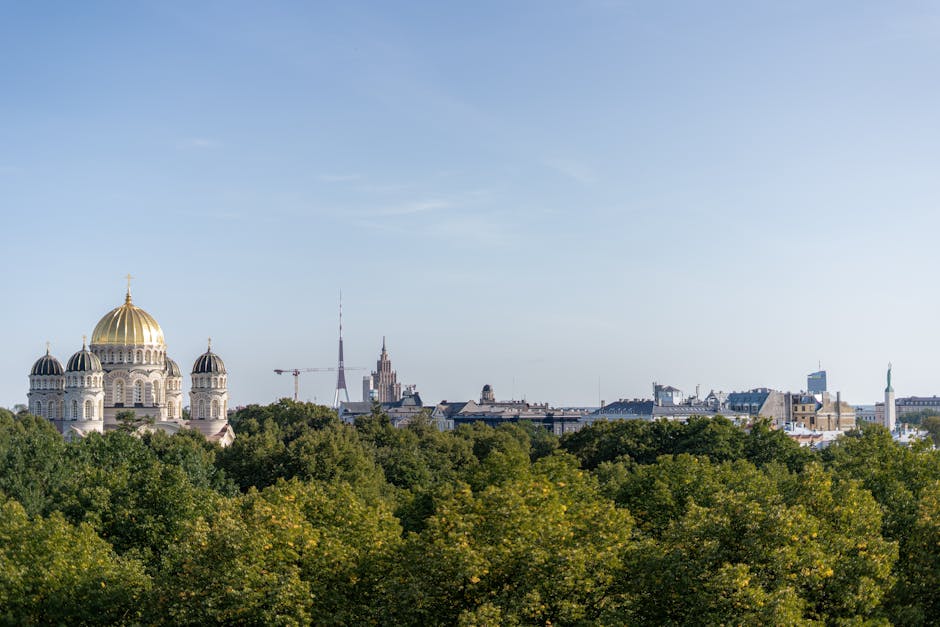
Discover Riga's modern skyline and historic wooden architecture on a scenic island walk with stunning river views and futuristic design.
 Easy
EasyNairobi, Kenya
Discover Nairobi's iconic skyline on this self-guided architecture walk through the CBD’s most famous modernist and Brutalist landmarks.
 Easy
EasyKrakow, Poland
Explore the prestigious Jagiellonian University district, featuring Neo-Gothic architecture, Baroque churches, and Krakow's hidden scholarly gems.
 Easy
EasyGdansk, Poland
Discover the 'Baltic Gold' on this self-guided walk through Gdansk's historic mills, massive cathedrals, and the magical Mariacka Street.
 Easy
EasyGothenburg, Sweden
Explore Gothenburg’s historic wooden houses, legendary giant cinnamon buns, and panoramic fortress views on this self-guided neighborhood stroll.