Self-guided audio tour in Tallinn
Start Free on iPhone
Start free on iPhone to unlock this self-guided walking tour in Tallinn. Hear all the stories that make it amazing, walk at your own pace, and begin whenever you want.
Your Private Tour Guide
Venturing beyond the medieval walls of the Old Town reveals a different side of Tallinn, where industrial grit meets creative rebirth. This self-guided walk takes you into the heart of Kopli, a peninsula once known for its heavy industry and worker barracks, now emerging as the city's most exciting creative frontier. For decades, Kopli was a place many locals avoided, but today it is a canvas for urban explorers and art enthusiasts. This neighborhood stroll captures the transition of the 'New North,' highlighting how derelict factories have become vibrant community hubs. The route begins in the tranquil Kopli Cemetery Park, a site that tells a poignant story of Tallinn's Baltic German history and the layers of change the city has endured. From there, you will navigate toward the Põhjala Factory, the crown jewel of the area’s regeneration. Unlike the more polished Telliskivi Creative City, Põhjala retains a raw, authentic edge. You can explore independent studios, hidden galleries, and lush greenery that seems to grow directly out of the concrete. As you continue your walking route, you will encounter the Botik Bar Garden, a 'secret' sanctuary that exemplifies the neighborhood's DIY spirit. The walk then leads you to the historic Kopli Tram Terminal and the legendary Kopli Lines. Once a row of dilapidated wooden barracks for shipyard workers, the Lines are currently undergoing one of the most dramatic architectural transformations in Northern Europe. This walking tour Tallinn experience concludes at the serene St. Nicholas' Church, a spiritual anchor amidst the industrial landscape. Whether you are interested in industrial heritage, modern street art, or simply seeking a peaceful escape by the sea, this self-guided adventure offers a deep dive into the soul of modern Estonia. Exploring this area independently allows you to soak in the atmosphere of a neighborhood in flux, where every corner reveals a new mural or a repurposed warehouse. Discover the unique charm of the Kopli peninsula and see why it is becoming the favorite haunt for local creatives on this immersive walking tour Tallinn. **Note:** This area is known for its ever-changing character. Street art, pop-up venues, and temporary exhibitions may differ from what's described. That's part of the adventure - you might discover something entirely new!
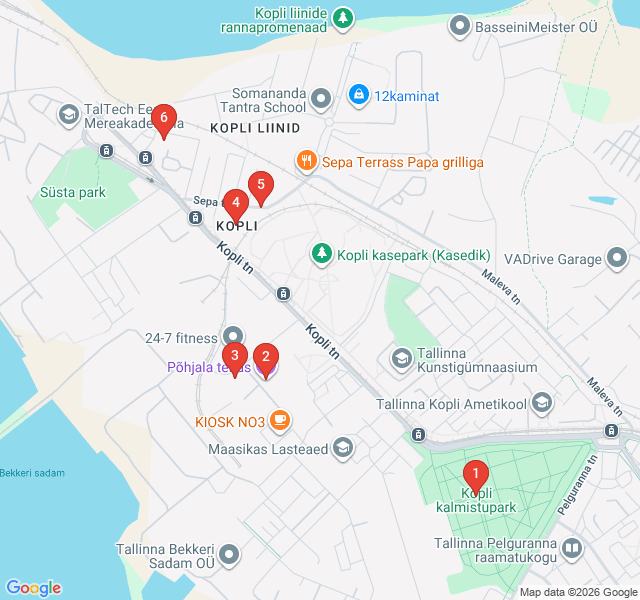
Numbers indicate the order of stops on the tour.
Begin your exploration at Kopli Cemetery Park, a place of profound quietude with a complex history. Established in 1774, this was once the primary burial ground for Tallinn's Baltic German elite. However, during the Soviet occupation in the early 1950s, the cemetery was completely leveled, its headstones repurposed as building materials for walls and parks across the city. Today, it has been sensitively restored as a public park. As you walk beneath the ancient lime trees, look for the subtle memorial markers that honor those once buried here. It serves as a stark reminder of how urban spaces are reclaimed and redefined through different political eras.
Arrive at the Põhjala Factory, the beating heart of the Kopli renaissance. This massive complex was originally built in the 1920s to manufacture rubber goods, from galoshes to raincoats. After falling into disrepair following the collapse of the Soviet Union, it has been revitalized by a community of artists and entrepreneurs. The space is volatile and ever-changing; you might find a pop-up gallery in one corner and a rooftop garden in another. Take time to wander through the corridors where industrial machinery once hummed, now replaced by the scent of fresh sourdough from the local bakery and the sight of modern murals. It represents the gritty, unpolished side of Tallinn's creative scene.
Tucked away near the factory is Botik, a bar and community space that feels like a hidden forest sanctuary. The 'garden' here is a prime example of the neighborhood's DIY aesthetic, featuring reclaimed furniture and lush, semi-wild greenery. This stop highlights the social shift in Kopli—from a strictly industrial zone to a place where locals gather for community events and quiet afternoons. Note that the garden's appearance and availability change with the seasons; in summer, it is a vibrant hub of outdoor life, while in winter, the focus shifts to the cozy, industrial-chic interior. It is an ideal spot to observe the local 'Kopli vibe' firsthand.
As you reach the end of the tram line, you are at a historic transit node. The Kopli Tram Terminal, with its distinctive loop and 1930s wooden station building, has long been the primary connection between this peninsula and the rest of Tallinn. For decades, reaching this 'end of the line' felt like entering a different world. The architecture here reflects the functionalist style of the Estonian Republic's first independence period. Notice how the trams navigate the tight loop—a mechanical choreography that has remained largely unchanged for nearly a century. It marks the transition point between the industrial factory zone and the residential 'Lines' ahead.
The Kopli Lines represent one of the city's most significant urban development stories. Originally built between 1912 and 1917 to house workers from the Russo-Baltic Shipyard, these wooden barracks eventually became synonymous with urban decay. For years, they were a 'no-go' zone of abandoned buildings. Now, the area is being transformed into a high-end residential district. As you walk through, you will see a striking contrast: meticulously restored wooden facades and modern glass architecture standing where ruins once were. The proximity to the sea and the unique street layout make this one of the most photogenic, yet controversial, examples of gentrification in the Baltic states.
This walking route concludes at St. Nicholas' Church, a modest but beautiful wooden Orthodox church. Built in 1934-1936 to serve the shipyard workers and the local community, it survived the industrialization of the Soviet era that claimed many other religious sites. Its architecture is characteristically Estonian, blending traditional wooden construction with Orthodox religious requirements. The interior is often filled with the scent of incense and the glow of candles, offering a peaceful, spiritual counterpoint to the industrial history of the surrounding streets. From here, you can look out toward the Gulf of Tallinn, reflecting on the layers of history that define this 'New North.'
Start Free on iPhone
Explore “Põhjala Factory: The New North” with your very own Private Tour Guide with Zigway. Start free on iPhone, skip the large group and the fixed routes, and hear the city come alive as you go.
Your Private Tour Guide
Don't miss the good stuff
Explore Freely
 Easy
EasyTallinn, Estonia
Uncover the myths and merchant history of Tallinn's Lower Town on this immersive self-guided stroll through medieval streets.
 Moderate
Tallinn, Estonia
Uncover the chilling legends and ghostly tales of medieval Tallinn on this atmospheric self-guided audio walk through the Old Town.
 Easy
EasyTallinn, Estonia
Discover imperial palaces and serene gardens on this self-guided walk through Tallinn’s historic Kadriorg district.
 Easy
EasyTallinn, Estonia
Discover Tallinn's industrial-chic heart. Explore daring architecture, cinematic history, and trendy boutiques in the award-winning Rotermann Quarter.
 Moderate
Gdansk, Poland
Discover Zaspa, a massive open-air gallery where grey housing blocks are transformed by over 60 monumental murals. Explore at your own pace.
 Moderate
Gdansk, Poland
Discover the raw beauty of Gdansk’s Lower Town. Explore industrial ruins, hidden sluices, and riverside bastions on this self-guided walk.
 Moderate
Gothenburg, Sweden
Discover Gothenburg’s maritime soul on this self-guided walk from the historic Central Station to the scenic riverfront at Stenpiren.
 Moderate
Nairobi, Kenya
Discover Nairobi's lush side on this self-guided walk through botanical gardens, historic memorials, and vibrant local markets.