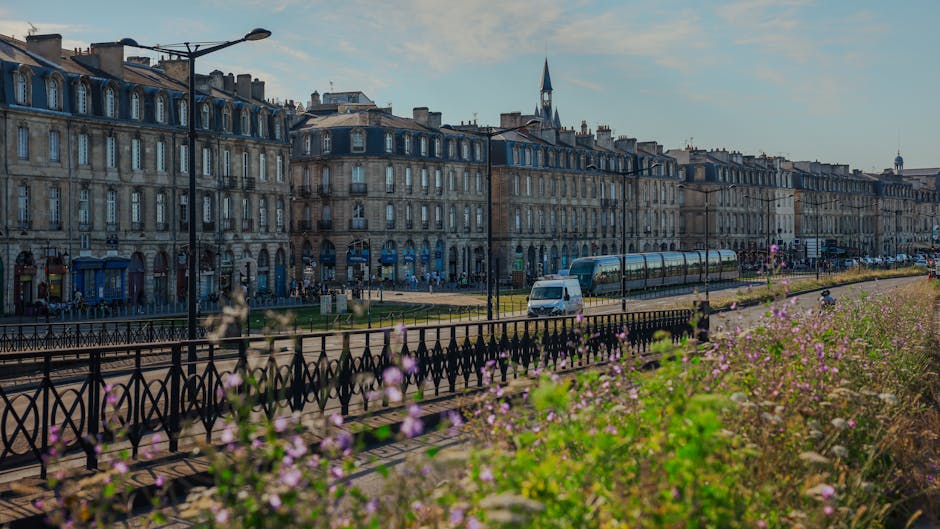
Self-guided audio tour in Bordeaux
Start Free on iPhone
Start free on iPhone to unlock this self-guided walking tour in Bordeaux. Hear all the stories that make it amazing, walk at your own pace, and begin whenever you want.
Your Private Tour Guide
Bordeaux is world-renowned for its wine, but beneath its celebrated vineyards lies a spiritual foundation carved in limestone and history. This self-guided walk invites you to trace the footsteps of medieval travelers on the Way of Saint James, exploring the city’s most significant religious and architectural landmarks. Long before the 18th-century facades defined the riverfront, Bordeaux was a vital sanctuary for pilgrims heading toward Santiago de Compostela. On this walking route, you will discover how the city’s sacred spaces evolved from Romanesque foundations to the soaring heights of Flamboyant Gothic. Beginning at the monumental Place Pey-Berland, the route highlights the duality of the city's power: the spiritual and the civic. You will encounter the Cathedral of Saint-André, a site of royal weddings and architectural innovation, before moving toward the ornate Baroque interiors of the 'Golden Age' churches. This neighborhood stroll through the Centre Ville offers a unique perspective on the city’s layout, revealing how ancient gates like Porte Dijeaux served as both defensive barriers and welcoming portals for weary travelers. Unlike a standard walking tour Bordeaux visitors might expect, this journey focuses on the 'Sacred Stones'—the enduring structures that have survived revolutions and urban renewals. The experience concludes at the Basilica of Saint Seurin, a site so ancient it predates the city’s current cathedral. Here, the history of early Christianity in Gaul comes alive amidst a sprawling necropolis. Whether you are an architecture enthusiast or a history buff, this audio walk provides the context needed to appreciate the intricate carvings, the soaring vaults, and the quiet cloisters of Bordeaux’s religious heritage. Explore independently and at your own pace, soaking in the atmosphere of the 'Sleeping Beauty' as she reveals her oldest secrets through this carefully curated pilgrimage path.
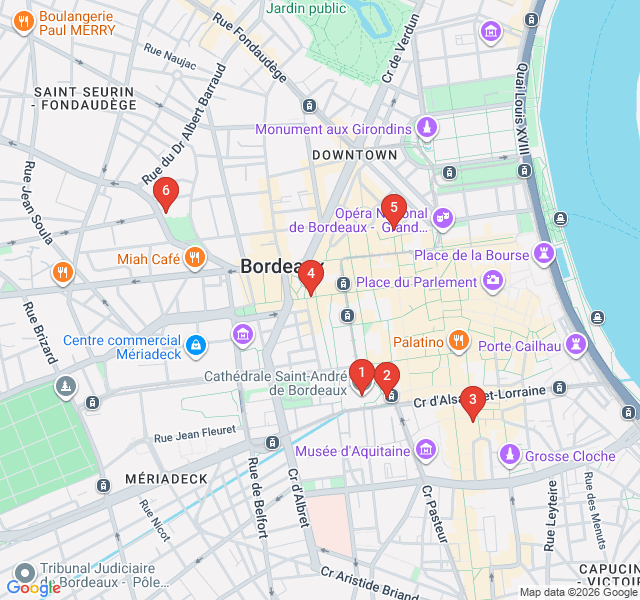
Numbers indicate the order of stops on the tour.
Welcome to the heart of Bordeaux’s spiritual history. The Cathedral of Saint-André is more than just a place of worship; it is a witness to the city’s most pivotal moments, including the marriage of Eleanor of Aquitaine to Louis VII in 1137. As you look at the structure, notice the mix of Romanesque and Gothic styles. The nave, originally built in the 11th century, was later expanded to accommodate the growing number of pilgrims on the Way of Saint James. Look up at the North Portal, often called the 'Royal Portal,' which features exquisite 13th-century sculptures. This cathedral served as a beacon for travelers crossing France, providing a moment of respite and prayer before they continued their arduous journey south toward the Pyrenees.
Standing separate from the cathedral is the Tour Pey-Berland, one of the most iconic silhouettes in the Bordeaux skyline. You might wonder why the bell tower isn't attached to the main church. The answer lies in the marshy ground of medieval Bordeaux; the weight of the massive bells and their vibrations would have threatened the structural integrity of the cathedral itself. Built in the 15th century by Archbishop Pey Berland, the tower is topped with a gleaming gilded statue of Notre-Dame d'Aquitaine. It represents the height of Flamboyant Gothic architecture in the region. For centuries, its bells have signaled the start of festivals, the arrival of kings, and the call to prayer for the thousands of pilgrims passing through the square.
As we move into the 17th century, the architectural style of Bordeaux shifted dramatically. This church is a prime example of Jesuit architecture, characterized by its sobriety and focus on the pulpit, designed to enhance the preaching during the Counter-Reformation. While the Gothic cathedrals reached for the heavens with pointed arches, the Jesuits favored the Baroque aesthetic of light and space. The interior is surprisingly grand, featuring a magnificent high altar. This stop marks a transition in our walk from the medieval pilgrimage route to the era of Catholic renewal, reflecting how Bordeaux’s religious identity continued to evolve as the city grew into a major maritime power.
You are standing before one of the grandest gateways into the old city. Porte Dijeaux was constructed in the mid-18th century on the site of an ancient Roman gate. Its name likely derives from 'De Jovis,' suggesting a temple to Jupiter once stood nearby. For pilgrims, this gate was a crucial landmark; it marked the western entrance to the city center. The classical architecture you see here, with its elegant pediment and coat of arms, reflects the urban planning of the Intendants who transformed Bordeaux from a cramped medieval town into a modern, airy city. Imagine the contrast for a traveler in the 1700s, moving from the dusty roads of the countryside into the sophisticated, stone-carved streets of the city through this very arch.
Often considered the most beautiful Baroque church in Bordeaux, Église Notre-Dame was inspired by the Church of the Gesu in Rome. Its facade is a masterpiece of stone carving, featuring intricate statues and scrolls that seem to dance in the sunlight. Built for the Dominican order in the late 17th century, it sits adjacent to the Cour Mably, a quiet cloister that once served as a place of meditation for monks. The church was strategically placed near the affluent residences of the time, serving the spiritual needs of the city's rising merchant class. Step inside to appreciate the exceptional acoustics and the detailed wood carvings of the organ, which remains one of the finest in the region.
Our journey ends at the Basilica of Saint Seurin, the true cradle of Christianity in Bordeaux. While the cathedral is the center of the diocese today, Saint Seurin was the city's first religious heart. This UNESCO World Heritage site is a stop on the Santiago de Compostela route and houses a fascinating archaeological crypt. Beneath your feet lies a 4th-century necropolis, where early Christians were buried alongside Roman sarcophagi. The basilica itself is a patchwork of history, with its 11th-century porch and Romanesque nave. It serves as a fitting conclusion to our pilgrimage path, connecting the modern city to its ancient, sacred roots and the countless travelers who have sought solace here for over fifteen hundred years.
Start Free on iPhone
Explore “Bordeaux’s Sacred Stones: The Pilgrimage Path” with your very own Private Tour Guide with Zigway. Start free on iPhone, skip the large group and the fixed routes, and hear the city come alive as you go.
Your Private Tour Guide
Don't miss the good stuff
Explore Freely
 Easy
EasyBordeaux, France
Explore the vibrant Saint-Michel district and the legendary Marché des Capucins on this self-guided food and culture walk through Bordeaux.
 Easy
EasyBordeaux, France
Discover the intellectual soul of Bordeaux on this self-guided walk through the haunts of legendary philosophers and writers.
 Moderate
Bordeaux, France
Explore the bold Brutalist architecture of Bordeaux's Mériadeck district on this self-guided walk through 1970s urban design and hanging gardens.
 Moderate
Bordeaux, France
Explore Bordeaux's creative edge on this self-guided walk from classic museums to the vibrant Darwin Ecosystem and industrial ruins.
 Easy
EasyNairobi, Kenya
Explore Nairobi's architectural evolution from colonial-era landmarks to iconic Brutalist skyscrapers on this historic self-guided walking route.
 Easy
EasyNairobi, Kenya
Discover Nairobi's iconic skyline on this self-guided architecture walk through the CBD’s most famous modernist and Brutalist landmarks.
 Easy
EasySalzburg, Austria
Discover the 'Rome of the North' on this self-guided walk through the Baroque squares and monumental legacy of Salzburg’s Prince-Archbishops.
 Easy
EasyGothenburg, Sweden
Discover Gothenburg’s 17th-century Dutch foundations, historic canals, and military fortifications on this self-guided architectural walk.
 Challenging
Paris, France
Explore the secret vineyards, legendary artist studios, and hidden squares of Paris's iconic hilltop on this self-guided bohemian walking route.
 Easy
EasyParis, France
Explore the evolution of Parisian design from Art Nouveau whimsy to Le Corbusier's Modernist masterpieces on this self-guided architectural walk.
 Easy
EasyParis, France
Explore the flavors and history of Bastille on this self-guided walk through the legendary Aligre Market and the scenic Coulée Verte.
 Easy
EasyParis, France
Discover aristocratic mansions, secret medieval courtyards, and royal history on this self-guided walk through the enchanting Marais district.