Self-guided audio tour in Buenos Aires
Start Free on iPhone
Start free on iPhone to unlock this self-guided walking tour in Buenos Aires. Hear all the stories that make it amazing, walk at your own pace, and begin whenever you want.
Your Private Tour Guide
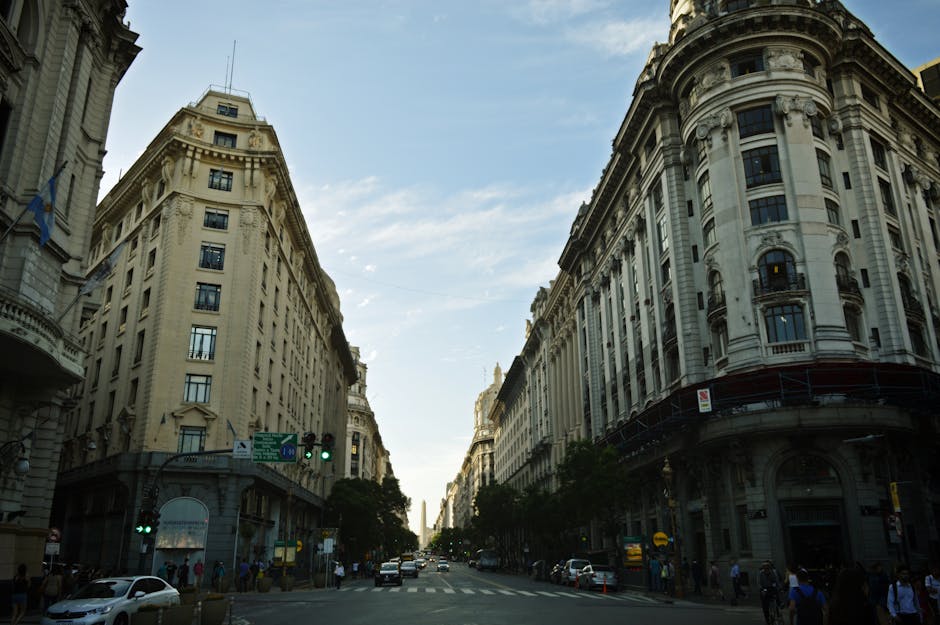
Step into the 'Paris of the South' on this self-guided walk along Avenida de Mayo, the first great boulevard of Buenos Aires. Established in 1894, this street was designed to rival the grand avenues of Europe, and it remains the city's architectural and political spine. This walking route takes you through a landscape of Belle Époque splendor, Spanish-style theaters, and literary cafes where the city’s intellectual elite once gathered. As you explore independently, you will witness the evolution of Buenos Aires from a colonial outpost to a global metropolis. The journey begins at the legendary Café Tortoni, the oldest coffee house in the country. From here, the route leads toward the historic Plaza de Mayo, the site of the 1810 May Revolution and the enduring heart of Argentine political life. You will see the colonial-era Cabildo, which stands as a quiet witness to the birth of the nation. Moving westward, the architecture shifts toward the ornate and the avant-garde. Highlights include the Teatro Avenida, a bastion of Spanish culture, and the extraordinary Palacio Barolo. This unique skyscraper was designed based on Dante’s Divine Comedy, with its floors representing Hell, Purgatory, and Heaven, topped by a lighthouse that once signaled across the Rio de la Plata. This neighborhood stroll is perfect for those who appreciate fine masonry, hidden symbolic meanings in architecture, and the rich literary history of figures like Jorge Luis Borges and Federico García Lorca. The walk concludes at the monumental National Congress, a neoclassical masterpiece that anchors the western end of the avenue. By following this walking route, you can set your own pace, stopping for a 'cortado' at a historic bar or lingering to photograph the intricate facades that define this iconic district. This walking tour Buenos Aires experience provides a deep dive into the soul of the city without the constraints of a rigid schedule.
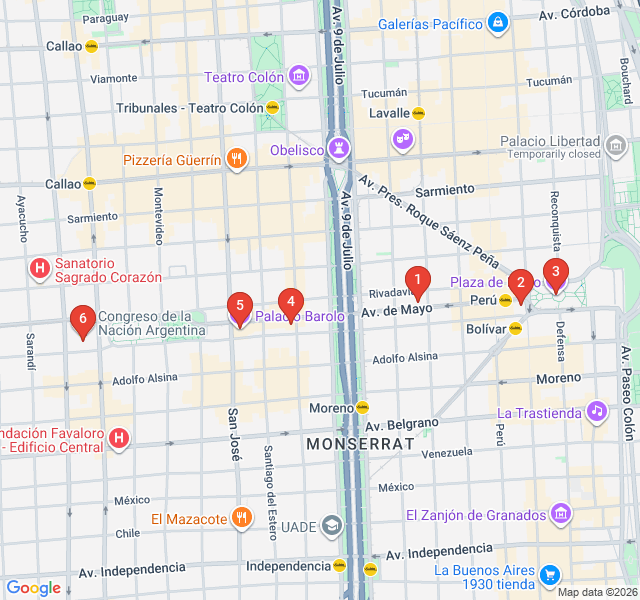
Numbers indicate the order of stops on the tour.
Welcome to Café Tortoni, the oldest café in Argentina, founded in 1858. This isn't just a place for coffee; it is a monument to the city's intellectual history. As you stand before its stained glass and dark wood interiors, imagine the 'Agrupación de Gente de Artes y Letras' meeting here, led by painter Benito Quinquela Martín. For decades, literary giants like Jorge Luis Borges and Federico García Lorca sat at these tables. The café was originally inspired by the Parisian style of the late 19th century, helping earn Buenos Aires its nickname, the 'Paris of the South.' Notice the bronze busts and the preserved atmosphere that makes this a cornerstone of the city's 'Bares Notables' list.
The Cabildo is a rare survivor of the colonial era. Originally completed in 1764, it served as the seat of the Spanish administration. However, its most famous moment came in May 1810, when citizens gathered here to demand independence from Spain, sparking the May Revolution. Look closely at the building; you might notice it looks a bit truncated. That is because parts of the original structure were demolished in the late 19th and early 20th centuries to make way for the opening of Avenida de Mayo and Diagonal Sur. Today, it houses a museum dedicated to the revolution and the colonial history of the city.
Plaza de Mayo is the most important square in Argentina. Since 1580, it has been the stage for the country's most significant social and political events. In the center stands the Pirámide de Mayo, the city's oldest national monument. You may notice white headscarves painted on the ground around the pyramid; these represent the Mothers of the Plaza de Mayo, who have marched here every Thursday since 1977 to demand justice for their disappeared children during the military dictatorship. Surrounding the square are the Casa Rosada (the Presidential Palace), the Metropolitan Cathedral, and the National Bank, making this the undeniable power center of the nation.
As you continue down Avenida de Mayo, you will find the Teatro Avenida, which opened in 1908. This theater has long been the spiritual home of the Spanish community in Buenos Aires, specializing in zarzuelas and Spanish drama. It witnessed a tragic fire in 1979 that nearly destroyed it, but it was lovingly restored and reopened in 1994. Its architecture reflects the Spanish influence that defines this specific avenue, distinguishing it from the French-inspired streets elsewhere in the city. The theater remains a vibrant part of the local arts scene, hosting operas and concerts that continue the neighborhood's long-standing cultural traditions.
Palacio Barolo is perhaps the most fascinating building in Buenos Aires. Completed in 1923 by architect Mario Palanti for textile tycoon Luis Barolo, the building is a physical manifestation of Dante Alighieri’s 'Divine Comedy.' The basement and ground floor represent Hell, the middle floors Purgatory, and the upper floors Heaven. The building’s height of 100 meters corresponds to the 100 cantos of Dante's poem. At the very top is a lighthouse that was intended to connect with a twin building, Palacio Salvo, in Montevideo, Uruguay. Its unique eclectic style, blending neo-Gothic and neo-Romanesque elements with Hindu-inspired details, makes it an architectural marvel unlike any other in the world.
This self-guided adventure ends at the Palace of the Argentine National Congress. Finished in 1906, this Greco-Roman neoclassical building features a massive 80-meter-high bronze dome that weighs 3,000 tons. The green patina of the copper is a landmark visible from far down the avenue. The building was designed to face the Casa Rosada at the opposite end of Avenida de Mayo, symbolizing the balance of power between the legislative and executive branches. In the square in front, look for the 'Monumento a los Dos Congresos' and a cast of Rodin’s 'The Thinker.' This site remains the focal point for modern political demonstrations and national celebrations.
Start Free on iPhone
Explore “Paris of the South: Avenida de Mayo” with your very own Private Tour Guide with Zigway. Start free on iPhone, skip the large group and the fixed routes, and hear the city come alive as you go.
Your Private Tour Guide
Don't miss the good stuff
Explore Freely
 Easy
EasyBuenos Aires, Argentina
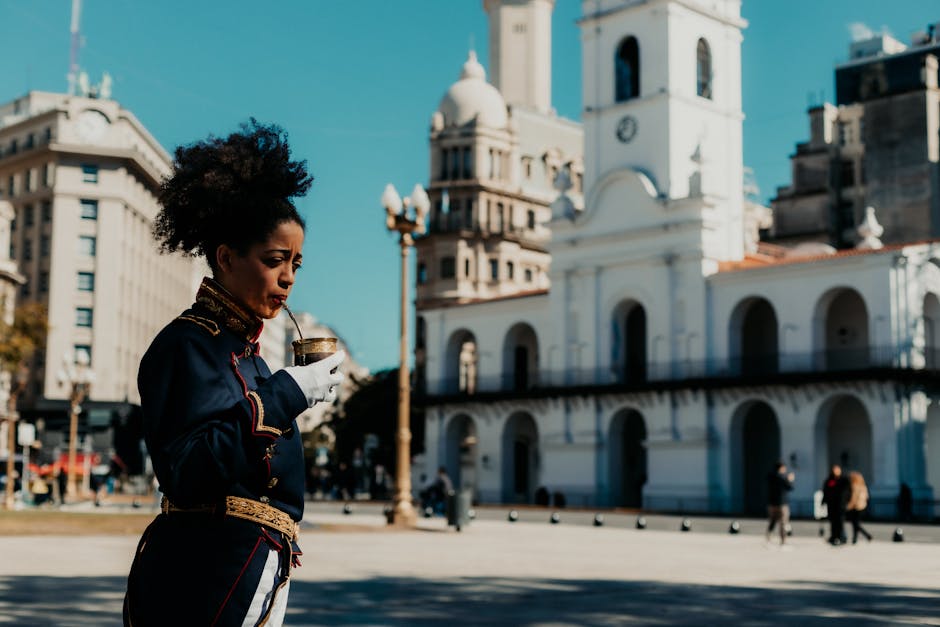
Explore the elegance of Recoleta on this self-guided walk featuring grand museums, colonial churches, and the legendary Recoleta Cemetery.
 Easy
EasyBuenos Aires, Argentina
Discover a blend of aristocratic mansions, lush gardens, and vibrant Asian culture on this self-guided walk through Buenos Aires' Belgrano district.
 Moderate
Buenos Aires, Argentina
Follow the footsteps of Borges and Ocampo through the bookstores, libraries, and historic cafes of Buenos Aires' most elegant neighborhoods.
 Moderate
Buenos Aires, Argentina
Explore the soulful heart of Buenos Aires on this self-guided walk through San Telmo’s historic markets, hidden tunnels, and antique-filled plazas.
 Moderate
Vienna, Austria
Follow the footsteps of Mozart and Strauss through Vienna’s historic center on this self-guided walk through the city's rich musical history.
 Moderate
Gothenburg, Sweden
Discover Gothenburg’s maritime soul on this self-guided walk from the historic Central Station to the scenic riverfront at Stenpiren.
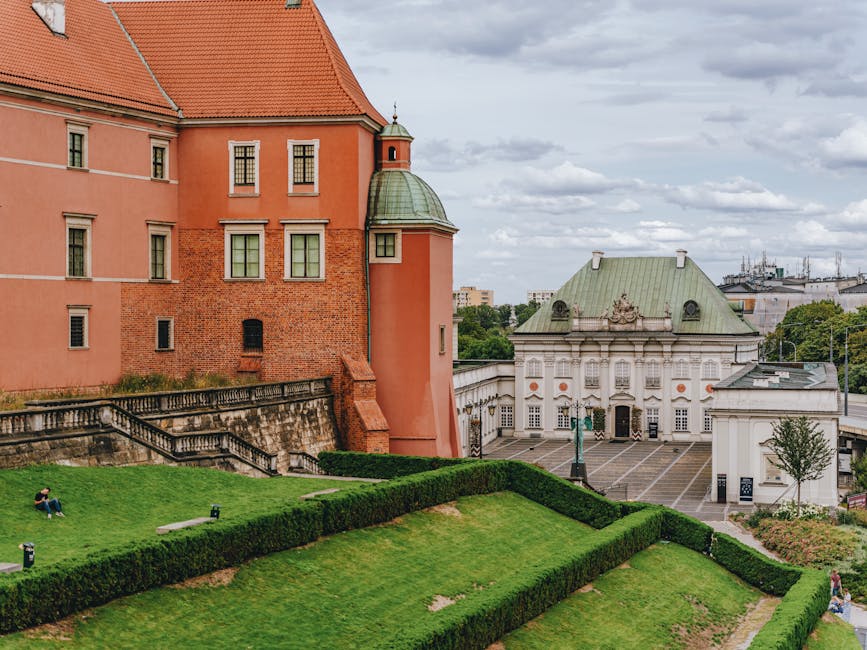 Moderate
Warsaw, Poland
Explore the resilient spirit of Warsaw's Muranów district on this self-guided walk through the history and landmarks of the former Jewish Ghetto.
 Moderate
Helsinki, Finland
Explore the 'Gibraltar of the North' on this independent walking route through the historic bastions and hidden gardens of Suomenlinna Sea Fortress.