Self-guided audio tour in Cape Town
Start Free on iPhone
Start free on iPhone to unlock this self-guided walking tour in Cape Town. Hear all the stories that make it amazing, walk at your own pace, and begin whenever you want.
Your Private Tour Guide
Step into 'Obs,' as locals affectionately call it, the bohemian soul of Cape Town. This self-guided walk invites you to explore a neighborhood where Victorian architecture meets street art, and where the city's intellectual heart beats alongside its most eccentric residents. Observatory has long been a sanctuary for activists, artists, and students, maintaining a gritty, authentic charm that stands in stark contrast to the polished Waterfront. On this walking route, you will experience the dual identity of the area: its vibrant, sometimes chaotic social scene and its quiet, prestigious scientific heritage. Starting on the bustling Lower Main Road, you will weave through streets lined with vintage clothing stores and independent cafes before finding peace in a historic garden of remembrance. The journey culminates at the South African Astronomical Observatory, the very institution that gave the suburb its name. Along the way, you will discover the stories of the SS Mendi, the evolution of South African alternative theater, and the colonial history embedded in the local library and Victorian residences. This neighborhood stroll is perfect for those looking to uncover a layer of Cape Town that many visitors miss—a place where history is lived on the sidewalks and the stars are studied from the hilltops. Whether you are interested in social history, architecture, or simply soaking up a unique local atmosphere, this self-guided adventure offers a comprehensive look at one of the city's most enduringly cool districts. The route is flat and easy to navigate, making it ideal for a relaxed afternoon of exploration at your own pace. **Note:** This area is known for its ever-changing character. Street art, pop-up venues, and temporary exhibitions may differ from what's described. That's part of the adventure - you might discover something entirely new!
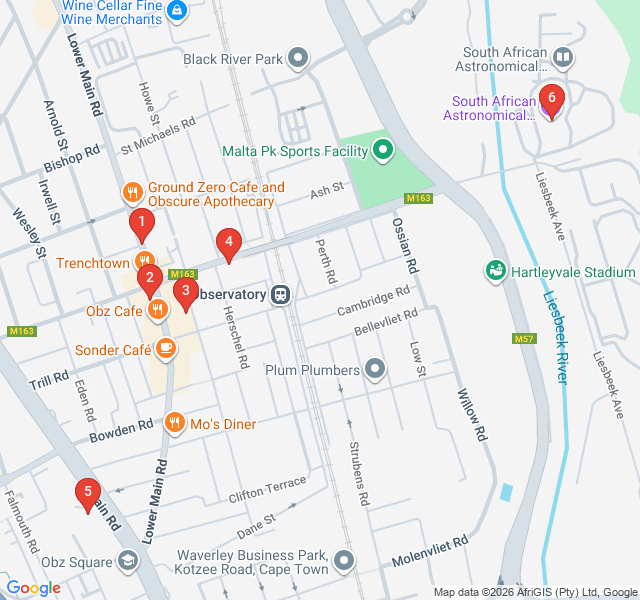
Numbers indicate the order of stops on the tour.
Welcome to the heart of Observatory. Lower Main Road is the neighborhood's primary artery, known for its eclectic mix of second-hand bookstores, vintage boutiques, and diverse eateries. As you begin your neighborhood stroll, notice the blend of Victorian-era shopfronts and modern street art. This area has historically been a 'grey area' during the apartheid era—a place where people of different races defied segregation laws to live and socialize together. Today, it remains a bastion of alternative culture and student life, thanks to its proximity to the University of Cape Town. Take a moment to soak in the atmosphere of one of the city's most authentic social hubs, where the scent of roasting coffee competes with the salty breeze from the nearby Black River.
The Armchair Theatre is more than just a venue; it is an institution in the South African alternative scene. For decades, this space has served as a launchpad for local musicians, comedians, and performance artists. Its quirky interior and intimate stage have seen legendary performances that defined the 'Obs' vibe. While the lineup of events changes constantly, the building itself stands as a monument to the neighborhood's creative spirit. In the 1990s and early 2000s, it was the epicenter of the city's underground culture. As you pass by, imagine the echoes of jazz, rock, and stand-up comedy that have filled this space, contributing to Observatory's reputation as the artistic soul of Cape Town.
Housed in a beautifully preserved Victorian building, A Touch of Madness exemplifies the residential architecture that defines Observatory. With its high ceilings, wooden floors, and wrap-around veranda, the building offers a glimpse into the late 19th-century suburban boom. The name itself reflects the neighborhood's slightly off-beat personality. This stop highlights the 'gentle' side of Obs—the quiet residential streets that branch off from the noisy main road. Many of these homes were originally built for workers and middle-class families as the city expanded outward. Today, they are highly sought after by those who appreciate historic character and a sense of community that is hard to find elsewhere in the city.
The Observatory Public Library is a vital community anchor. This red-brick building is a classic example of colonial-era civic architecture and has served the residents of the area for generations. Beyond its role as a quiet space for study, the library represents the neighborhood's commitment to literacy and shared public resources. In a digital age, it remains a bustling hub where students from the nearby university rub shoulders with lifelong local residents. The library grounds often serve as a meeting point for local community groups, reflecting the strong sense of civic engagement that characterizes the people who choose to call Observatory home. It is a testament to the enduring value of public spaces in Cape Town's urban fabric.
This peaceful garden holds a somber and significant place in South African history. It is home to the Mendi Memorial, which commemorates the sinking of the SS Mendi in 1917. During World War I, the ship was carrying over 600 members of the South African Native Labour Corps when it collided with another vessel in the English Channel. Most of the men on board perished. The memorial here serves as a poignant reminder of their sacrifice and the racial complexities of South Africa's military history. The garden provides a space for quiet reflection amidst the urban bustle, honoring those who were often overlooked in official histories for far too long. It is a core site for understanding the neighborhood's deeper historical layers.
You have reached the destination that gave this suburb its name. The South African Astronomical Observatory (SAAO), established in 1820, is the oldest permanent scientific institution in Sub-Saharan Africa. The main building, a grand neoclassical structure, sits on a small hill that once provided an unobstructed view of the southern skies. While the city's light pollution has moved most active research to the Karoo desert, this site remains the SAAO's headquarters and a center for scientific outreach. The historic McClean telescope, housed in a magnificent dome designed by Herbert Baker, is a marvel of Victorian engineering. Note that access to the buildings and telescope usually requires checking for specific open days or pre-arranged events, but the historic grounds themselves represent a bridge between Cape Town's colonial past and its scientific future.
Start Free on iPhone
Explore “Obs: Bohemia, Science, and Alternative Cape Town” with your very own Private Tour Guide with Zigway. Start free on iPhone, skip the large group and the fixed routes, and hear the city come alive as you go.
Your Private Tour Guide
Don't miss the good stuff
Explore Freely
 Moderate
Cape Town, South Africa
Explore the vibrant murals and creative hubs of Woodstock on this self-guided neighborhood stroll through Cape Town's artistic heart.
 Easy
EasyCape Town, South Africa
Explore the evolution of Cape Town’s harbor from its 18th-century roots to a modern cultural hub on this self-guided maritime history walk.
 Easy
EasyCape Town, South Africa
Discover the heritage of Cape Town on this self-guided audio walk through the historic Company’s Garden and its surrounding landmarks.
 Easy
EasyCape Town, South Africa
Explore the resilient spirit of District Six on this self-guided walk through Cape Town’s most moving historical landscape.
 Easy
EasyNairobi, Kenya
Discover Nairobi’s literary soul on this self-guided walk through historic libraries, iconic bookshops, and cultural centers in the heart of the CBD.
 Easy
EasyKrakow, Poland
Explore the prestigious Jagiellonian University district, featuring Neo-Gothic architecture, Baroque churches, and Krakow's hidden scholarly gems.
 Easy
EasyKrakow, Poland
Discover Krakow’s creative soul in Zabłocie, exploring industrial heritage, contemporary art museums, and avant-garde architecture at your own pace.
 Easy
EasyHelsinki, Finland
Discover Helsinki's oldest neighborhood on this self-guided audio walk through Kruununhaka’s historic streets, hidden courtyards, and scenic shores.
 Easy
EasyJohannesburg, South Africa
Explore Johannesburg's cultural soul on this self-guided walk through Newtown’s historic theaters, jazz venues, and powerful migrant labor museums.
 Easy
EasyJohannesburg, South Africa
Discover the 'City of Gold' on this self-guided walk through Johannesburg’s historic mining district, from Gandhi Square to Mandela’s law office.
 Moderate
Johannesburg, South Africa
Explore the creative soul of Johannesburg on this self-guided walk through Melville’s iconic bookstores, cafes, and ancient ridges.
 Easy
EasyJohannesburg, South Africa
A sensory self-guided walk through Johannesburg's Indian district, featuring aromatic spices, legendary street food, and rich anti-apartheid history.