Self-guided audio tour in Cape Town
Start Free on iPhone
Start free on iPhone to unlock this self-guided walking tour in Cape Town. Hear all the stories that make it amazing, walk at your own pace, and begin whenever you want.
Your Private Tour Guide
Walk through the echoes of a community that once pulsed with jazz, laughter, and solidarity. District Six remains one of the most poignant symbols of South Africa’s complex history. In 1966, this vibrant multicultural neighborhood was declared a 'white-only' area under the Group Areas Act, leading to the forced removal of over 60,000 residents and the demolition of their homes. Today, much of the land remains a grassy scar on the face of Cape Town, serving as a powerful monument to memory and the enduring human spirit. On this self-guided walk, you will explore the physical and emotional landscape of this historic district at your own pace. This walking route begins at the District Six Museum, a sanctuary of memory housed in a former mission church. From there, you will navigate the 'fringe' of the city, where the surviving architecture meets the empty fields where houses once stood. You will encounter landmarks like the Homecoming Centre and the Fugard Annex, spaces that have transitioned from sites of struggle to hubs of creativity and storytelling. The route also takes you past the iconic Charly’s Bakery, a splash of color in a neighborhood defined by its somber past, and St. Mark’s Anglican Church, one of the few original structures to survive the bulldozers. As you move toward the Cape Peninsula University of Technology campus, you will witness the ongoing tension between urban development and the right to return. This neighborhood stroll is not just a history lesson; it is an invitation to witness the resilience of a community that refuses to be forgotten. Whether you are a first-time visitor or a local, this self-guided adventure offers a deep, reflective look at the human rights struggles that shaped modern South Africa. Discover the stories of Hanover Street, the music that once filled the air, and the people who still call this land home in their hearts. This walking tour Cape Town provides a quiet space for reflection amidst the bustling city center.
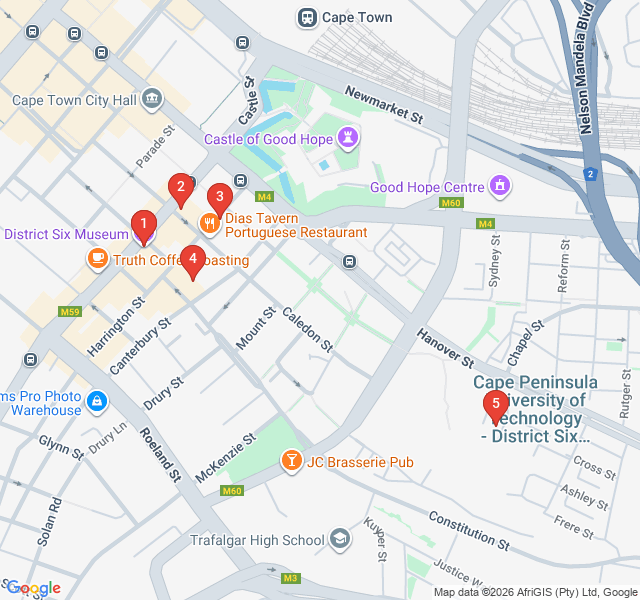
Numbers indicate the order of stops on the tour.
Welcome to the starting point of your self-guided walk. This building was once the Central Methodist Mission Church, a place of sanctuary during the dark days of apartheid. In 1994, it became the District Six Museum, a space dedicated to the memory of the 60,000 people forcibly removed from this area. Inside, the floor is covered by a massive hand-drawn map of the district as it once was. Former residents have come here to mark where their houses stood, reclaiming their place in history. The 'Memory Cloth' hanging here contains the signatures and messages of those who lost their homes. This museum serves as a reminder that a community is not just made of bricks and mortar, but of the relationships and stories shared between neighbors.
A short walk brings you to the Homecoming Centre, located in the historic Sacks Futeran building. This space was originally a soft goods warehouse, but today it serves as an extension of the District Six Museum. It is a place for dialogue, art, and education. The name 'Homecoming' reflects the ongoing struggle and hope of former residents to return to the land from which they were evicted. Look around at the rotating exhibitions that often feature photography and oral histories. It’s a bridge between the trauma of the past and a future where justice and restitution are still being sought by the families of District Six.
This building is part of the legacy of the Fugard Theatre, named after the world-famous South African playwright Athol Fugard, known for his powerful anti-apartheid plays. The Annex and the main theatre were built within the shells of a former congregational church and a warehouse. The architecture here is a beautiful example of how old structures can be repurposed to serve the arts. District Six was always a hub of creativity, particularly jazz and musical theatre. By bringing world-class performances to this specific location, the creators aimed to honor the cultural spirit that the apartheid government tried to erase. It stands as a testament to the power of storytelling in the face of oppression.
In the midst of this historical journey, you’ll find a vibrant burst of color at Charly’s Bakery. Housed in a beautifully restored Victorian building, this family-run institution is famous for its 'Mucking Afazing' cakes and its role in the local community. While it is a popular spot for a treat, it also represents the revitalization of the 'East City' or the 'Fringe' district. The bakery has long been a supporter of local social justice causes, reflecting the inclusive spirit of the old District Six. The murals on the exterior change periodically, often reflecting the creative and quirky energy of Cape Town’s artisan community.
As you walk further into the district, St. Mark's Anglican Church stands as a lonely sentinel. Built in 1867, it was one of the very few buildings left standing when the rest of the neighborhood was razed to the ground. The apartheid government generally spared religious buildings, but they stood as empty shells in a wasteland once the congregations were moved miles away to the Cape Flats. For decades, the church remained a symbol of defiance. On Sundays, former residents would travel long distances back to their old parish, keeping the spirit of the community alive even when the houses were gone. The simple stone architecture hides a wealth of resilience within its walls.
You are now standing at the edge of the Cape Peninsula University of Technology (CPUT). This campus was built on the site of the demolished homes, a move that was highly controversial at the time. It was seen by many as an attempt to permanently occupy the land and prevent residents from ever returning. Today, the campus is a place of learning for thousands of students, many of whom are the first in their families to attend university. However, the empty fields surrounding the campus remain a point of contention and a site of ongoing land restitution claims. This is where the past meets the present, and where the future of District Six is still being written.
Start Free on iPhone
Explore “Echoes of District Six: A Journey of Memory and Resilience” with your very own Private Tour Guide with Zigway. Start free on iPhone, skip the large group and the fixed routes, and hear the city come alive as you go.
Your Private Tour Guide
Don't miss the good stuff
Explore Freely
 Moderate
Cape Town, South Africa
Explore the vibrant murals and creative hubs of Woodstock on this self-guided neighborhood stroll through Cape Town's artistic heart.
 Easy
EasyCape Town, South Africa
Explore the evolution of Cape Town’s harbor from its 18th-century roots to a modern cultural hub on this self-guided maritime history walk.
 Easy
EasyCape Town, South Africa
Discover the heritage of Cape Town on this self-guided audio walk through the historic Company’s Garden and its surrounding landmarks.
 Easy
EasyCape Town, South Africa
Explore Cape Town's bohemian heart and scientific heritage on this self-guided walk through the eclectic and historic Observatory neighborhood.
 Easy
EasyNairobi, Kenya
Discover Nairobi’s literary soul on this self-guided walk through historic libraries, iconic bookshops, and cultural centers in the heart of the CBD.
 Easy
EasyWarsaw, Poland
Discover the hidden courtyards and grand pre-war architecture of Warsaw's most atmospheric neighborhood on this self-guided stroll.
 Easy
EasyGothenburg, Sweden
Explore Gothenburg's elegant academic district, featuring grand 19th-century stone architecture and the iconic cultural hub of Götaplatsen.
 Easy
EasyGothenburg, Sweden
Explore Gothenburg’s historic wooden houses, legendary giant cinnamon buns, and panoramic fortress views on this self-guided neighborhood stroll.
 Easy
EasyJohannesburg, South Africa
Explore Johannesburg's cultural soul on this self-guided walk through Newtown’s historic theaters, jazz venues, and powerful migrant labor museums.
 Easy
EasyJohannesburg, South Africa
Discover the 'City of Gold' on this self-guided walk through Johannesburg’s historic mining district, from Gandhi Square to Mandela’s law office.
 Moderate
Johannesburg, South Africa
Explore the creative soul of Johannesburg on this self-guided walk through Melville’s iconic bookstores, cafes, and ancient ridges.
 Easy
EasyJohannesburg, South Africa
A sensory self-guided walk through Johannesburg's Indian district, featuring aromatic spices, legendary street food, and rich anti-apartheid history.