Self-guided audio tour in Nashville
Start Free on iPhone
Start free on iPhone to unlock this self-guided walking tour in Nashville. Hear all the stories that make it amazing, walk at your own pace, and begin whenever you want.
Your Private Tour Guide
Nashville's history is often synonymous with country music, but another melody—one of justice and courage—echoes through its downtown streets. This self-guided walking route explores the pivotal moments of the Nashville sit-in movement, a campaign that became a model for nonviolent protest across the United States. As you walk these streets, you aren't just visiting landmarks; you are tracing the footsteps of young students from local colleges who challenged Jim Crow laws with quiet dignity and unwavering resolve. The journey begins at the Nashville Public Library, where a dedicated Civil Rights Room serves as a powerful introduction to the city's past. From there, the route takes you to the historic Woolworth on 5th, the actual site where students sat at lunch counters and endured harassment to demand equality. This isn't just a walking tour Nashville offers for sightseeing; it's a deep dive into the soul of the 'Athens of the South.' You'll encounter the Witness Walls, a stunning public art installation that visualizes the movement's milestones, and stand before the Davidson County Courthouse, where a massive silent march led to a historic confrontation with the mayor. The path continues to the First Baptist Church, Capitol Hill, a sanctuary that served as a headquarters for strategy and nonviolence training under the leadership of Reverend James Lawson. Finally, the route visits Griggs Hall at American Baptist College, the training ground for giants like John Lewis and Bernard Lafayette. Exploring this neighborhood stroll allows you to reflect on the bravery of those who stood up by sitting down. It is an essential experience for anyone seeking to understand the true heritage of Music City beyond the neon lights of Broadway. This walking route is designed for those who prefer to discover at their own pace, offering a poignant look at the struggle for civil rights in the heart of Tennessee.
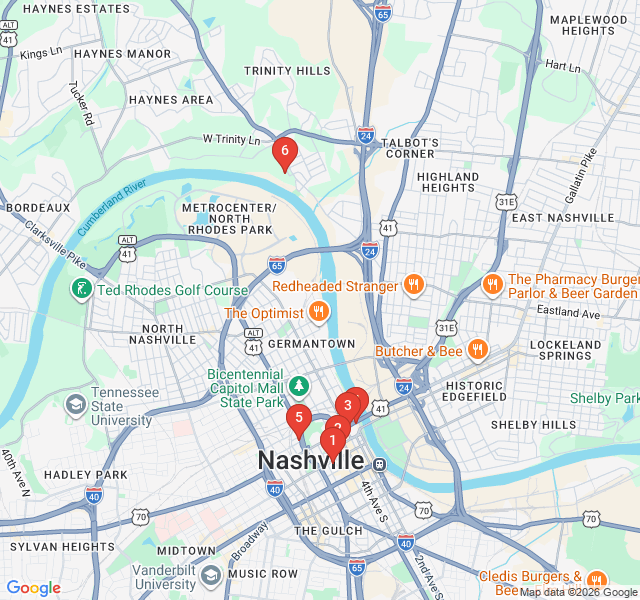
Numbers indicate the order of stops on the tour.
Start your journey at the Nashville Public Library. On the second floor, you’ll find the Civil Rights Room, a space dedicated to the city’s role in the national movement. The centerpiece is a symbolic lunch counter, featuring a timeline of the 1960 sit-ins. This room serves as a quiet sanctuary for reflection and education, housing black-and-white photographs of students like Diane Nash and John Lewis. It was here that local activists developed the strategies of nonviolent resistance that would eventually spread across the South. Take a moment to sit at the counter and read the 'Ten Rules of Conduct' that the students followed—reminders of the discipline and grace required to confront systemic injustice.
Step onto 5th Avenue and stand before Woolworth on 5th. This building was one of the primary sites of the 1960 lunch counter sit-ins. In February of that year, African American students from local universities sat at the 'whites only' counter, requesting service. They were met with verbal abuse, physical intimidation, and eventually arrest, yet they never retaliated. Their persistence forced the city to confront its segregation policies. While the building has seen many uses over the decades, its architecture remains a testament to that era. Looking at the storefront today, imagine the tension of the 1960s and the incredible courage it took for a teenager to simply sit down and ask for a cup of coffee.
Located near the Public Square, the Witness Walls are a series of concrete murals that tell the story of Nashville’s civil rights struggle through art. Created by artist Walter Hood, these walls use images from the era—protest marches, school integration, and the sit-ins—to create a permanent visual record. As you walk along the walls, you’ll see the faces of everyday citizens who joined the movement. The shadows and textures of the concrete are meant to evoke the complexity and weight of history. It’s a powerful place to see how collective action can transform a city’s landscape and its laws.
Stand on the plaza of the Davidson County Courthouse. On April 19, 1960, after the home of civil rights attorney Z. Alexander Looby was bombed, over 3,000 people marched here in total silence. They were met on these very steps by Mayor Ben West. In a historic moment of vulnerability and honesty, student leader Diane Nash asked the mayor if he felt it was wrong to discriminate against someone based on their race. West admitted that he did. That admission was a turning point for Nashville, leading to the desegregation of downtown lunch counters just weeks later. The courthouse remains a symbol of the intersection between grassroots activism and political change.
This historic church served as the 'nerve center' for the Nashville movement. Under the guidance of Reverend James Lawson, students gathered in the basement here to practice nonviolence. They engaged in role-playing exercises, learning how to remain calm while being yelled at or pushed. This training was essential for the success of the sit-ins. The church provided spiritual and tactical support, serving as a safe harbor during the height of the protests. Today, the church stands as a monument to the role of faith and community organization in the fight for equality, continuing its mission of social justice from its prominent position overlooking the city.
To reach the final stop, you'll travel slightly north of downtown to the campus of American Baptist College. Griggs Hall was the dormitory for several key figures of the movement, including the late Congressman John Lewis. The college was known as the 'Cradle of the Movement' because so many of its students were at the forefront of the protests. Standing here, you can feel the academic and spiritual energy that fueled the activists' resolve. The hall represents the intellectual foundation of the struggle, where young minds were taught that their education was a tool for liberation. It is a fitting place to conclude a walk dedicated to the power of youth and conviction.
Start Free on iPhone
Explore “Civil Rights and Courage: The Sit-in Trail” with your very own Private Tour Guide with Zigway. Start free on iPhone, skip the large group and the fixed routes, and hear the city come alive as you go.
Your Private Tour Guide
Don't miss the good stuff
Explore Freely
 Easy
EasyNashville, United States
Explore the 'Athens of the South' on this self-guided walk through Centennial Park, featuring the world's only full-scale Parthenon replica.
 Easy
EasyNashville, United States
Explore Nashville's academic heart and Art Deco gems on this self-guided walk through historic Hillsboro Village.
 Easy
EasyNashville, United States
Explore the heart of Nashville's music industry. Discover iconic studios and the history of the legendary Nashville Sound at your own pace.
 Easy
EasyNashville, United States
Explore Nashville's oldest neighborhood! Discover Victorian architecture, Civil War history, and world-class craft beer on this self-guided walk.
 Easy
EasyNairobi, Kenya
Discover Nairobi’s literary soul on this self-guided walk through historic libraries, iconic bookshops, and cultural centers in the heart of the CBD.
 Easy
EasyKrakow, Poland
Explore the prestigious Jagiellonian University district, featuring Neo-Gothic architecture, Baroque churches, and Krakow's hidden scholarly gems.
 Moderate
Gdansk, Poland
Discover the origins of WWII in Gdansk on this self-guided walk through heroic last stands, massive museums, and strategic hilltop fortifications.
 Easy
EasyNairobi, Kenya
Explore Nairobi's architectural evolution from colonial-era landmarks to iconic Brutalist skyscrapers on this historic self-guided walking route.
 Easy
EasyNew York City, United States
Explore the golden age of Manhattan architecture on this self-guided walk through Midtown's iconic Art Deco skyscrapers and historic landmarks.
 Easy
EasyNew York City, United States
Discover the literary legends, jazz haunts, and revolutionary history of Greenwich Village on this immersive self-guided walking route.
 Easy
EasyNew York City, United States
Explore Manhattan's transformation on this self-guided walk from the High Line to Hudson Yards.
 Easy
EasyNew York City, United States
Discover the world's finest cast-iron architecture and the evolution of fashion on this self-guided walking route through NYC's iconic SoHo district.