Self-guided audio tour in Ljubljana
Start Free on iPhone
Start free on iPhone to unlock this self-guided walking tour in Ljubljana. Hear all the stories that make it amazing, walk at your own pace, and begin whenever you want.
Your Private Tour Guide
Beneath the elegant Baroque facades and Art Nouveau flourishes of modern Ljubljana lies a hidden city of stone and legend: Emona. Two thousand years ago, this was a vital Roman colony, a fortified stronghold that served as a gateway to the Danube. This self-guided walk invites you to peel back the layers of time and trace the original boundaries of this ancient settlement. Exploring the southern edge of the city center, you will encounter the remarkably preserved remnants of a civilization that laid the foundations for the Slovenian capital we see today. Your walking route begins at the National Museum of Slovenia, where the story of Emona is vividly told through a vast collection of artifacts, including the famous bronze 'Emonan' statue. From here, the path leads you through the quiet streets of the Mirje neighborhood, a peaceful area that hides some of the city's most significant archaeological treasures. You will discover the Early Christian Centre, where intricate floor mosaics reveal the spiritual transition of the late Roman period, and stand on the site of the ancient Forum at Congress Square, once the bustling heart of administrative and religious life. One of the most striking aspects of this history walk is the interaction between Roman heritage and 20th-century design. As you reach the massive Roman Wall in Mirje, you will see how Slovenia's most famous architect, Jože Plečnik, reimagined these ancient ruins in the 1930s. He added a pyramid, stone pillars, and a lapidarium, turning a defensive structure into a public park. This journey offers a unique perspective on a walking tour Ljubljana visitors often miss, focusing on the hidden-gems of the Roman era. Whether you are a history enthusiast or simply looking for a quiet neighborhood stroll, this audio walk provides an immersive look at the 2,000-year-old skeleton of the city. Discover the ingenuity of Roman engineering, from underfloor heating systems to sophisticated urban planning, all while enjoying the relaxed atmosphere of Ljubljana's greenest corners.
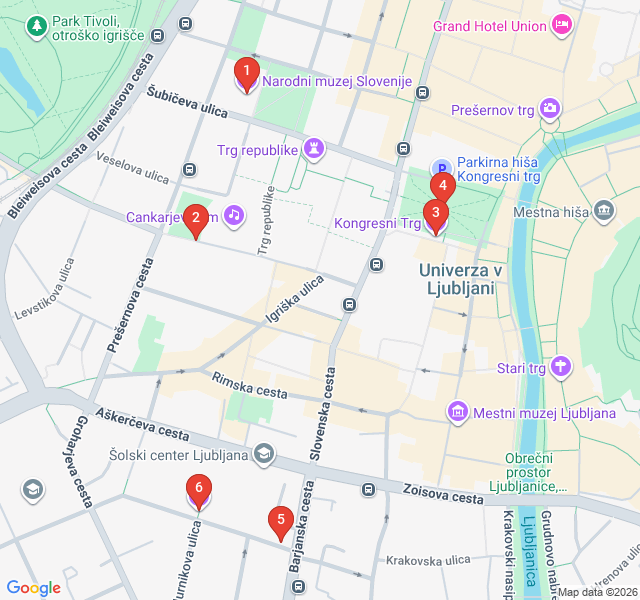
Numbers indicate the order of stops on the tour.
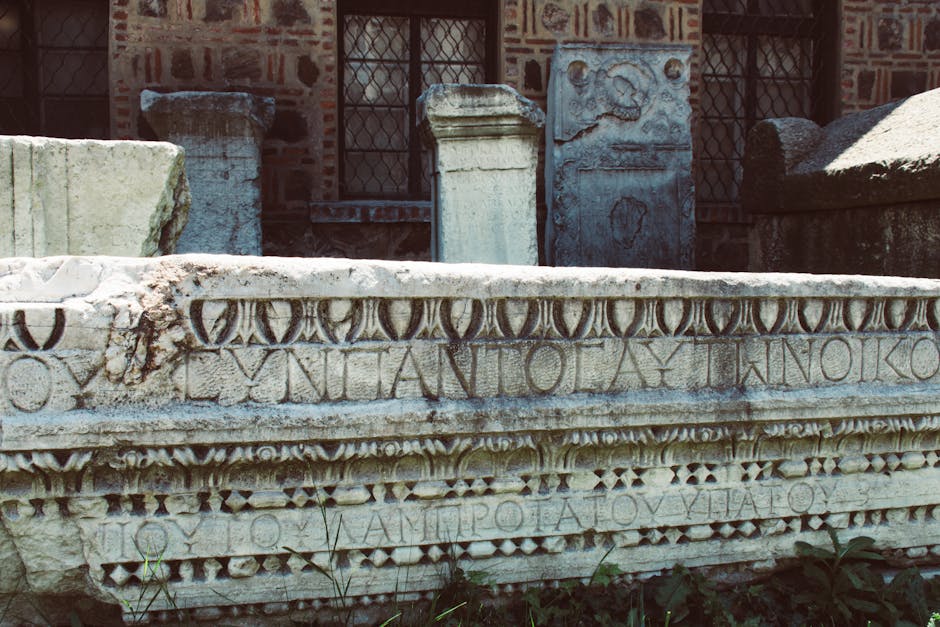
Begin your exploration at the National Museum of Slovenia, the country's oldest museum institution. While the building itself is a neo-Renaissance masterpiece from the late 19th century, its true treasures date back much further. Step inside to visit the Lapidarium, where over 200 Roman stone monuments are preserved. These tombstones, altars, and votive stones provide a written record of the people who lived in Emona between the 1st and 4th centuries AD. Pay close attention to the inscriptions; they reveal the names of soldiers, merchants, and families, giving a human face to the ancient ruins you are about to see. This museum sets the stage for understanding the strategic importance of Emona on the Roman trade routes.
As you walk toward the Mirje neighborhood, you find the Early Christian Centre. This archaeological park sits on the site of a former Roman residential block. By the 4th century, as Christianity began to spread through the Empire, a portion of a private house was converted into a religious center. The highlight here is the stunning floor mosaics, which have survived for over 1,600 years. You can clearly see the geometric patterns and the remains of a baptistery with a small pool. It is a quiet, contemplative spot that illustrates the transition from the pagan Roman colony to the early medieval Christian world, tucked away behind modern residential buildings.
Congress Square is one of Ljubljana's most beautiful and central plazas, but its layout is deeply connected to the past. In the Roman era, this area served as the Forum—the administrative, commercial, and religious heart of Emona. This is where the main north-south and east-west roads (the Cardo and Decumanus) intersected. While the Roman structures are now buried beneath the pavement, the square's vast, open nature preserves the sense of scale from the ancient city. Imagine the colonnades and temples that once stood here, where citizens gathered to discuss politics or trade goods from across the Empire. Today, it remains a central gathering point, framed by the University of Ljubljana and the Philharmonic Hall.
Standing near the edge of the square is a gilded bronze statue of a man clad in a toga. This is a replica of the 'Emonan,' a 2nd-century bronze statue discovered nearby in 1836. The original, which you can see in the National Museum, is one of the most important Roman finds in Slovenia. The statue represents a citizen of Emona, likely a member of the local elite, and it serves as a powerful symbol of the city's Roman identity. Notice the detail of the toga, which signifies his status and Roman citizenship. It stands as a silent sentinel, reminding passersby that the modern streets of Ljubljana are built directly atop the bones of an ancient Roman colony.
Take a short walk south to reach the Emona House Archaeological Park. This site offers a rare glimpse into the domestic life of the Roman middle class. You are standing in the remains of a 'domus,' or urban villa, that once belonged to a wealthy family. The most impressive feature here is the hypocaust system—an ancient form of central heating where hot air from a furnace circulated under the floors and through the walls. You can still see the small brick pillars that supported the raised floors. The presence of such luxury, along with the remains of beautiful mosaics, proves that Emona was a sophisticated and comfortable city for those who could afford it.
The final stop on your journey is the magnificent Roman Wall in the Mirje district. This is the longest surviving stretch of Emona's southern defensive wall, originally built around 14 AD. However, what you see today is a unique collaboration between ancient history and modern architecture. In the 1930s, the architect Jože Plečnik led a project to preserve and enhance the ruins. He added a stone pyramid, a colonnade, and a vaulted passage, turning the crumbling wall into a monumental park. It is a perfect example of how Ljubljana honors its past by integrating it into the living city. Take a moment to walk through the gate and admire the sheer scale of the limestone blocks that protected the city for centuries.
Start Free on iPhone
Explore “Tracing the Walls of Roman Emona” with your very own Private Tour Guide with Zigway. Start free on iPhone, skip the large group and the fixed routes, and hear the city come alive as you go.
Your Private Tour Guide
Don't miss the good stuff
Explore Freely
 Easy
EasyLjubljana, Slovenia
Explore the vibrant street art and counter-culture of Metelkova Mesto on this self-guided walk through Ljubljana's alternative art district.
 Moderate
Ljubljana, Slovenia
Discover the mythical heart of Ljubljana on this self-guided walk featuring dragon legends, Baroque fountains, and medieval castle heights.
 Moderate
Ljubljana, Slovenia
Explore the green heart of Ljubljana on this self-guided walk featuring panoramic views, medieval stairs, and hidden forest paths.
 Easy
EasyLjubljana, Slovenia
Discover Ljubljana’s soul on this self-guided literary route, exploring the poets and writers who shaped the Slovenian identity.
 Easy
EasyKrakow, Poland
Explore the prestigious Jagiellonian University district, featuring Neo-Gothic architecture, Baroque churches, and Krakow's hidden scholarly gems.
 Easy
EasyGothenburg, Sweden
Discover Gothenburg’s 17th-century Dutch foundations, historic canals, and military fortifications on this self-guided architectural walk.
 Easy
EasyNairobi, Kenya
Explore Nairobi's architectural evolution from colonial-era landmarks to iconic Brutalist skyscrapers on this historic self-guided walking route.
 Easy
EasyNairobi, Kenya
Discover Nairobi's iconic skyline on this self-guided architecture walk through the CBD’s most famous modernist and Brutalist landmarks.