Self-guided audio tour in Riga
Start Free on iPhone
Start free on iPhone to unlock this self-guided walking tour in Riga. Hear all the stories that make it amazing, walk at your own pace, and begin whenever you want.
Your Private Tour Guide
Embark on a sensory exploration of Latvia's capital through a self-guided walk that bridges the gap between historic trade and modern culinary innovation. This neighborhood stroll begins at the UNESCO-listed Riga Central Market, a marvel of 20th-century engineering housed in former Zeppelin hangars. As you wander through the aromatic stalls of the Fish and Meat Pavilions, you will encounter the authentic pulse of the city, where traditional smoked meats and Baltic seafood remain staples of the local diet. This walking route is designed for those who want to discover the city's soul through its stomach, moving from the bustling markets to the cobblestone streets of the Old Town (Vecrīga). Beyond the food stalls, this walking tour Riga experience dives into the architectural and cultural shifts of the city. You will see the red-brick warehouses of the Spīķeri Quarter, a testament to Riga's industrial past, and the soaring 'Stalinist Gothic' silhouette of the Latvian Academy of Sciences. As you transition into the medieval heart of the city, the narrative shifts toward the legendary hospitality of the Black Heads and the subterranean folk culture of Ala Pagrabs. This explore-at-your-own-pace journey provides a comprehensive look at how Riga transformed from a Hanseatic trading hub into a vibrant, modern European capital. From the first bite of rye bread to the final view of the Freedom Monument, this audio walk offers a deep dive into the flavors and stories that define Latvia. Whether you are interested in the Soviet-era history of the first Western fast-food chains or the medieval grandeur of the Rozengrāls wine cellar, this route captures the eclectic spirit of Riga. It is more than just a food walk; it is a cultural immersion that highlights the resilience and creativity of the Latvian people. Start exploring with Zigway and see why this walking tour Riga route is a must for any visitor to the Baltics. **Note:** This area is known for its ever-changing character. Street art, pop-up venues, and temporary exhibitions may differ from what's described. That's part of the adventure - you might discover something entirely new!
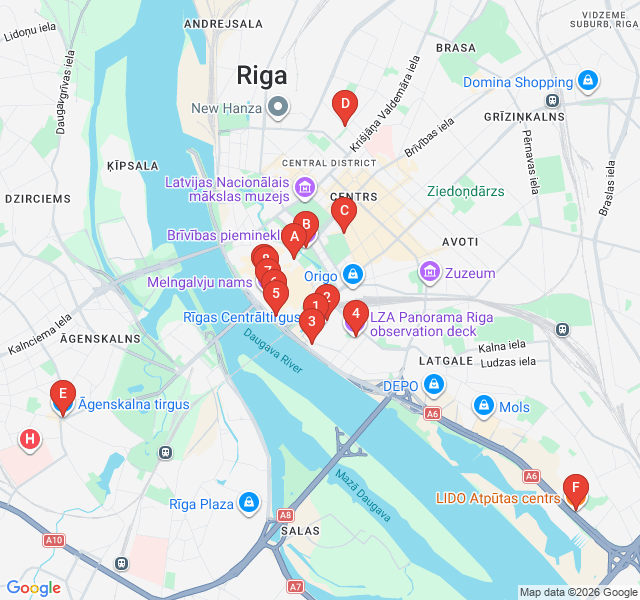
Numbers indicate the order of stops on the tour.
Begin your self-guided adventure at one of Europe's largest markets. These massive structures were originally intended as hangars for German Zeppelin airships during WWI. The Fish Pavilion is a sensory overload, where the scent of smoked sprats and salmon fills the air. Look for 'reņģes' (herring) and 'nēģi' (lamprey), a local delicacy often served in jelly. This pavilion represents the Baltic Sea's bounty and has been the heart of Riga's trade since the 1930s. Take a moment to admire the high, arched ceilings that once housed giants of the sky.
Moving deeper into the market complex, the Meat Pavilion showcases the agrarian roots of Latvia. Here, you will find everything from traditional smoked hams to 'speķis' (smoked pork fatback), a staple of the Latvian diet for centuries. The organization of these pavilions by food group was a revolutionary concept in the 1920s. Observe the bustling interactions between vendors and locals; this is where the city's real life happens. It is a place where tradition survives in every slice of rye bread and every link of sausage.
Just outside the market lies the Spīķeri Quarter, a collection of 19th-century red-brick warehouses. Once used to store goods arriving by ship and rail, these buildings now house creative industries, galleries, and cafes. This area serves as a bridge between the industrial past and the artistic present. The architecture here is distinctive 'Baltic brick style,' and the district has been beautifully restored to preserve its rugged, maritime character. It’s a quiet contrast to the market's chaos and a favorite spot for local artists.
Towering over the district is the Latvian Academy of Sciences, often called 'Stalin's Birthday Cake' due to its Socialist Realist architecture. Built in the 1950s, it was the first skyscraper in Latvia. While its history is tied to the Soviet occupation, it remains a landmark of the city's skyline. Look closely at the exterior to find hammers, sickles, and Latvian folk motifs integrated into the design. It serves as a stark reminder of the mid-20th-century political shifts that reshaped Riga's urban landscape.
As you walk toward the Old Town, you pass the Wellton Riverside. This location offers one of the best vantage points of the Daugava River. For centuries, this river was the lifeblood of Riga, bringing merchants from the Hanseatic League to trade timber, wax, and fur. The modern hotel stands as a symbol of Riga's 21st-century growth and its evolution into a premier European destination. Take a deep breath of the river air before heading into the narrow streets of the medieval city.
Descending into Ala Pagrabs is like stepping back into a folkloric version of Latvia. This 'Folk Club' is located in an ancient labyrinthine cellar. It is the best place to experience Latvian beer culture and traditional snacks like 'ķiploku grauzdiņi' (fried garlic rye bread). The atmosphere is usually lively with folk music and dancing. While the menu and entertainment may change, the spirit of Latvian hospitality here is evergreen. It’s a local favorite for a reason—it feels like a hidden world beneath the city streets.
The House of the Black Heads is perhaps Riga's most iconic building. Originally built in the 14th century for the Brotherhood of Blackheads—a guild for unmarried German merchants—it was destroyed during WWII and meticulously rebuilt in the late 1990s. The facade is a masterpiece of Dutch Renaissance style, adorned with sculptures and astronomical clocks. It represents the wealth and power of Riga during its time as a Hanseatic city. The motto on the gate once read: 'Should I ever fall to dust, rebuild me you must.'
LIDO is more than a restaurant chain; it is a Latvian institution. Alus sēta (Beer Court) in the Old Town offers a glimpse into this unique dining concept. It combines a rustic, wooden interior with a high-quality buffet of traditional foods like grey peas with bacon and fried potatoes. Founded after the restoration of independence, LIDO became a symbol of Latvian identity through its celebration of national cuisine and folk-inspired decor. It’s the perfect spot to see how modern Latvians enjoy their culinary heritage.
Step into the medieval past at Rozengrāls. This restaurant is located in a cellar that was mentioned in scripts as early as 1293. It was once the wine vault of the Riga City Council. Today, it maintains an authentic medieval atmosphere, lit entirely by candles with staff in period dress. Even if you don't stop for a meal, the entrance and history of this 'Vinarium' provide a window into the life of a medieval Burgher. It is one of the few places where you can truly feel the weight of Riga's 800-year history.
It might seem strange to stop at a McDonald's on a cultural route, but this specific location near the Freedom Monument is historic. Opened in 1994, it was the first McDonald's in the Baltic States following the collapse of the Soviet Union. At the time, it was a powerful symbol of Western capitalism and the 'New Latvia.' People queued for hours just to taste a Big Mac. It marks a pivotal moment in the city's transition from a planned economy to a globalized market.
The Freedom Monument, or 'Milda,' is the sacred heart of Latvia. Erected in 1935 to honor soldiers killed during the Latvian War of Independence, it miraculously survived the Soviet era. The female figure at the top holds three gilded stars, representing the three historical regions of Latvia: Kurzeme, Vidzeme, and Latgale. The base features reliefs depicting Latvian history and culture. You might see the Guard of Honor here, standing as a silent testament to the nation's hard-won sovereignty and pride.
Located near the beautiful Vērmane Garden, this LIDO branch is a popular hub for students and office workers. It offers a slightly more modern take on the LIDO experience while maintaining the beloved buffet style. The surrounding park is the oldest public garden in Riga, gifted to the city by Anna Gertrud Vērmane. It’s a wonderful place to observe the daily rhythm of Riga life, away from the more tourist-heavy areas of the Old Town.
For a taste of Riga's modern intellectual life, visit the Kim? Contemporary Art Centre. The name 'Kim?' is an abbreviation of the Latvian 'Kas ir māksla?' meaning 'What is art?'. This center hosts rotating exhibitions of local and international contemporary artists. It reflects Riga's status as a modern European cultural hub that isn't afraid to ask difficult questions. Please note that exhibits change frequently, so the art you see today is a unique snapshot of the current creative conversation in the Baltics.
Crossing to the left bank of the Daugava, we reach the Agenskalns Market. This 1911 brick masterpiece recently underwent a massive renovation. Unlike the Central Market, Agenskalns has a more community-focused, hip vibe. The ground floor remains a traditional market for fresh produce, while the upper floor features modern food stalls and event spaces. It is a brilliant example of how Riga preserves its architectural heritage while adapting to the needs of a younger, urban population.
The final stop is the LIDO Leisure Centre on Krasta iela. This is the flagship of the LIDO empire—a massive log building that is one of the largest wooden structures in Europe. It features a windmill, a bistro, a cellar restaurant, and an ice rink in winter. It is the ultimate destination for Latvian comfort food and family fun. While it is a bit of a distance from the city center, it provides the most complete 'LIDO experience' and a fitting end to your journey through the flavors of Riga.
Start Free on iPhone
Explore “Flavors of the Great Riga Central Market” with your very own Private Tour Guide with Zigway. Start free on iPhone, skip the large group and the fixed routes, and hear the city come alive as you go.
Your Private Tour Guide
Don't miss the good stuff
Explore Freely
 Moderate
Riga, Latvia
Discover Riga's Soviet-era architecture and history, from the KGB building to the iconic Stalinist Academy of Sciences on this self-guided walk.
 Easy
EasyRiga, Latvia
Explore Riga's lush 'Green Belt,' a scenic chain of historic parks, monuments, and romantic canals along the city's grand 19th-century boulevards.
 Easy
EasyRiga, Latvia
Explore Riga's poetic soul through its grand parks and iconic libraries on this self-guided literary walking route.
 Moderate
Riga, Latvia
Discover Riga's modern skyline and historic wooden architecture on a scenic island walk with stunning river views and futuristic design.
 Easy
EasyGothenburg, Sweden
Explore Gothenburg’s historic wooden houses, legendary giant cinnamon buns, and panoramic fortress views on this self-guided neighborhood stroll.
 Easy
EasyNairobi, Kenya
Explore Nairobi's architectural evolution from colonial-era landmarks to iconic Brutalist skyscrapers on this historic self-guided walking route.
 Easy
EasyNairobi, Kenya
Discover Nairobi's iconic skyline on this self-guided architecture walk through the CBD’s most famous modernist and Brutalist landmarks.
 Easy
EasyKrakow, Poland
Explore the historic heart of Kazimierz on this self-guided walk through synagogues, ancient cemeteries, and vibrant squares.