Amsterdam Walking Tours: Best Self-Guided Routes
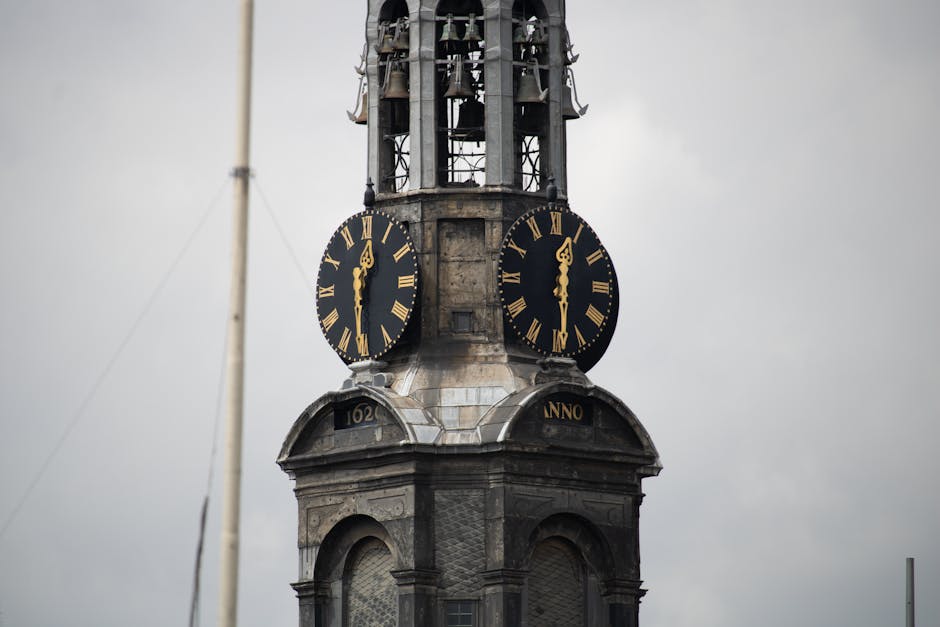
Amsterdam is, quite possibly, the most walkable city in Europe. It is almost entirely flat. It is compact enough that you can cross the historic center in 30 minutes. And it is built around a concentric ring of canals that act as a natural navigation system: if you are lost, just follow the water until you find a bridge you recognize.
But the real reason Amsterdam rewards walking is that the city hides its best secrets just out of sight. Behind an unmarked wooden door on a Jordaan side street, there is a 17th-century courtyard garden. Down a narrow alley near the Oude Kerk, a hidden church fills the attic of what looks like an ordinary canal house. Across the IJ river, an abandoned shipyard has become one of Europe's largest open-air street art galleries. You will not find any of this from a tour bus or a canal boat.
A self-guided audio tour on your phone (we recommend Zigway for free, narrated walks) is the ideal way to explore Amsterdam's neighborhoods in depth. You move at your own speed, duck into any shop or cafe that catches your eye, and get the stories behind what you are seeing right when you need them. No groups, no schedules, no waiting.
Here are the best self-guided walking routes in Amsterdam, neighborhood by neighborhood.
The Jordaan: Secret Courtyards and Hidden Alleys

The Jordaan is Amsterdam's most beloved neighborhood, and the one that most rewards a slow, curious walk. Originally built in the 1600s for working-class families and immigrant artisans, it has evolved into a tangle of narrow streets, independent galleries, vintage shops, and tiny brown cafes where locals have been drinking the same jenever for generations.
The real treasures here are the hofjes: hidden inner courtyards originally built as charitable housing for the elderly and the poor. Many survive behind unmarked doors that you would walk right past without a guide. The Karthuizerhof is the largest, a serene garden enclosed by 17th-century brick walls. The Van Brienenhofje hides a former Catholic sanctuary behind a modest gate on the Prinsengracht. Each one is a world apart from the busy streets outside.
The self-guided route through the Jordaan also takes you past the Westerkerk (whose tower Anne Frank could see from her hiding place), the Noordermarkt square where an organic farmers' market runs on Saturdays, and the Egelantiersgracht, arguably the most beautiful canal in the city. It is one of the most photogenic walks in Amsterdam, and it is entirely flat.
The Canal Belt: Golden Age Grand Houses
In the 1600s, Amsterdam was the richest city on Earth. The Dutch East India Company was printing money, and the merchant elite poured their fortunes into a ring of canals lined with the grandest houses northern Europe had ever seen. Today, the Canal Belt is a UNESCO World Heritage site, and walking along the Herengracht and Keizersgracht remains one of the essential Amsterdam experiences.
The self-guided Golden Age route starts at the Willet-Holthuysen Museum, where a perfectly preserved 19th-century interior gives you a glimpse of how the canal house elite actually lived: room after gilded room of porcelain, silk wallpaper, and formal gardens. From there, the walk follows the Herengracht to the Gouden Bocht (Golden Bend), the most prestigious stretch of canal, where the houses grow wider and the gables shift from Dutch step-styles to grander French-inspired facades.
You will pass Museum Van Loon (the family helped found the Dutch East India Company), the Cromhout House, and the Renaissance-style Bartolotti House before arriving at Dam Square and the Royal Palace, once considered the Eighth Wonder of the World. With an audio tour, every gable, every carved stone cartouche, every leaning facade has a story.
De Pijp: Amsterdam's Culinary Crossroads

South of the canal ring, De Pijp is Amsterdam's answer to Brooklyn or Belleville: a formerly working-class neighborhood that has become the city's most vibrant food and culture district. The streets here are narrower, the buildings more uniform (long rows of 19th-century workers' housing), and the energy is distinctly local.
The anchor is the Albert Cuyp Markt, one of the largest daytime street markets in Europe. On any given day, you can eat your way through freshly fried kibbeling (battered fish), warm stroopwafels made on the spot, Surinamese roti from a stall that has been here for decades, and Dutch herring served the traditional way (raw, with onions, tilted into the mouth). The self-guided food walk connects the market with the surrounding streets, where you will find cozy brown cafes, craft breweries housed in a former monastery, and the beautiful Sarphatipark for a mid-walk breather.
De Pijp is also the most multicultural neighborhood in the city. Waves of immigration from Suriname, Turkey, Morocco, and Indonesia have layered Amsterdam's food scene with flavors you will not find in any other European capital. An audio tour here tells the story of how these communities transformed a grid of identical brick housing into one of the most interesting food neighborhoods on the continent.
De Wallen: Medieval History Beyond the Neon
Most visitors know De Wallen as the Red Light District. But this is also Amsterdam's oldest neighborhood, and the self-guided history walk here peels back the neon to reveal a medieval city that predates nearly everything else in town.
The route starts at Ons' Lieve Heer op Solder, a secret Catholic church hidden in the attic of a canal house. During the Reformation, Catholics were forbidden from worshipping publicly, so they built entire churches inside ordinary-looking homes. This one, with its three-story nave concealed above a 17th-century merchant's residence, is one of Amsterdam's most extraordinary hidden spaces.
From there, the walk leads to the Oude Kerk, the city's oldest building (consecrated in 1306), where Rembrandt's wife Saskia is buried beneath the floor. You will follow the Zeedijk, the original medieval sea wall that now runs through Chinatown, and pass the Waag, a 15th-century city gate that later served as a weighing house and the anatomical theater where Rembrandt painted The Anatomy Lesson. Every step here is layered with centuries of trade, tolerance, and reinvention.
NDSM Wharf: Street Art on the North Bank
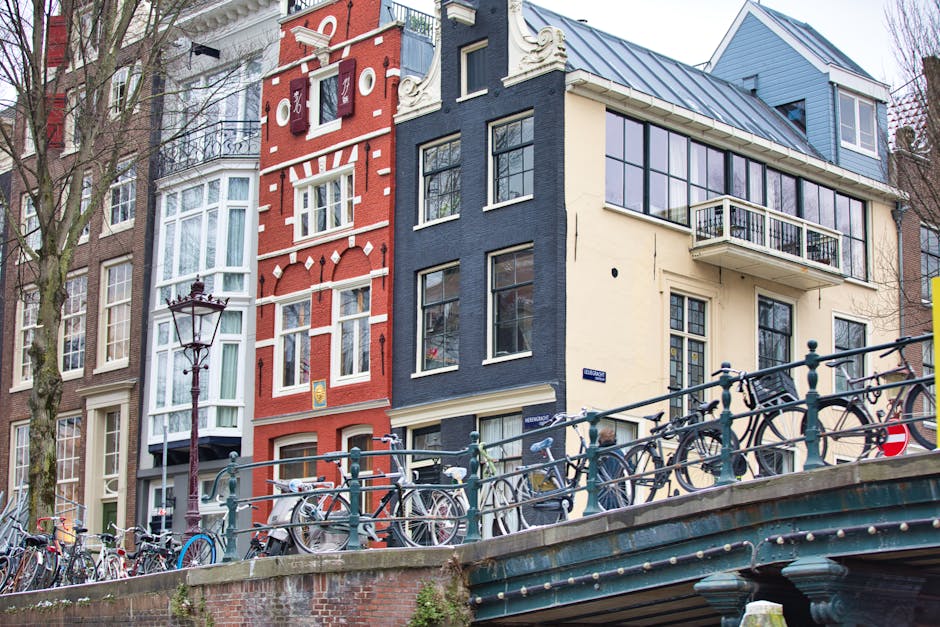
Take the free ferry from behind Centraal Station (a five-minute ride across the IJ river) and you arrive in a different Amsterdam entirely. The NDSM Wharf was once one of the world's largest shipbuilding yards. When the industry collapsed in the 1980s, squatters and artists moved into the rusting hangars, and a creative community took root that has grown into one of Europe's most exciting art districts.
The self-guided street art walk here takes you past towering murals (including Eduardo Kobra's massive portrait of Anne Frank), the Faralda Crane Hotel (a luxury hotel built inside a shipyard crane), the STRAAT Museum (one of the world's largest street art museums), and villages of repurposed shipping containers that house studios, restaurants, and workshops. The scale is industrial and the art is bold. This is the walk for anyone who thinks they have already seen Amsterdam.
The Jewish Quarter: Echoes of Resistance
The Jodenbuurt (Jewish Quarter) is one of the most important and moving walks you can take in Amsterdam. For centuries, this neighborhood was the heart of Jewish life in the Netherlands, home to the Portuguese Synagogue (a 1675 masterpiece lit entirely by candlelight to this day), the diamond-cutting workshops that made Amsterdam famous, and the philosophical circles where Spinoza challenged the foundations of Western thought.
The self-guided walk traces both the prosperity and the tragedy of this community. You will visit the National Holocaust Names Monument, designed by Daniel Libeskind, where 102,000 individual bricks bear the names of Dutch Jewish, Sinti, and Roma victims. Along the quiet Nieuwe Keizersgracht, the Schaduwkade memorial lists the names of deported residents directly across from the homes they were taken from. The route continues to Wertheimpark and finishes at the Rembrandt House Museum, where the artist lived and worked in the heart of this neighborhood.
This is not a walk to rush. An audio guide gives you the space to absorb each site at your own pace, with the context to understand what you are standing in front of.
Explore all self-guided walking tours in Amsterdam
Tips for Walking in Amsterdam
Watch out for bikes. This is the most important rule. Amsterdam has more bicycles than people, and cyclists move fast and expect pedestrians to stay out of the bike lanes (the red-paved strips alongside the roads). Look both ways before stepping off a sidewalk, and never stand in a bike lane to take a photo.
Wear comfortable shoes with grip. The cobblestones and canal bridges can be slippery, especially when wet. Flat, waterproof shoes with decent tread are ideal. Heels are a bad idea.
Download your audio tours before heading out. Amsterdam's city center has solid Wi-Fi and mobile coverage, but signal can drop in some of the older neighborhoods and especially on the north bank. Having your Zigway tours downloaded means the narration keeps flowing even when the signal does not.
Time your walks wisely. The Jordaan and Canal Belt are best in the morning, when the light on the water is magical and the streets are quiet. De Pijp comes alive mid-morning when the Albert Cuyp Market opens. De Wallen's medieval architecture is best appreciated in daylight, before the neon takes over. NDSM is best on a weekday afternoon when the creative spaces are open.
Use the ferries. The free GVB ferries behind Centraal Station are Amsterdam's best-kept transit secret. They run constantly, take bikes, and get you to NDSM and the rest of Amsterdam Noord in minutes. No ticket needed.
Plan for rain. It rains in Amsterdam. Not always heavily, but often. A lightweight waterproof jacket or a compact umbrella will save your walk. The upside: rain clears the tourist crowds and makes the canal reflections even more beautiful.
Stop for coffee and cake. The Dutch take their coffee seriously, and Amsterdam's cafe culture is one of the pleasures of walking the city. A koffie verkeerd (the Dutch latte) and an appeltaart at Winkel 43 in the Jordaan is one of the best mid-walk breaks in Europe.
Start Walking Amsterdam
Amsterdam is a city that hides its best stories behind unmarked doors, down narrow alleys, and inside attic churches you would never find on your own. A self-guided audio tour gives you the keys to all of it, at whatever pace feels right, with the freedom to stop for a stroopwafel or a canal-side coffee whenever the mood strikes.
Browse all of our free self-guided walking tours in Amsterdam and beyond, and start exploring.